
Amblyopia: Understanding Vision Development and Patching Therapy for Children
 Jan, 4 2026
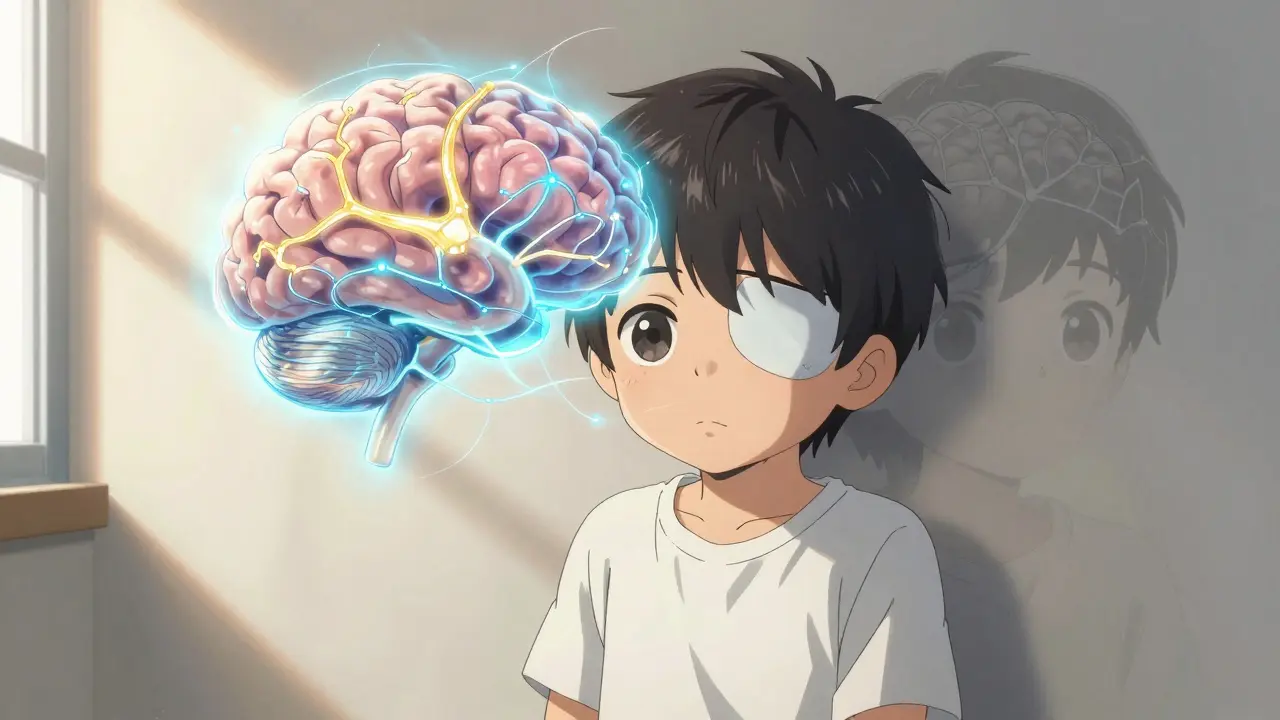
When a child squints, tilts their head, or closes one eye to see better, it’s not just a habit-it could be a sign of amblyopia, commonly called "lazy eye." This isn’t about weak muscles or blurry glasses. It’s a brain issue. During the first few years of life, the brain learns to see by combining input from both eyes. If one eye sends a blurry or misaligned image, the brain starts ignoring it. Over time, that eye loses its connection to the brain, and vision in that eye fades-not because the eye is broken, but because the brain stopped listening.
What Exactly Is Amblyopia?
Amblyopia is a developmental vision disorder. It happens when the visual system doesn’t mature properly because of problems during early childhood. The eye itself might look perfectly normal, but the brain doesn’t process the images from one eye the way it should. This leads to reduced best-corrected visual acuity (BCVA), meaning even with glasses, the child can’t see clearly with that eye. It’s the most common cause of vision loss in kids, affecting 2% to 4% of children worldwide. Unlike cataracts or glaucoma, there’s no structural damage to the eye. The problem is in the wiring between the eye and the brain. And here’s the critical part: if you don’t fix it early, the brain never learns to use that eye properly. The window for effective treatment closes around age 7 to 8, though recent studies show even older kids can still improve.Three Main Types of Amblyopia
Not all lazy eyes are the same. There are three main types, each with a different cause:- Strabismic amblyopia (about 50% of cases): This happens when one eye turns inward, outward, up, or down. The brain gets conflicting images, so it shuts off the misaligned eye to avoid double vision. Over time, that eye’s vision weakens.
- Anisometropic amblyopia (about 30%): One eye has a much stronger prescription than the other-say, one eye is nearsighted while the other is farsighted. The brain prefers the clearer image and ignores the blurry one. The eye with the worse focus slowly loses its visual power.
- Deprivation amblyopia (10-15%): Something physically blocks light from entering the eye, like a congenital cataract, droopy eyelid (ptosis), or corneal scar. Even if the brain is ready to learn, the eye can’t send clear signals. This type is the most serious and needs urgent treatment.
Bilateral amblyopia can also occur, especially in kids with very high prescriptions in both eyes. These children often don’t show obvious signs, which is why routine eye exams are so important.
Who’s at Risk?
Some kids are more likely to develop amblyopia. Risk factors include:- Being born prematurely (risk increases by 2.3 times)
- Low birth weight (under 2,500 grams)
- Family history of amblyopia or other vision problems (risk up 30-40%)
- Developmental delays or neurological conditions
These aren’t just statistics. In clinics, doctors see more cases in kids born early or with siblings who wore patches. If your child has any of these risk factors, don’t wait for symptoms. Get their eyes checked by age 1, and again before starting school.
How Is It Diagnosed?
Amblyopia often goes unnoticed because kids don’t know what “normal” vision is. They don’t complain. That’s why routine screenings are vital. A full pediatric eye exam includes:- Visual acuity testing using pictures or letters (depending on age)
- Refraction to check for glasses prescriptions
- Eye alignment tests to spot strabismus
- Fundus exam to rule out cataracts or other eye diseases
The American Association for Pediatric Ophthalmology and Strabismus (AAPOS) recommends screening at 6-12 months, 3 years, and before kindergarten. Many schools do basic vision checks, but they miss up to 40% of cases. A full exam by an eye specialist is the only way to be sure.

Patching Therapy: The Gold Standard
The most proven treatment for amblyopia is patching therapy. The idea is simple: cover the stronger eye to force the brain to use the weaker one. Over weeks and months, the brain relearns how to see with that eye. The amount of patching depends on severity and age:- For mild cases: 2 hours a day
- For moderate cases: 2-6 hours a day
- For severe cases: Up to 6 hours, sometimes more
Here’s the surprising part: you don’t need to patch all day. The landmark Amblyopia Treatment Study (ATS) showed that 2 hours of patching gave the same results as 6 hours for kids with moderate amblyopia (20/40 to 20/100 vision). That’s a game-changer-it means less stress for kids and parents.
What If My Child Won’t Wear the Patch?
Compliance is the biggest hurdle. Studies show only 40-60% of kids stick with patching as prescribed. Parents report resistance, skin irritation, and social embarrassment. Successful families use creative strategies:- Start slow: 30 minutes a day, then build up
- Make it fun: "Patching parties" with siblings or friends who also wear patches
- Use rewards: Sticker charts, small treats, or extra screen time
- Try digital tools: Apps like "LazyEye Tracker" help log hours and remind parents
One clinic in Bristol found that when parents got a 20-minute counseling session explaining how the brain rewires itself, adherence jumped from 45% to 89%. Knowledge matters.
Alternatives to Patching
Patching isn’t the only option. Other treatments include:- Atropine drops: A drop of 1% atropine in the stronger eye once a day blurs near vision. The child then uses the weaker eye to read or play. Studies show it works just as well as patching for moderate cases, with better compliance.
- Bangerter filters: These are frosted stickers placed over glasses lenses. They blur vision slightly without looking like a patch. Great for older kids who hate traditional patches.
- Visual therapy: Exercises to improve eye tracking, focusing, and depth perception. When added to patching, kids gain 15-20% more in 3D vision (stereopsis).
For kids with strabismus, eye muscle surgery might be needed first. But even after surgery, patching is still required-about 70-80% of these kids need it to reach full vision recovery.

How Long Does Treatment Take?
There’s no quick fix. Most children need treatment for 6 to 12 months. Follow-ups every 4-8 weeks are essential to adjust patching time based on progress. Results vary:- Children treated before age 5: 85-90% recover near-normal vision
- Children treated between ages 5-7: 50-60% recover
- Children treated after age 8: Improvement is possible, but rare to reach full normal vision
The American Academy of Ophthalmology says 97% of kids will show some improvement with treatment-but only 65-75% will fully normalize their vision. That’s why early detection is everything.
New Frontiers in Treatment
Science is moving beyond patches. New approaches include:- Weekend-only atropine: A 2022 study showed that giving drops only on weekends maintained gains after initial daily treatment, making life easier for families.
- Transcranial random noise stimulation (tRNS): A non-invasive brain stimulation technique being tested at Massachusetts Eye and Ear. Early results show 40% greater improvement when combined with patching.
- Digital games like AmblyoPlay: FDA-cleared since 2021, these are interactive video games that require both eyes to work together. In European clinics, compliance hits 75%-far higher than patching.
Even adults with amblyopia are now seeing modest gains through intensive perceptual training. But the truth remains: the best outcomes still come from treating kids early.
What Parents Need to Know
You’re not alone. Thousands of families go through this. The key is to act fast, stay consistent, and stay informed.- Don’t wait for symptoms. Screen at age 1, 3, and before school.
- Follow the prescribed patching schedule-even if your child cries.
- Ask about alternatives if patching isn’t working.
- Use apps, rewards, and peer support to make it stick.
- Keep follow-up appointments. Vision can regress if treatment stops too soon.
Amblyopia isn’t just about seeing clearly. It’s about giving your child the full range of vision needed for learning, sports, driving, and life. The brain is most flexible when it’s young. Treat it early, and you give your child a lifetime of clear sight.
Can amblyopia fix itself without treatment?
No. Amblyopia does not resolve on its own. Without treatment, the brain continues to ignore the weaker eye, leading to permanent vision loss in that eye. Early intervention is essential to retrain the brain and restore vision.
Is patching painful or harmful?
Patching is not painful, but some children experience mild skin irritation or discomfort from the adhesive. Using hypoallergenic patches, rotating placement, and taking short breaks can help. It’s not harmful to the eye-it’s a safe, proven therapy.
How do I know if patching is working?
Your eye doctor will track visual acuity with standardized tests every 4-8 weeks. You might also notice your child reaching for objects with the weaker eye, or no longer squinting or closing one eye. Progress can be slow, but steady improvement is the goal.
Can older children or adults benefit from treatment?
Yes, but results are limited. While children under 7 respond best, studies show older kids and even adults can improve vision with intensive therapy-especially with digital games or brain stimulation. However, full recovery is rare after age 8, making early treatment critical.
Are there side effects from atropine drops?
Atropine drops can cause light sensitivity and blurred near vision in the treated eye. Some kids may have a mild allergic reaction or redness. These effects are temporary and usually manageable. The benefits of improved vision in the amblyopic eye far outweigh the minor side effects.
How often should my child have eye exams?
The American Academy of Pediatrics recommends eye screenings at 6-12 months, 3 years, and before kindergarten. If amblyopia is diagnosed, follow-ups every 4-8 weeks during treatment, then every 6 months after stabilization. Regular exams are the best way to catch problems early.
Vinayak Naik
January 5, 2026 AT 17:14Man, I wish my mom knew about this when I was a kid. I used to squint like a grumpy owl and my parents thought I was just being dramatic. Turns out I had anisometropic amblyopia and they didn’t catch it till I was 9. Lost a ton of depth perception. Patching was hell-my friends made fun of me, called me ‘Pirate Kid.’ But now? I can actually catch a baseball. 🙌
Kiran Plaha
January 6, 2026 AT 07:37So patching works even if the kid hates it? My cousin cried every day for 3 weeks. We almost quit. But we kept going and now his vision’s almost normal. Wild.
Molly McLane
January 6, 2026 AT 17:57As a pediatric nurse, I’ve seen so many parents panic when their kid gets diagnosed. But honestly? The best thing you can do is stay calm and make it a game. One mom turned patching into ‘Superhero Mask Time’-her kid wore it like a cape. Now he asks for it. 😊
Joann Absi
January 8, 2026 AT 07:28AMERICA NEEDS TO START SCREENING AT BIRTH. 🇺🇸 WHY ARE WE SO SLOW?! My cousin’s kid got diagnosed at 4 because the pediatrician said ‘he’ll grow out of it.’ FOUR YEARS. FOUR. YEARS. 😭 Now he needs glasses AND patching AND therapy. This is a public health CRISIS. We’re letting our kids go blind because we’re too lazy to check their eyes. #FixTheSystem
Ashley S
January 8, 2026 AT 12:17Ugh. I hate when people act like this is some miracle cure. My kid wore a patch for 6 months and still can’t see the board at school. It’s all just a scam to sell glasses and apps. 🤷♀️
Rachel Wermager
January 9, 2026 AT 04:45It’s worth noting that the efficacy of patching is modulated by neuroplasticity windows, which are highly sensitive to critical periods in visual cortex maturation. The ATS-2 trial demonstrated non-inferiority of 2-hour patching over 6-hour for moderate amblyopia (p<0.01), but this is contingent on adherence metrics and baseline BCVA. Also, tRNS shows promise in augmenting GABAergic inhibition-see the 2023 JAMA Ophthalmology meta-analysis.
Tom Swinton
January 9, 2026 AT 22:40Oh my gosh, I just read this whole thing and I’m crying-like, actual tears. My daughter was diagnosed at age 4, and I thought I was failing as a parent because she wouldn’t wear the patch. I felt guilty every single day. But then we tried AmblyoPlay, and now she plays it like a video game-she even asks to do it! She just told me yesterday, ‘Mommy, I see the stars better now.’ And I swear to you, I haven’t stopped smiling since. If you’re reading this and you’re struggling-please, don’t give up. You’re not alone. The brain is so much smarter than we think. It just needs a little time, a little patience, and a lot of love. 💙
Katelyn Slack
January 10, 2026 AT 05:48wait… so atropine drops are a thing? i thought they were just for dilation… oops. i’ll tell my sister. she’s been struggling with patching for months.