
How to Appeal Insurance Denials for Generic Medications: A Step-by-Step Guide
 Jan, 29 2026
Why Your Insurance Might Reject Your Generic Medication Request
It’s not uncommon to get a letter from your insurance company saying they won’t cover the medication your doctor prescribed. Often, they want you to try a cheaper generic version first. But what if that generic didn’t work for you before? Or what if it caused bad side effects? That’s when you need to appeal.
Insurance companies use formularies-lists of approved drugs-to control costs. They push generics because they’re cheaper. But not every patient responds the same way. Some people have allergic reactions. Others find generics less effective. And some medications just don’t have a true generic equivalent, even if they look similar on paper.
According to data from the American Medical Association, about 1 in 5 prior authorization requests for prescriptions get denied. But here’s the good news: more than 7 out of 10 of those denials are overturned when patients and doctors appeal properly. That means your denial isn’t the end-it’s just the first step.
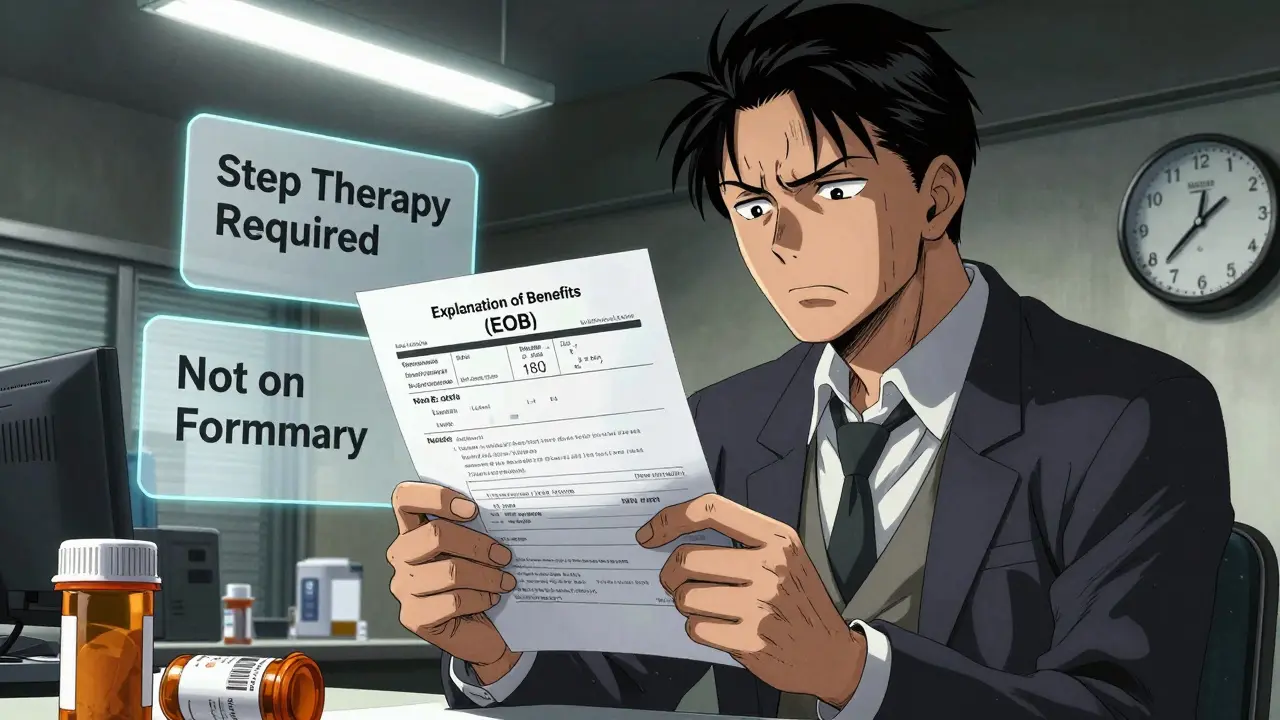
Step 1: Read Your Explanation of Benefits (EOB)
After your pharmacy tells you the drug isn’t covered, you’ll get an Explanation of Benefits (EOB) from your insurer. Don’t ignore it. This isn’t a bill-it’s your roadmap for appeal.
The EOB must legally include:
- The exact name of the drug denied
- Why it was denied (e.g., "step therapy required," "not on formulary")
- How to file an appeal
- The deadline to appeal
For commercial insurance, you have 180 days from the denial date to start your appeal. Medicare Part D gives you only 120 days. Medicaid timelines vary by state, so check your plan’s website or call customer service right away. Missing the deadline means you lose your right to appeal unless you qualify for an exception.
Step 2: Talk to Your Doctor
Your doctor isn’t just a name on the prescription-they’re your strongest ally in this fight. Insurance companies don’t care about your opinion. They care about clinical evidence.
Ask your doctor for a letter of medical necessity. This isn’t just a note saying "please cover this drug." It needs to include:
- Specific reasons why the generic won’t work for you (e.g., "patient experienced severe nausea and dizziness with generic metformin, leading to non-compliance and HbA1c rise from 6.8% to 8.1%")
- Proof that you tried other alternatives and failed
- References to clinical guidelines (like those from the American Diabetes Association or American College of Rheumatology)
According to a GoodRx analysis of 15,000 appeals, 78% of successful cases included a letter citing official medical guidelines. Only 29% of failed appeals had that detail.
Many doctors now use templates from the American Medical Association to make this easier. If your doctor says they don’t know how to write one, ask if they can use the AMA’s free form. Most clinics have it on file.
Step 3: File the Internal Appeal
Every insurance plan has an internal appeal process. This is your first official shot at reversing the denial. You’ll usually find the form on your insurer’s website under "Member Services" or "Appeals." If you can’t find it, call them and ask for the "Prescription Drug Prior Authorization Exception Request Form."
Fill out every section. Include:
- Your full name and policy number
- The exact drug name and dosage
- The date of denial
- Attach the doctor’s letter and any lab results or past prescriptions showing failed alternatives
Submit it by certified mail or through the insurer’s online portal. Keep a copy. If you mail it, get a tracking number. Insurance companies often claim they never received documents-and having proof stops that excuse.
Timeline matters. For drugs you haven’t started yet, insurers have 30 days to respond. If you’re already taking the medication, they have 60 days. For urgent cases-like if you’re at risk of hospitalization-you can request an expedited review. They must respond within 4 business days.

Step 4: Request a Peer-to-Peer Review
This is where most appeals succeed.
After you file your internal appeal, your insurer will assign a medical reviewer-a doctor employed by the insurance company-to look at your case. But here’s the trick: you can ask for a peer-to-peer review. That means your doctor talks directly to theirs.
Studies show peer-to-peer calls result in approval rates over 75%. Why? Because insurance doctors are more likely to listen when another doctor explains the clinical reasoning face-to-face.
Don’t wait for them to offer it. Call the number on your denial letter and say: "I’d like to schedule a peer-to-peer review between my prescribing physician and your medical director." Most insurers will agree, especially if you’ve already submitted strong documentation.
Prepare your doctor for the call. Give them a quick summary: "I’ve had three bad reactions to generics. Here’s the lab data. The guidelines say this is the preferred option for patients like me."
Step 5: If You’re Still Denied, Go External
If your internal appeal fails, you have the right to an external review. This is when an independent third party-unaffiliated with your insurer-looks at your case.
For commercial insurance, this is usually handled by your state’s insurance department. In California, the Department of Insurance resolves 92% of formal complaints within 30 days. In New York, they require insurers to complete peer reviews within 72 hours.
For Medicare Part D, the external review is the fourth level of appeal. It’s handled by an Independent Review Entity (IRE). The overturn rate here is 63.2%, the highest of any level in the Medicare system.
You have 60 days from your internal denial notice to file for external review. Use the form your insurer sent you-or download it from your state’s insurance commissioner website. Attach everything you sent before: the doctor’s letter, lab results, prior denials, and your appeal history.
What Makes Appeals Succeed (and What Kills Them)
Successful appeals have three things in common:
- Detailed documentation: Not just "it didn’t work," but specific side effects, dates, and lab values.
- Clinical guidelines: Citing the American College of Cardiology, Endocrine Society, or similar groups gives your case authority.
- Timeliness: Filing early and following up keeps your case alive.
Failures usually happen because:
- The doctor’s letter is too vague-"the patient needs this drug" isn’t enough.
- Patient didn’t prove they tried alternatives.
- Appeal was filed after the deadline.
- Expedited review was requested but not properly labeled as urgent.
One patient in the T1D Exchange case study successfully appealed denial of semaglutide after showing 12 episodes of severe hypoglycemia with other drugs. That’s the kind of detail that wins.

Help Is Out There
You don’t have to do this alone.
State insurance commissioners offer free help. In every state, you can call or email their office. The average response time is under 7 business days. They’ll walk you through forms and even follow up with your insurer.
Nonprofits like the Crohn’s & Colitis Foundation and the Patient Advocate Foundation provide free appeal templates and case managers. Their data shows that patients using structured templates have a 65% success rate-more than double those who write appeals on their own.
Reddit communities like r/healthinsurance and patient forums are full of real stories. Read them. Learn what worked. And don’t be afraid to ask for help.
What’s Changing in 2026
The system is slowly improving. In January 2024, the National Association of Insurance Commissioners updated its rules to require insurers to review step therapy exceptions within 48 hours when adverse reactions are documented.
Medicare is moving toward faster reviews too. The Biden administration’s 2023 proposal cut the standard urgent review time from 7 days to 3 business days.
And more providers are using digital prior authorization systems. According to the AMA, 62% of doctors report higher appeal success rates with these tools. They reduce errors and speed up communication.
Still, the system is broken in places. Physicians spend an average of 16 hours a week just on prior auths and appeals. That’s time taken away from patients.
But until the system changes completely, knowing how to appeal correctly is your best tool.
Final Checklist Before You Submit
- ✅ Did you read the EOB and note the denial reason and deadline?
- ✅ Did your doctor write a detailed letter with clinical evidence and guideline references?
- ✅ Did you include proof of failed alternatives (prescriptions, lab results, dates)?
- ✅ Did you submit the appeal before the deadline?
- ✅ Did you request a peer-to-peer review?
- ✅ Did you keep copies of everything and track submissions?
If you answered yes to all of these, you’ve done everything right. Now wait. Follow up if you don’t hear back in the timeline listed. And don’t give up.
Sheila Garfield
January 31, 2026 AT 04:26i got denied for my metformin last year and thought it was over. turned out my doc just needed to cite the ADA guidelines on individualized treatment plans. i didn’t even know those existed. now i have my brand name and zero nausea. thanks for the breakdown, this is the kind of stuff that actually saves people.
Sazzy De
February 2, 2026 AT 00:06peer-to-peer review changed everything for me. my doctor called their med rep and 20 minutes later i got approval. no forms, no waiting. just two docs talking like humans. why does the system make it so hard otherwise?
Kelly Weinhold
February 2, 2026 AT 15:57okay real talk i cried when i got approved after 3 denials. i’ve been on semaglutide for 2 years and the generics made me feel like i was being slowly poisoned. my a1c was climbing, i was passing out at work, and the insurance rep just kept saying "it’s the same thing." it’s not the same thing. my body knows the difference. i used the template from the Patient Advocate Foundation and attached every lab result from the last 8 months. they didn’t know what hit them. if you’re reading this and you’re stuck? keep going. you’re not crazy. your pain is real. and there’s a way out. i’m living proof.
Russ Kelemen
February 3, 2026 AT 00:09the real issue isn’t the appeal process-it’s that we’ve turned healthcare into a cost optimization problem instead of a clinical one. doctors aren’t just prescribing drugs, they’re playing chess with insurance algorithms. and patients? we’re the pawns. but this guide? it’s a cheat code. it gives us back agency. the fact that 70% of appeals succeed means the system isn’t broken-it’s just been rigged to make us give up. don’t give up.
Diksha Srivastava
February 4, 2026 AT 05:31from india here and i never thought this would help someone like me but wow. my cousin in texas used this exact method to get her lupus med covered. i printed it out and shared it with my local clinic. we don’t have insurance here but the structure? it’s universal. thank you for writing this like a human not a robot.
Sidhanth SY
February 4, 2026 AT 07:41step 2 is the golden ticket. my doc used to just write "patient needs this" and got denied every time. then he started using the AMA template with actual lab numbers and references to upToDate. now they approve everything on the first try. the system isn’t evil-it’s just lazy. give it good data and it works.
Adarsh Uttral
February 4, 2026 AT 08:46just wanna say thx for this. i used to think ins co were just being jerks but now i see its more about paperwork and deadlines. i missed mine last time and lost 3 weeks of meds. now i set phone alerts for every denial. also the peer call thing? my doc did it and they approved it before lunch. wild.
April Allen
February 4, 2026 AT 08:50from a clinical pharmacy perspective, the key metric isn’t just "did it work?" it’s "did it fail safely?" and that’s where most appeals collapse. if you’re documenting HbA1c shifts, QT prolongation, or drug levels, you’re speaking the insurer’s language. the real win is when your doctor references the FDA’s therapeutic equivalence codes-those are legally binding. if a generic isn’t AB-rated, it’s not interchangeable. that’s the nuclear option. i’ve used it three times. all approved. never lost.