
Inhaled Corticosteroids: How to Prevent Oral Thrush and Hoarseness
 Jan, 15 2026
Inhaled Steroid Side Effect Risk Calculator
Risk Assessment
This tool helps you understand your risk of developing oral thrush or hoarseness from inhaled corticosteroids based on your medication, dosage, and risk factors.
Your Risk Assessment
Based on your inputs
Your risk of developing oral thrush is low. This is due to your lower dosage, use of spacer, and absence of additional risk factors.
Recommended action: Continue rinsing after each inhaler use and maintaining your current habits.
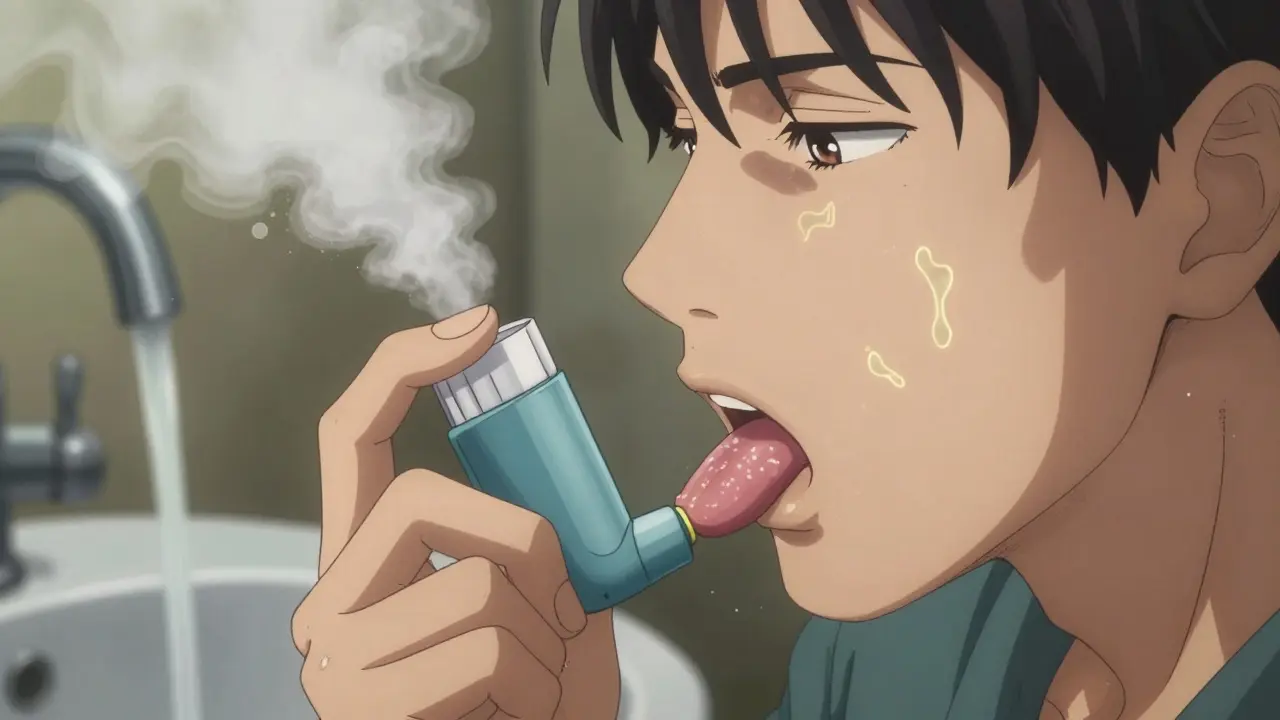
When you use an inhaled corticosteroid for asthma or COPD, you’re doing something smart: you’re stopping inflammation in your lungs before it turns into a full-blown attack. But if you don’t take a few simple steps after each puff, you might end up with a white, patchy mouth or a voice that sounds like gravel. Oral thrush and hoarseness aren’t rare side effects-they’re common, avoidable, and often misunderstood.
Why Your Inhaler Causes Oral Thrush
Inhaled corticosteroids like fluticasone, budesonide, and beclomethasone are designed to land in your lungs. But a lot of the medication doesn’t make it there. Instead, it sticks to the back of your throat, your tongue, and the inside of your cheeks. That’s not a design flaw-it’s physics. The particles are small, but not that small. When steroid residue sits in your mouth, it quietly weakens your local immune defenses. Normally, your body keeps Candida albicans-a type of yeast that lives harmlessly in most mouths-in check. But when the steroids dampen your immune response in that area, the yeast takes over. You get white, creamy patches that look like cottage cheese. They might hurt. You might lose your taste. Scrape them off, and you’ll see red, raw skin underneath. This isn’t just a nuisance. For people with diabetes, older adults, or anyone with a weakened immune system, oral thrush can become a recurring problem. Studies show that up to 60% of people using high-dose inhaled steroids develop thrush if they don’t rinse. And it’s not just about how much you use-it’s about how you use it.Why Your Voice Gets Hoarse
Hoarseness hits differently. It doesn’t show up as patches or pain. It shows up as a voice that won’t cooperate. You speak, and it cracks. You try to sing, and it’s gone. You clear your throat, and it still feels scratchy. This happens because the steroid particles land directly on your vocal cords. Your vocal cords are delicate. They vibrate thousands of times a minute to make sound. When steroid dust settles on them, they swell up slightly. That changes how they move. The result? A raspy, tired, or weak voice. It usually starts within minutes after using your inhaler. It can last hours. Some people get it every time. Others only notice it after weeks of use. It’s not dangerous-but it’s annoying. And for singers, teachers, or anyone who relies on their voice, it can be frustrating enough to make them skip doses.The Two-Step Fix That Works
There’s no magic pill. No secret supplement. The solution is simple, cheap, and backed by decades of research: rinse and spit. Not just swish. Not just gargle. Rinse, gargle, swish, and spit. Do it immediately after every single use. A 2023 review in Healthcare (Basel) found that rinsing reduces the risk of oral thrush by 60-70%. That’s not a guess. That’s from clinical trials. Patients who rinsed after every inhaler use had nearly the same thrush rates as people who didn’t use steroids at all. Here’s how to do it right:- After you inhale, take a sip of water.
- Swish it around your mouth for 10 seconds-make sure it touches your tongue, cheeks, and gums.
- Gargle for another 10 seconds. Tilt your head back and let the water reach your throat.
- Spit it out. Don’t swallow.
Spacers Aren’t Optional-They’re Essential
If you’re using a metered-dose inhaler (MDI)-the kind that makes a puff sound-you need a spacer. It’s a plastic tube that attaches to your inhaler. It holds the medicine in a chamber so you can breathe it in slowly. Without a spacer, about 80% of the medication hits your throat. With one, that drops to 20%. That’s not a small difference. That’s life-changing. Asthma.net and the Global Initiative for Asthma (GINA) both say spacers are the single best tool to reduce side effects. But here’s the catch: many people don’t use them. Some think they’re bulky. Others forget. Some think their doctor said it’s optional. It’s not optional. If you’re on fluticasone, budesonide, or beclomethasone, and you’re not using a spacer, you’re increasing your risk of thrush and hoarseness by at least 50%. Even if you rinse, the extra medication in your mouth makes rinsing less effective. Clean your spacer every week with warm water and mild soap. Don’t dry it with a towel-air dry it. Oil from your fingers can build up and trap medication.
Who’s Most at Risk
Not everyone gets thrush or hoarseness. But some people are far more likely to.- People using more than 800 mcg per day of beclomethasone equivalent (that’s about 500 mcg of fluticasone or 1,000 mcg of budesonide).
- People with diabetes, especially if their HbA1c is above 7.0%.
- Older adults-saliva production drops with age, and saliva helps wash away yeast.
- People who wear dentures. Yeast can hide under them.
- Those who skip rinsing, especially at night.
What Doesn’t Work
You’ll hear a lot of advice online. Some say you don’t need to rinse if you use a spacer. Others say apple cider vinegar cures thrush. Some swear by probiotics. Here’s the truth:- Spacers alone aren’t enough. You still need to rinse. Even with a spacer, about 5-10% of the dose still lands in your mouth.
- Apple cider vinegar, tea tree oil, or coconut oil? No clinical proof. They might irritate your mouth more.
- Probiotic mouthwashes? Promising, but still experimental. Not recommended as a replacement for rinsing.
What If You Already Have Thrush?
If you see white patches, it’s not the end of the world. But don’t ignore it. Your doctor can prescribe a simple antifungal rinse like nystatin or lozenges like clotrimazole. You’ll need to use it for 7-14 days. Sometimes longer. And if you keep using your inhaler without rinsing, it will come back. Don’t wait for it to get worse. If you’ve had thrush once, you’re more likely to get it again. That’s why prevention isn’t just helpful-it’s critical.
Real Stories, Real Results
One user on Asthma.net said: "I got thrush twice in two years. Then I started rinsing after every puff-even at night. Five years later, I’ve never had it again. It takes 30 seconds. Worth it." Another said: "My voice sounded like I’d been shouting for days after my Symbicort. My doctor showed me to tilt my head down slightly when I inhale. Now, I barely notice hoarseness." These aren’t outliers. They’re people who did the basics right.What’s Changing in 2026
New inhalers are coming. Some now have built-in spacers. Others are designed to release medicine in a way that minimizes throat deposition. The FDA now requires all ICS inhalers to include clear rinsing instructions on the label. But the biggest change? Doctors and dentists are working together more. A 2024 study showed that when asthma patients got a check-up with their dentist every six months-along with their pulmonologist-their thrush rates dropped by 35%. It’s not about fancy tech. It’s about consistency. Rinsing. Spacers. Technique. Awareness.Final Checklist: Your Daily Routine
- Use a spacer with your metered-dose inhaler.
- Rinse, gargle, swish, and spit with water after every puff.
- Wait 30 minutes before brushing your teeth.
- Clean your spacer weekly with soap and water.
- Check your mouth weekly for white patches.
- If you have diabetes or wear dentures, tell your doctor.
- Never skip rinsing at night.
Can I just rinse with mouthwash instead of water?
No. Most mouthwashes contain alcohol or strong chemicals that can irritate your mouth and throat, especially after steroid exposure. Water is the safest, most effective option. It rinses away the residue without adding extra irritation. If you want to freshen your breath, wait 30 minutes after rinsing with water, then use a mild, alcohol-free mouthwash.
Do I need to rinse if I use a dry powder inhaler (DPI)?
Yes. Dry powder inhalers like Asmanex or Pulmicort Flexhaler still leave residue in your mouth-even though they don’t need a spacer. Studies show that up to 40% of the dose can deposit in your throat. Rinsing reduces your risk of thrush and hoarseness by about 60%. Don’t skip it just because your inhaler doesn’t puff.
How long does hoarseness last after using an inhaler?
Usually, hoarseness lasts 2-6 hours after use. For some people, it fades within 30 minutes. If your voice stays hoarse for more than a day or two, or if it gets worse, talk to your doctor. It could be a sign of vocal cord irritation that needs attention, or it could mean you’re using too high a dose.
Can oral thrush spread to my lungs?
No. Oral thrush is a localized fungal infection in the mouth and throat. It doesn’t travel to the lungs. However, if you have a severely weakened immune system (like from chemotherapy or advanced HIV), there’s a small risk of systemic fungal infection-but that’s extremely rare in people using inhaled steroids for asthma or COPD. The thrush you get from your inhaler stays in your mouth.
Is it safe to swallow the water after rinsing?
No. Swallowing the rinse water lets the steroid residue enter your digestive system, which defeats the purpose. You’re trying to remove the medication from your mouth-not absorb it through your stomach. Always spit it out. If you accidentally swallow a tiny bit, it’s not dangerous, but don’t make it a habit.
What if I forget to rinse after using my inhaler?
If you forget once, don’t panic. One missed rinse won’t cause thrush. But if it happens often, your risk goes up. Keep a cup of water next to your inhaler. Set a phone reminder if you need to. The goal isn’t perfection-it’s making rinsing automatic, like brushing your teeth. Over time, it becomes second nature.