
Medication-Induced Hyperkalemia: Managing High Potassium and Cardiac Risks
 Apr, 11 2026
Hyperkalemia Risk & ECG Simulator
Normal Range
Low RiskPotassium levels are within the typical physiological range. No cardiac electrical abnormalities expected.
Clinical Action Recommended:
ECG Visualization
Imagine taking a pill every morning to protect your heart or manage your blood pressure, only for that very medication to push your body toward a cardiac emergency. This is the paradox of hyperkalemia is a condition where serum potassium levels rise above the normal range, typically exceeding 5.0 to 5.5 mEq/L. While potassium is essential for muscle and nerve function, too much of it acts like a glitch in your heart's electrical system. In severe cases, where levels hit 6.5 mEq/L or higher, the heart can literally stop beating correctly, leading to sudden cardiac arrest.
Quick Summary: What You Need to Know
- The Danger: Potassium levels above 6.5 mEq/L are life-threatening and require immediate medical intervention.
- The Cause: Common blood pressure and heart failure meds (RAAS inhibitors) are the primary triggers.
- The Risk: High potassium disrupts the heart's electrical signals, leading to arrhythmias or heart attacks.
- The Solution: Acute cases need calcium gluconate for stabilization; chronic cases use potassium binders.
How Medications Trigger High Potassium
Your kidneys are the primary filter for potassium. When they work well, they dump excess potassium into your urine. However, many life-saving medications interfere with this process. The biggest culprits are RAAS inhibitors drugs that block the renin-angiotensin-aldosterone system to lower blood pressure and protect the kidneys . These include ACE inhibitors (like lisinopril) and ARBs (like losartan). By blocking aldosterone-a hormone that tells the kidneys to get rid of potassium-these drugs cause the mineral to build up in the blood.
It gets riskier when you mix these. For example, adding a potassium-sparing diuretic like spironolactone to an ACE inhibitor creates a dangerous synergy. Data shows that combining spironolactone with these agents and certain antibiotics, such as co-trimoxazole, can increase the risk of sudden death by 5.5 times. This isn't just a rare side effect; about 10-20% of people on these medications experience some level of hyperkalemia.
The Cardiac Warning Signs: From T-Waves to Sine Waves
The scary thing about high potassium is that you might feel nothing at all until your heart is in crisis. You might experience mild palpitations or muscle weakness, but the real story is told on an electrocardiogram (ECG). As potassium levels climb, the heart's resting membrane potential shifts, making the cardiac cells "leaky" and unstable.
Doctors look for a specific progression of changes on the ECG to gauge the danger:
- 5.5 to 6.5 mEq/L: You'll typically see "peaked T-waves," which look like tall, sharp tents on the heart rhythm strip.
- 6.5 to 7.5 mEq/L: The PR interval prolongs, and the QRS complex begins to widen-essentially, the electrical signal is slowing down and spreading.
- Above 7.5 mEq/L: The rhythm can collapse into a "sine wave" pattern, which is the final warning before ventricular fibrillation or total cardiac arrest.
Acute Treatment: Stopping the Heart from Failing
When a patient arrives in the ER with severe hyperkalemia, the goal isn't actually to lower the potassium first-it's to stop the heart from stopping. Potassium lowering takes time; heart stabilization must happen in seconds.
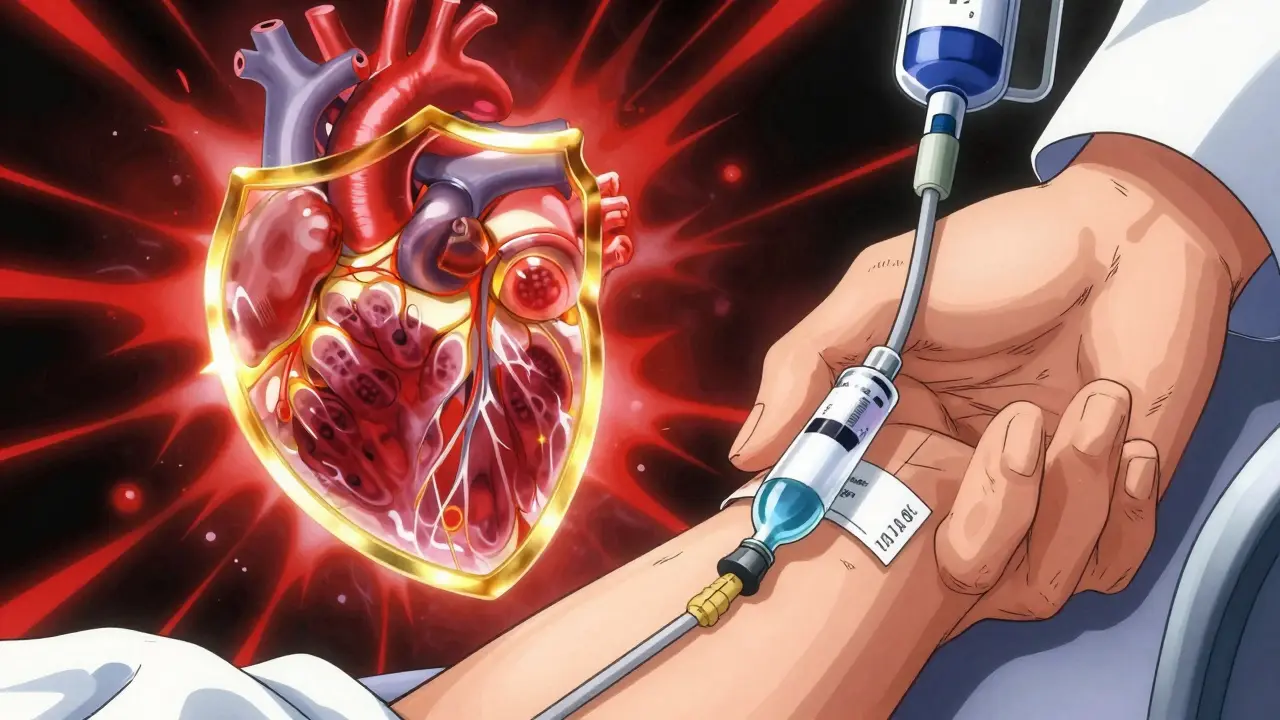
The gold standard for immediate stabilization is calcium gluconate an intravenous medication used to stabilize the myocardial cell membrane against the effects of hyperkalemia . Administering 1-2 grams over a few minutes doesn't remove a single milliequivalent of potassium from the blood, but it "shields" the heart cells so they can continue beating while other treatments work.
Once the heart is safe, doctors use "shifting agents" to hide the potassium inside the cells:
- Insulin and Glucose: 10 units of regular insulin combined with 25g of glucose pushes potassium into cells, lowering blood levels by 0.5 to 1.5 mEq/L within 30 minutes.
- Albuterol: A high-dose nebulizer treatment can shift another 0.5 to 1.0 mEq/L of potassium.
Long-Term Management and Potassium Binders
The great dilemma for doctors is that RAAS inhibitors are incredibly effective at preventing heart failure and kidney decline. Stopping them just because potassium is a bit high can actually harm the patient in the long run. This is where potassium binders oral medications that bind to potassium in the gut, preventing its absorption and promoting excretion through stool come into play.
| Drug Name | Mechanism | Typical Dose | Common Side Effect |
|---|---|---|---|
| Patiromer (Veltassa) | Cation exchange in colon | 8.4 - 25.2 g daily | Constipation |
| Sodium Zirconium Cyclosilicate (Lokelma) | Selective powder binder | 5 - 10 g daily | Diarrhea |
Using these binders allows many patients to stay on their target doses of heart medication. In fact, studies show that about 86% of patients can maintain their RAASi therapy when using a binder, compared to only 66% who don't. Without these tools, nearly 40% of patients are forced to stop their life-saving medication due to mild potassium spikes.

Practical Steps for Patients and Caregivers
If you are on blood pressure medications, especially if you have chronic kidney disease or diabetes, you are in a higher risk bracket. You cannot rely on "feeling" the symptoms. The only way to know is through regular blood work. Depending on how stable your levels are, your doctor may want to check your serum potassium every one to four weeks.
Dietary changes are your first line of defense. While the "no-potassium diet" is a myth (you still need some for your nerves to work), restricting intake to 2,000-3,000 mg daily can make a huge difference. This means being careful with high-potassium foods like bananas, avocados, and spinach, and avoiding "salt substitutes" which are often made of potassium chloride.
Can I just stop taking my blood pressure meds if my potassium is high?
No. You should never stop RAAS inhibitors (ACEs or ARBs) without talking to your doctor. These drugs prevent heart failure and kidney damage. Often, a doctor will add a potassium binder or adjust your diet so you can keep the protective benefits of the medication while keeping your potassium levels safe.
Is calcium gluconate used to lower potassium levels?
Actually, no. Calcium gluconate does not lower the amount of potassium in your blood. Instead, it stabilizes the heart muscle's electrical membrane, making the heart less likely to stop or beat irregularly. It buys the doctors time to use other methods, like insulin or binders, to actually remove the potassium.
What are the most dangerous medications for potassium levels?
The highest risk comes from combining medications. Taking a potassium-sparing diuretic (like spironolactone) alongside an ACE inhibitor or ARB is particularly risky. Adding certain antibiotics like trimethoprim-sulfamethoxazole to this mix further increases the danger of severe hyperkalemia.
How do I know if my potassium is dangerously high?
Because mild to moderate hyperkalemia often has no symptoms, the only reliable method is a blood test and an ECG. If you feel extreme muscle weakness, numbness, or heart palpitations, seek emergency care immediately, as these can be signs of severe levels.
Are potassium binders safe for long-term use?
Yes, medications like Veltassa and Lokelma are designed for chronic management. While they can cause gastrointestinal issues-constipation is common with patiromer and diarrhea with sodium zirconium cyclosilicate-they are generally well-tolerated and allow patients to maintain essential cardiovascular therapies.
Next Steps and Troubleshooting
If you've just received a blood test showing potassium levels over 5.5 mEq/L, don't panic, but do act. Your first step is to review all your supplements and over-the-counter meds; some "health" drinks or salt substitutes are hidden sources of potassium. Schedule a follow-up with your cardiologist or nephrologist to discuss if a potassium binder is right for you.
For those with Chronic Kidney Disease (CKD), the challenge is greater because the kidneys can't compensate even with a strict diet. In these cases, monitoring frequency should increase. If you notice a sudden decrease in urine output or a spike in blood pressure, get your potassium checked immediately, as dehydration can trigger a rapid rise in serum levels.
Sam Dyer
April 13, 2026 AT 11:27Finally someone puts the facts out there because the medical industrial complex loves to keep us in the dark about how these meds actually wreck your internal chemistry 🙄 it is just absolute madness how they push these pills without mentioning the cardiac risks in plain English
Shaylia Helland
April 15, 2026 AT 09:04it is honestly so wild to think about how something as simple as a banana or some spinach could be dangerous when you are on the wrong meds and just thinking about the heart's electrical system glitching out makes me feel for everyone dealing with this daily struggle because it is just a lot to manage when you are already feeling sick
Clint Humphreys
April 16, 2026 AT 11:28Now, let's be friendly here, but have any of you actually looked into why these specific drugs are the gold standard or if there is some deeper agenda to keep us dependent on these expensive potassium binders that just happen to fix the problem the first drug created, which honestly sounds like a classic loop to keep the pharma companies swimming in cash while we just hope our T-waves don't peak too high one morning
john chiong
April 17, 2026 AT 04:21pure hogwash to think the system cares about your heart when they are just churning out these chemical cocktails that turn your blood into a salty soup of chaos
melissa mac
April 19, 2026 AT 00:20It's really important that we keep the conversation open about these side effects so people don't feel alone in their health journey. Managing blood pressure is a balancing act and having this information helps us advocate for ourselves in the doctor's office.
Haley Moore
April 19, 2026 AT 11:06Imagine not knowing that salt substitutes are basically potassium bombs... like, seriously? 🙄 I can't even with the way some people just blindly follow a diet without reading the labels. It's honestly embarrassing 💅
Catherine Mailum
April 21, 2026 AT 05:19oh yeah because nothing says a great morning like waking up and wondering if your heart is about to turn into a sine wave just because you took your prescribed medicine... just wonderful
Clare Elizabeth
April 22, 2026 AT 11:01Stay strong everyone! Just keep tracking those labs and talking to your doctors and you can totally manage this and stay healthy and keep your heart beating strong!
Jasmin Stowers
April 23, 2026 AT 17:33glad this was shared it helps a lot
Kenzie Evans
April 24, 2026 AT 02:15The part about the sine wave is basic medicine and if you're actually taking these meds and not checking your labs every two weeks you're basically playing Russian roulette with your life and it's honestly pathetic how lazy some patients are with their own survival
Princess Busaco
April 25, 2026 AT 18:44I find it absolutely fascinating that people still believe dietary changes are the 'first line of defense' when we all know that once your kidneys hit a certain stage of failure the amount of spinach you avoid is practically irrelevant to the systemic failure occurring in your body, and honestly, the way this is framed as a 'paradox' is just such a simplistic way of describing a complex biochemical failure that most people can't even grasp because they aren't paying attention to the actual endocrine markers
Mary Johnson
April 25, 2026 AT 22:21They are hiding the real data on these binders because they don't want us to know there are natural ways to flush the system without spending five hundred dollars a month on a powder that probably contains heavy metals from some unregulated lab, and if you think your doctor is telling you the whole truth about why your potassium is spiking, you are delusional and just letting the system feast on your fear!
Becca Suttmiller
April 26, 2026 AT 22:04I appreciate the clear breakdown of the ECG changes. It helps in understanding why medical staff react so quickly when those peaked T-waves show up.