
Medications That Cause Palpitations and Rapid Heartbeat: What You Need to Know
 Mar, 21 2026
QT Interval Calculator
This tool calculates your corrected QT interval (QTc) based on your heart rate and QT measurement. QTc values above normal range may indicate increased risk of medication-induced arrhythmias.
Enter your heart rate and QT interval to see results
Medication Risk Alert
Important: This calculator helps identify potential QT prolongation risk. Certain medications mentioned in the article (like antibiotics, asthma inhalers, and antidepressants) can increase QTc values and cause palpitations. Always consult your doctor about medication safety.
Normal QTc range: Under 450ms (men), under 460ms (women)
High risk: Above 500ms or increases >60ms from baseline
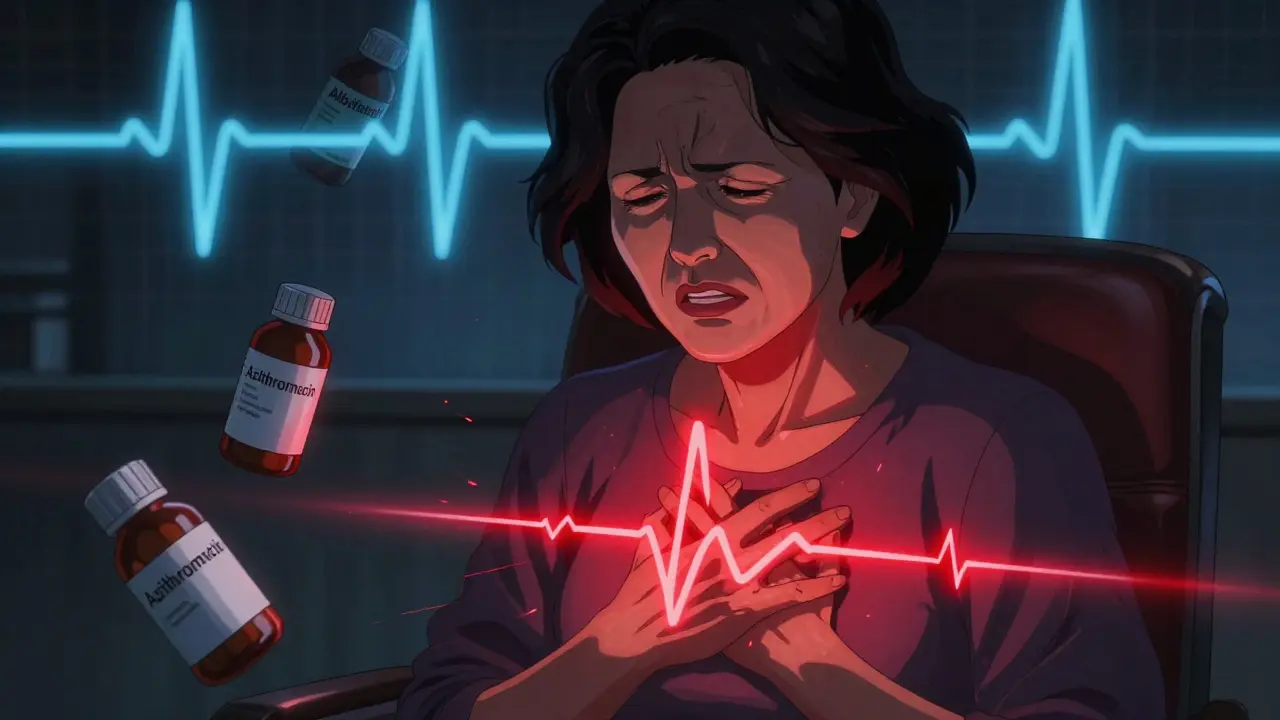
Many people experience a sudden, strong heartbeat - a thumping, fluttering, or racing sensation in the chest - and assume it’s just stress, anxiety, or caffeine. But sometimes, the cause is something more specific: a medication you’re taking. Palpitations and rapid heartbeat from medications are far more common than most realize, and they can range from annoying to life-threatening. In fact, medication-induced palpitations account for up to 20% of all arrhythmia cases seen in clinics, according to the American Heart Association. If you’ve noticed your heart skipping, pounding, or racing after starting a new pill, patch, or inhaler, you’re not alone. And you’re not imagining it.
Which Medications Can Trigger Palpitations?
It’s not just illegal stimulants or energy drinks. Many everyday prescriptions and over-the-counter drugs can interfere with your heart’s electrical system. The most common culprits fall into clear categories, each with its own mechanism.Asthma inhalers like albuterol (Salbutamol) are among the top offenders. In 40-50% of users, they cause a heart rate increase of 15-25 beats per minute within half an hour. That’s not a side effect - it’s a direct action. These drugs stimulate beta-2 receptors in the lungs to open airways, but they also hit beta receptors in the heart, making it beat faster and harder. Long-acting versions like salmeterol can keep your heart racing for up to 12 hours.
Antibiotics like azithromycin (Zithromax) are another surprise. A 2021 study of 1.2 million patients found azithromycin increases the risk of rapid heartbeat by more than twice. It does this by prolonging the QT interval - the time it takes for the heart to recharge between beats. When this interval gets too long, it can trigger a dangerous rhythm called torsades de pointes. Fluoroquinolones like levofloxacin and ciprofloxacin carry similar risks, though slightly lower.
Decongestants like pseudoephedrine (Sudafed) are sold as harmless cold remedies. But at standard 60mg doses, they can push your heart rate up by 10-20 beats per minute. Phenylephrine, often marketed as a "safer" alternative, has similar effects. People with high blood pressure or heart conditions are especially vulnerable.
Thyroid meds like levothyroxine (Synthroid) are essential for many, but too much can turn your heart into a jackhammer. When your TSH level drops below 0.1 mIU/L - often from over-replacement - palpitations appear in 8-12% of users. Many describe waking up with their heart pounding, sometimes for weeks before they realize it’s the medication.
Antidepressants vary widely. Tricyclics like amitriptyline can lengthen the QT interval by 40-60 milliseconds. Even SSRIs aren’t safe: citalopram at doses above 40mg/day has been linked to serious rhythm problems, especially in older adults. On the other hand, sertraline has a much lower risk profile - a key reason doctors switch patients when palpitations arise.
Newer drugs like semaglutide (Ozempic, Wegovy) weren’t expected to affect the heart this way. But clinical trials show a consistent 3-5 bpm increase in heart rate, even at standard doses. It’s mild for most, but for someone with existing heart issues, it’s enough to trigger symptoms.
How Doctors Evaluate Medication-Induced Palpitations
If you’re reporting palpitations, your doctor shouldn’t just shrug it off. A full evaluation follows a clear, step-by-step process.First, they’ll ask for every medication you’ve taken in the last 72 hours. Why? Because 70% of drug-induced arrhythmias start within three days of a new dose or a change. This includes supplements, herbal products, and even over-the-counter pain relievers. Many patients forget to mention cold medicine or magnesium pills - but those can matter.
Next comes the ECG. A 12-lead electrocardiogram checks your heart’s electrical pattern. The key number? The corrected QT interval (QTc). Normal is under 450ms for men, under 460ms for women. If it’s over 500ms, or has jumped more than 60ms from your baseline, you’re at high risk. Some hospitals now use automated alerts in electronic health records that flag dangerous combinations before the prescription is even filled.
If the resting ECG looks normal but symptoms persist, a Holter monitor - a portable device worn for 24-48 hours - catches intermittent rhythms. In 35-45% of cases, the problem only shows up during daily activity, not in the doctor’s office.
Blood tests are also routine. Low potassium (<3.5 mmol/L) or low magnesium (<1.7 mg/dL) make your heart more sensitive to drug effects. Thyroid function (TSH) is checked if you’re on levothyroxine. And if you’re on theophylline or digoxin, they’ll measure blood levels - these drugs have narrow safety windows.
Some clinics use the Brigham and Women’s Risk Score, which adds points for age over 65, female sex, existing heart disease, and taking multiple QT-prolonging drugs. A score above 5 means immediate action is needed.

What to Do When Medications Cause Heart Issues
Not every palpitation means stopping the drug. Treatment depends on risk level.Mild cases - occasional fluttering, no dizziness, QTc under 500ms - may just need monitoring. Your doctor might ask you to check your pulse daily, avoid caffeine, and get a repeat ECG in a week. Electrolyte imbalances are often fixed with simple supplements.
Moderate cases - frequent palpitations, lightheadedness, QTc between 480-500ms - usually respond to dose reduction. Studies show 60-70% of patients see improvement within 72 hours of lowering the dose. For example, switching from 100mg of azithromycin to 50mg, or reducing levothyroxine by 12.5mcg, often stops symptoms without losing therapeutic benefit.
High-risk cases - QTc over 500ms, fainting, or a documented episode of torsades de pointes - require immediate discontinuation. Hospitals follow strict protocols: stop the drug, give IV magnesium, and monitor in a cardiac unit. In these cases, the drug isn’t just risky - it’s dangerous.
When a medication can’t be stopped - like chemotherapy or certain heart drugs - doctors use protective strategies. Beta-blockers like metoprolol are often prescribed to blunt the heart’s response. One study showed this cut arrhythmia risk by 45% in cancer patients on trastuzumab, with no loss in cancer control.
For antibiotics, switching from azithromycin to amoxicillin reduces arrhythmia risk from 2.9% to 0.8%. For thyroid patients, keeping TSH between 0.5 and 2.0 mIU/L cuts palpitations from 12% down to 4.3%. For antidepressants, switching from citalopram to sertraline often resolves symptoms while maintaining mood stability.
Prevention Is the Best Strategy
The best way to avoid medication-induced palpitations? Don’t wait for symptoms.The American Heart Association now recommends baseline ECG screening before starting high-risk drugs like azithromycin, fluoroquinolones, or certain antidepressants. This simple test can catch hidden QT prolongation before it becomes dangerous. One expert estimates this could prevent 15,000-20,000 serious events each year in the U.S. alone.
Older adults are especially vulnerable. People over 75 have more than three times the risk of torsades de pointes compared to younger patients on the same dose. The American Geriatrics Society advises avoiding QT-prolonging drugs in this group unless absolutely necessary.
Patients are also encouraged to keep a simple medication symptom journal. Note the time you take each drug and when you feel your heart race. Does it happen 30 minutes after the inhaler? Two hours after the antibiotic? This pattern helps doctors pinpoint the trigger faster than any test.
There are also five "never events" - combinations that should never happen:
- Two QT-prolonging drugs together (risk jumps 5.7 times)
- High-dose ondansetron (for nausea) in someone with QTc over 450ms
- Fluoroquinolones in patients with heart failure
- Citalopram over 40mg/day in elderly patients
- Starting levothyroxine without an ECG if you have heart disease
Electronic systems in hospitals now block these combinations automatically. If your pharmacy flags a dangerous prescription, it’s not a mistake - it’s a lifesaver.
Real Stories, Real Outcomes
On patient forums, common patterns emerge. One Reddit user described waking up every night with her heart racing after starting azithromycin for a sinus infection. It stopped within 48 hours of stopping the drug. Another, on thyroid forums, said she’d been told her palpitations were "just anxiety" - until her TSH was found to be 0.05. A simple 25mcg dose reduction fixed it.A 68-year-old woman in Bristol had been on citalopram for depression for years. When she started getting daily palpitations, her GP switched her to sertraline. Within 10 days, the symptoms vanished. She didn’t need to stop her antidepressant - just change it.
These aren’t rare cases. They’re predictable. And they’re preventable.
What You Can Do Today
If you’re taking any of these medications and feel your heart racing:- Check your pulse. Is it consistently over 100 at rest?
- Review your meds. Did you start a new drug, change a dose, or add an OTC product in the last week?
- Write it down. Note when symptoms happen - before or after taking your pill?
- Don’t stop meds on your own. Talk to your doctor. Bring a full list of everything you take.
- Ask: "Could this be my medication?" Many doctors don’t ask this unless you do.
Palpitations from medications aren’t a sign of weakness. They’re a signal - your body telling you something’s off. Pay attention. Speak up. And remember: what’s labeled as a "common side effect" isn’t always harmless. Sometimes, it’s a warning.
Can over-the-counter cold medicines cause rapid heartbeat?
Yes. Pseudoephedrine and phenylephrine, found in many cold and sinus medications, can increase heart rate by 10-20 beats per minute. Even if you don’t have heart disease, these drugs can trigger palpitations, especially at higher doses or in older adults. Always check labels and avoid combination products if you’re prone to heart rhythm issues.
Is a rapid heartbeat from medication always dangerous?
Not always. Mild palpitations with no dizziness, chest pain, or fainting are often harmless. But if your QT interval is prolonged on an ECG, or if you have underlying heart disease, even a small increase in heart rate can be risky. The difference between harmless and dangerous often comes down to your personal health history, not just the symptom.
How long do medication-induced palpitations last?
It depends. If you stop the drug, symptoms often clear within 24 to 72 hours. For drugs with long half-lives, like some antibiotics or antidepressants, it may take up to a week. If the cause is an electrolyte imbalance, fixing potassium or magnesium can resolve it within hours. But if you keep taking the drug, symptoms can persist or worsen.
Can I still take my medication if it causes palpitations?
Sometimes, yes - but only with careful management. For essential drugs like thyroid medication or certain cancer treatments, doctors may lower the dose, add a protective beta-blocker, or switch to a safer alternative. Never stop a vital medication without medical advice. The goal is to balance benefit and risk, not eliminate the drug entirely.
Should I get an ECG before starting a new medication?
If you’re starting a medication known to affect heart rhythm - like azithromycin, citalopram, or certain antibiotics - yes, especially if you’re over 65, have heart disease, or take other heart-affecting drugs. A baseline ECG takes minutes and can prevent serious complications. Many hospitals now require it before prescribing high-risk drugs.
Natali Shevchenko
March 21, 2026 AT 16:23It's wild how we normalize side effects until they start messing with our lives. I remember going through a phase where I thought my heart was just being dramatic-until I realized I’d started that new albuterol inhaler two weeks prior. The fluttering got worse at night, like my chest was trying to escape my ribs. I almost went to the ER thinking it was anxiety, but my pulmonologist just asked, "What else are you taking?" Like, of course, it’s the inhaler. They don’t warn you enough. Beta-agonists aren’t just for lungs-they’re like a caffeine IV for your sinoatrial node. And don’t even get me started on how long they linger. I thought "long-acting" meant "gentler," but no, it just means your heart’s been running a marathon for twelve hours straight. We treat these meds like candy. They’re not. They’re precision tools with brutal side effects if you forget they’re even there.
It’s not just about avoiding them. It’s about understanding how deeply they infiltrate your biology. The body doesn’t compartmentalize. A drug meant for your airways doesn’t care that your heart isn’t the target. It’s just chemistry. And chemistry doesn’t ask permission.
I’ve since switched to a dry powder inhaler with a different delivery system. No more palpitations. Just quiet breathing. But I wish more doctors talked about this before prescribing. Not just in footnotes. Not just in studies. In the actual conversation.
It’s like giving someone a hammer and saying "don’t hit your thumb"-but never telling them the hammer has a trigger. We’re all just walking around with invisible levers in our chests, and we don’t even know which pills pulled the strings.
And yet, we’re supposed to be grateful when the side effects aren’t fatal. That’s the real tragedy. We’ve normalized survival over comfort. And comfort matters. A lot.
Maybe next time, we’ll stop calling it a "side effect" and start calling it what it is: a secondary target. Because the heart is never just a bystander. It’s always in the room. Always listening. Always reacting.
Johny Prayogi
March 22, 2026 AT 16:03Bro, I had the same thing with azithromycin. Took it for a sinus infection and felt like my heart was trying to break out of my chest. Went to urgent care thinking I was having a heart attack. ECG said QTc was 510. They were like, "Yep, Z-Pack." I was like, "But I’ve taken this before!" They said, "Maybe your potassium was low that time." I had eaten like 3 bananas and drank 2 liters of coconut water after. Still, 2x the risk? That’s insane. Why isn’t this on the box? Why isn’t it a warning label with a skull? I’m not mad, I’m just confused. We need better labeling. Like, "This might make your heart audition for a rock concert." 🤘❤️
Nicole James
March 24, 2026 AT 01:28Okay, but… have you considered… that this isn’t just about medication? What if the pharmaceutical industry… is deliberately designing drugs to cause mild arrhythmias… so that people… become dependent on more meds? Think about it. You take albuterol, your heart races, you get anxious, you take beta-blockers, then you need blood pressure meds, then you need anti-anxiety meds… it’s a pyramid scheme. And who profits? The same companies that make the original drugs. They don’t want you cured. They want you… perpetually unstable. And the FDA? They’re complicit. The ECG? A placebo. The Holter monitor? A distraction. They don’t want you to know that the real problem is… profit. Not physiology. Not science. Profit. And they’re using your heart as a bargaining chip. You think this is an accident? It’s a feature. And you’re the product.
Nishan Basnet
March 25, 2026 AT 16:00I’ve been a pharmacist for 17 years, and I can’t tell you how many times I’ve seen patients come in with palpitations, convinced it’s stress-only to realize they started a new OTC decongestant or a herbal supplement. I had a woman last month who was taking pseudoephedrine for allergies, along with St. John’s Wort and magnesium citrate. Her QTc jumped 80ms. She didn’t even know these could interact. We need better patient education-not just from doctors, but from pharmacies. I always ask patients: "What else are you taking?" Not just prescriptions. Not just pills. Supplements. Teas. Tinctures. Even that one energy shot you drink on Sundays. They’re all players in this game. And the heart? It doesn’t care if it’s FDA-approved. It just reacts. I’ve started handing out little laminated cards with common drug interactions. Simple. Clear. No jargon. Because if we don’t make this accessible, people will keep getting hurt. And it’s preventable. Always.
Solomon Kindie
March 27, 2026 AT 02:55So like basically every med you take is secretly trying to kill you right? Like what even is medicine anymore I mean if your heart starts acting up from albuterol and azithromycin and thyroid pills and antidepressants and now ozempic then what the hell are we even doing here are we just a bunch of lab rats with insurance cards I swear if I have to take one more pill I’m just gonna start eating raw garlic and yelling at the moon
Jackie Tucker
March 28, 2026 AT 09:37How delightful. Another essay on how modern medicine is a slow, elegant torture device disguised as care. Truly, the pinnacle of human ingenuity: giving people a drug to help them breathe… so they can feel their heart trying to escape their ribcage. How poetic. I suppose next we’ll be prescribed a wearable device that vibrates gently in sync with our arrhythmias-so we can enjoy the rhythm of our impending doom. I’ll take my sertraline, thank you very much. And my placebo. And my $1,200 monthly subscription to feeling like a malfunctioning robot. It’s not a side effect. It’s a lifestyle upgrade.
Thomas Jensen
March 30, 2026 AT 03:10Wait… so Ozempic makes your heart race? That’s it. I’m done. I’ve been on it for 8 months and I’ve been telling everyone how amazing it is. But now I’m thinking… what if the weight loss isn’t the miracle? What if it’s just my heart trying to escape? I’m not even mad. I’m just… terrified. I’m gonna call my doctor tomorrow. But honestly? I think they’re all in on it. The whole system. They want us to feel this way. So we keep coming back. So we keep paying. So we keep believing. It’s not a drug. It’s a trap. And I just walked right in.
matthew runcie
March 30, 2026 AT 09:54Good info. Thanks for sharing. I’ve had palpitations on albuterol too. Switched to a different inhaler. No more issues. Simple fix. Don’t panic. Talk to your doctor. But yeah, this stuff matters.
shannon kozee
March 30, 2026 AT 11:40QTc >500ms = stop the drug. That’s it. No debate. If your ECG shows that, you’re in danger. No one should be told to "wait and see." This is an emergency. Always.