
Monoclonal Antibody Biosimilars: Examples and Clinical Uses
 Mar, 16 2026
When you hear the word biosimilar, you might think it’s just another word for generic. But that’s not true. Generics are exact chemical copies of small-molecule drugs-like aspirin or metformin. Biosimilars? They’re different. They’re highly similar versions of complex biological drugs, especially monoclonal antibodies. These aren’t made in a lab with simple chemical reactions. They’re grown in living cells, like Chinese hamster ovary cells, and even tiny changes in the process can affect how they work. That’s why regulators treat them differently. And that’s why they matter-especially when they can cut costs by 30% or more without sacrificing safety.
What Makes Monoclonal Antibody Biosimilars Unique?
Monoclonal antibodies are large proteins, each weighing about 150,000 daltons. Compare that to a small molecule like insulin at just 5,808 daltons. The size alone makes them harder to replicate. Think of it like trying to copy a handmade Swiss watch versus a plastic keychain. Even if you get the shape right, the tiny internal details-how the parts are assembled, how they’re cleaned, how they’re stored-can change how the final product behaves in the body. The FDA and EMA both require biosimilar manufacturers to prove their product is “highly similar” to the original. That means no clinically meaningful differences in safety, purity, or potency. But they don’t need to be identical. Minor differences in sugar chains (called glycosylation) or protein folding are allowed-as long as they don’t affect how the drug works. For example, one study found that in rare cases of cetuximab-related anaphylaxis, the immune reaction was linked to a specific sugar structure (alpha-1,3-galactose) that wasn’t in the original. That’s why testing for these subtle differences is now part of every biosimilar approval.Approved Monoclonal Antibody Biosimilars and What They Treat
There are now dozens of approved monoclonal antibody biosimilars in the U.S. and Europe. Here are the most common ones and the conditions they treat:- Bevacizumab biosimilars (originally Avastin): Used for colorectal, lung, and brain cancers. The FDA has approved six: Mvasi, Zirabev, Alymsys, Vegzelma, Avzivi, and Jobevne.
- Rituximab biosimilars (originally Rituxan): Used for non-Hodgkin’s lymphoma, chronic lymphocytic leukemia, and autoimmune diseases like rheumatoid arthritis. Approved versions include Truxima, Ruxience, and Riabni.
- Trastuzumab biosimilars (originally Herceptin): Used for HER2-positive breast and stomach cancers. Six are approved: Ogivri, Herzuma, Ontruzant, Trazimera, Kanjinti, and Hercessi.
- Infliximab biosimilars (originally Remicade): Used for Crohn’s disease, ulcerative colitis, and rheumatoid arthritis. The first monoclonal antibody biosimilar approved globally was a version of infliximab in the EU in 2013. In 2023, Celltrion’s Remsima became the first FDA-approved interchangeable biosimilar for infliximab.
These aren’t just lab curiosities. They’re being used in real hospitals every day. In 2022, a study of over 1,200 patients at 15 U.S. cancer centers showed switching from Rituxan to Truxima cut costs by 28% per treatment cycle-with no drop in effectiveness or rise in side effects.
How Are Biosimilars Different From Generics?
It’s easy to confuse the two. But here’s the key difference:| Feature | Generics | Biosimilars |
|---|---|---|
| Drug Type | Small-molecule chemicals | Large, complex proteins |
| Molecular Weight | Under 1,000 daltons | ~150,000 daltons |
| Manufacturing | Chemical synthesis | Live cell culture |
| Identical to Original? | Yes, chemically identical | No, highly similar, not identical |
| Testing Required | Bioequivalence studies | Full analytical, non-clinical, and clinical studies |
| Interchangeability | Automatic | Requires extra FDA proof |
Generics don’t need to prove they work the same way in patients-they just need to show they absorb the same way in the body. Biosimilars? They need full clinical trials. That’s why they take longer and cost more to develop. But they still end up cheaper than the original biologic.
Cost Savings and Market Impact
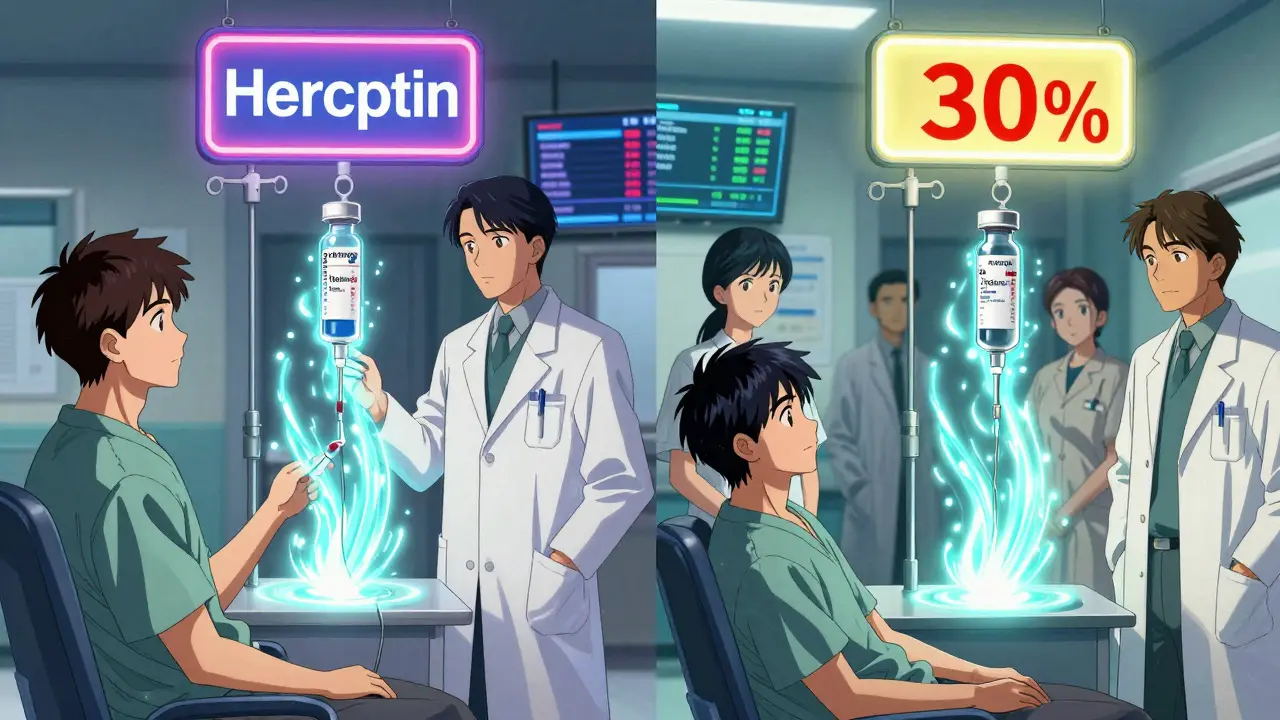
The financial impact is huge. In 2023, industry analysts estimated biosimilar monoclonal antibodies could save the U.S. healthcare system $250 billion between 2023 and 2028. Bevacizumab, trastuzumab, and rituximab biosimilars alone will make up 78% of those savings. One reason? These drugs are expensive. A single cycle of Herceptin can cost over $5,000. A biosimilar version? Often under $3,500. That’s a 30% drop. For patients on long-term treatment-like those with breast cancer or rheumatoid arthritis-that adds up fast. The FDA has also started designating some biosimilars as “interchangeable.” That means pharmacists can switch a patient from the brand to the biosimilar without asking the doctor. Remsima (infliximab) was the first monoclonal antibody to get this status in 2023. More are coming. This will make biosimilars even easier to adopt.Challenges and Barriers
Despite the savings and proven safety, adoption isn’t universal. Three big hurdles remain:- Patient and provider hesitation: A 2022 ASCO survey found only 58% of oncologists felt “very confident” prescribing biosimilars. Many still worry about hidden risks-even though data shows no increase in side effects.
- Patent battles: Drugmakers fight to protect their profits. On average, each monoclonal antibody biosimilar faces 14.7 patent challenges before it can launch. These lawsuits can delay access for years.
- Pharmacy formulary rules: Some insurance plans still block biosimilars, even when they’re cheaper. A 2023 report found 32% of biosimilar launches were restricted by pharmacy benefit managers.
Immunogenicity is another concern. The EMA’s safety report from 2021 tracked 1.2 million patient-years of biosimilar use and found just 12 unexpected immune reactions. That’s 0.001%-the same rate as the original drugs. Still, any reaction matters. That’s why post-market monitoring is required.
The Future: What’s Next?
The pipeline is full. As of late 2023, 37 monoclonal antibody biosimilars were under FDA review. The biggest focus? Biosimilars for Humira (adalimumab) and Keytruda (pembrolizumab). Humira is the best-selling drug in history-so its biosimilars could change the game. The first U.S. adalimumab biosimilar, Hyrimoz, was approved in September 2023. Analytical tools are getting better too. The FDA’s 2023 draft guidance recommends 127 specific tests to compare biosimilars to the original. These include advanced mass spectrometry and glycan mapping. This isn’t just science-it’s insurance. It ensures that even as manufacturing scales up, quality stays tight. By 2027, IQVIA predicts monoclonal antibody biosimilars will make up 35% of all biologic prescriptions in the U.S., up from 18% in 2022. Cancer treatments will drive most of that growth, making up 62% of the volume.What This Means for Patients
If you’re on a biologic drug for cancer, rheumatoid arthritis, or another chronic condition, biosimilars mean more options-and lower costs. You don’t have to sacrifice quality. The data is clear: these drugs work just as well. The only real difference? Price. Talk to your doctor. Ask if a biosimilar is right for you. Ask if your pharmacy can switch you. Don’t assume the brand name is better. In most cases, it’s not.Are monoclonal antibody biosimilars safe?
Yes. Regulatory agencies like the FDA and EMA require biosimilars to prove no clinically meaningful differences in safety, purity, or potency compared to the original drug. Large-scale studies and real-world use show similar side effect rates. For example, a 2021 EMA safety report found only 12 unexpected immune reactions in 1.2 million patient-years of exposure-matching the rate of the reference products.
Can biosimilars be substituted for the original drug without a doctor’s approval?
Only if they’re labeled as “interchangeable.” In the U.S., the FDA grants this status to biosimilars that meet extra requirements showing switching between the original and biosimilar won’t increase risks. As of 2023, only one monoclonal antibody biosimilar-Remsima (infliximab)-has this designation. Most biosimilars still require a doctor’s prescription for substitution.
Why are biosimilars cheaper than the original biologics?
Biosimilars don’t need to repeat all the early clinical trials that the original drug did. Manufacturers only need to prove similarity, not start from scratch. This cuts development costs significantly. Also, competition between multiple biosimilars drives prices down. For example, six bevacizumab biosimilars are now on the market, pushing prices 30-40% below the original.
Do biosimilars work as well as the original drugs in cancer treatment?
Yes. Multiple studies have confirmed this. One 2022 JAMA Oncology study followed 1,247 cancer patients switching from Rituxan to Truxima. No difference in effectiveness, progression-free survival, or safety was found. Similar results were seen with trastuzumab and bevacizumab biosimilars. Cancer centers now routinely use biosimilars as standard of care.
How many monoclonal antibody biosimilars are approved in the U.S.?
As of 2023, the FDA has approved 19 monoclonal antibody biosimilars. These include six for bevacizumab, three for rituximab, six for trastuzumab, and others for infliximab, adalimumab, and epoetin alfa. More are in late-stage development, with 37 candidates under FDA review.
Nicole Blain
March 16, 2026 AT 23:03Just saw my oncologist switch me to a biosimilar last month 🤓. Same treatment, half the price. My insurance is happy, my wallet is happy, and my cancer hasn’t noticed the difference. Biosimilars are the quiet heroes of modern medicine.
Kathy Underhill
March 18, 2026 AT 08:36The regulatory rigor around biosimilars is what makes this possible. Not just cost-cutting, but precision engineering at a biological level. The fact that glycosylation patterns are scrutinized down to the monosaccharide tells you how seriously science takes this. We’re not trading quality-we’re refining access.
Srividhya Srinivasan
March 19, 2026 AT 17:56Wait… so you’re telling me Big Pharma just LETS these cheaper versions exist?!!? There’s NO WAY this isn’t a government-corporate collusion scheme to slowly poison people under the guise of ‘savings.’ I read on a blog that the Chinese hamster cells are laced with nanobots that reprogram your immune system. They’re not saving money-they’re running an experiment. You think your ‘safe’ biosimilar is safe? Check your bloodwork. Check your dreams. They’re watching.
Prathamesh Ghodke
March 20, 2026 AT 07:59Honestly? I’m shocked more people aren’t talking about this. My cousin’s on a trastuzumab biosimilar for breast cancer-cost dropped from $6K to $3.8K per cycle. She’s been on it for 18 months. No issues. No drama. Just… life. Maybe we should stop acting like biosimilars are risky and start calling them what they are: common sense.
Stephen Habegger
March 20, 2026 AT 17:59This is huge. More people need to know this. If you’re on a biologic, ask your doc about biosimilars. Seriously. It’s not a gamble-it’s a smarter choice. And if your pharmacy won’t switch you? Push back. You’re not just saving money-you’re saving your future self from financial ruin.
Justin Archuletta
March 22, 2026 AT 17:276 biosimilars for bevacizumab?! That’s wild. Imagine 6 different versions of the same thing all fighting for shelf space. It’s like a biologic bazaar. And yeah, the price drop is insane-like, ‘I can afford to actually live’ insane. Why are we still whispering about this?
Kyle Young
March 22, 2026 AT 20:41It’s fascinating how the regulatory framework for biosimilars reflects a deeper philosophical tension: identity versus equivalence. A generic must be identical; a biosimilar must be functionally equivalent despite structural variance. This isn’t just pharmacology-it’s epistemology. What does it mean for two things to be ‘the same’ when they are, by design, not identical? The answer lies not in chemistry, but in clinical outcomes. And the data, overwhelmingly, says: they are.
Aileen Nasywa Shabira
March 22, 2026 AT 22:20Oh wow, so now we’re just supposed to trust that ‘highly similar’ means ‘just as safe’? Let me guess-the same people who told us ‘the science is settled’ on climate change are now telling us this? 😏 Maybe next they’ll say biosimilars are just as good as the original because they’re ‘approved by the FDA.’ You know what else was approved by the FDA? Vioxx. And fen-phen. And thalidomide. Progress? Or just corporate math with a lab coat?