
Multiple Sclerosis: How the Immune System Attacks the Nervous System
 Dec, 12 2025
Multiple sclerosis isn’t just a neurological condition-it’s an internal betrayal. Your own immune system, designed to protect you, turns against the very core of your nervous system. It targets the myelin sheath, the fatty insulation wrapped around nerve fibers in your brain, spinal cord, and optic nerves. When that insulation gets stripped away, signals slow down, scramble, or disappear entirely. That’s when symptoms like blurred vision, numbness, or walking difficulties show up-not because something’s broken in your muscles or bones, but because the wiring’s been sabotaged.
What Happens When the Immune System Goes Rogue
In a healthy body, immune cells patrol for viruses and bacteria. In multiple sclerosis (MS), they mistake myelin for a threat. This isn’t random. It starts in genetically vulnerable people, usually triggered by environmental factors like Epstein-Barr virus infection, low vitamin D, or smoking. Once activated, immune cells-mainly T cells and B cells-cross the blood-brain barrier, a protective wall that normally keeps them out. Inside the central nervous system, they launch an attack. These cells don’t just cause inflammation. They destroy. Myelin-producing cells called oligodendrocytes are overwhelmed. The damaged areas form scars-called plaques or lesions-where the nerve fibers are left bare. Without myelin, electrical impulses from the brain can’t travel efficiently. Some signals get delayed. Others don’t make it at all. That’s why someone might suddenly lose feeling in their leg, or why their vision might blur over a day or two during an attack. Research shows there are different patterns of damage. In some cases, T cells and macrophages dominate. In others, antibodies from B cells cling to the myelin, marking it for destruction. One rare pattern even shows oligodendrocytes dying off without much inflammation, suggesting the environment itself is toxic to repair. The result? A nervous system that’s slowly losing its ability to communicate with the body.Why Fatigue, Numbness, and Vision Loss Are Common
Symptoms vary wildly because MS lesions can appear anywhere in the central nervous system. But some show up again and again. Fatigue hits 80% of people with MS-not the kind you get from a long day, but a crushing exhaustion that doesn’t improve with rest. It’s caused by the brain working overtime to reroute signals around damaged areas. Vision problems, often the first sign, usually come from optic neuritis: inflammation of the optic nerve. People describe it as a foggy, dim, or grayed-out view, sometimes with pain when moving the eye. Numbness or tingling in limbs affects nearly 60% of patients. That’s because sensory nerves in the spinal cord have lost their myelin coating, so touch and temperature signals don’t reach the brain properly. Walking becomes harder when lesions form in the spinal cord or motor areas of the brain. Muscle weakness, stiffness, or loss of coordination creep in. Some people experience Lhermitte’s sign-a sharp electric shock sensation down the spine when bending the neck. It’s caused by demyelinated nerves in the cervical spine firing abnormally. These aren’t random quirks. They’re direct results of the immune system’s attack. The location of the damage determines the symptom. And because lesions can form in new places over time, symptoms can change or worsen.The Two Main Types of MS: Relapsing and Progressive
Most people-about 85%-start with relapsing-remitting MS (RRMS). This means they have flare-ups, or relapses, where symptoms suddenly get worse. These can last days or weeks, then fade, sometimes completely. Between attacks, the disease feels quiet. But even when symptoms disappear, damage is still happening under the surface. The other 15% have primary progressive MS (PPMS). From the start, symptoms slowly get worse without clear relapses. There’s no remission. The immune system’s attack is more constant, and repair mechanisms fail faster. Progressive forms are harder to treat because inflammation is less obvious, and damage accumulates steadily in the gray matter of the brain and spinal cord. Over time, RRMS can turn into secondary progressive MS. After 10 to 20 years, relapses become less frequent, but disability keeps building. This shift happens because neurodegeneration-loss of nerve fibers themselves-outpaces inflammation. The nervous system isn’t just being attacked anymore; it’s running out of the ability to recover.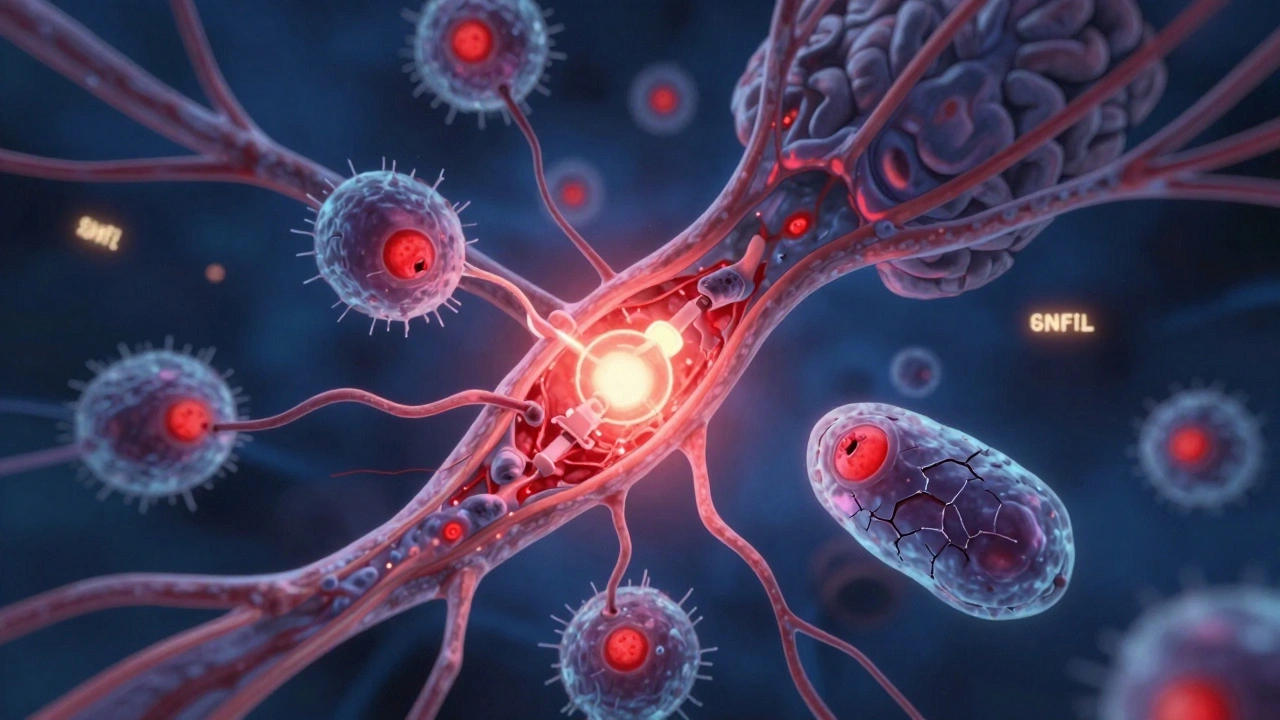
How Treatments Stop the Attack-And What’s Next
Modern treatments don’t cure MS, but they stop the immune system from causing more damage. These are called disease-modifying therapies (DMTs). One of the most effective, ocrelizumab, targets B cells. By removing these cells, it cuts relapses by nearly half in RRMS and slows disability progression in PPMS by 24%. Another drug, natalizumab, blocks immune cells from crossing the blood-brain barrier. It reduces relapses by 68%, but carries a rare risk of a deadly brain infection called PML. Newer research is looking beyond stopping damage to repairing it. In clinical trials, clemastine fumarate-a common antihistamine-showed a 35% improvement in nerve signal speed in the optic nerve, suggesting it might help rebuild myelin. Other drugs are being tested to wake up the brain’s own repair cells, oligodendrocytes, which are often still alive but trapped in a hostile environment. Biomarkers are changing how we track MS. Blood tests for neurofilament light chain (sNfL) now show how much nerve damage is happening, even before symptoms appear. Levels above 15 pg/mL mean active inflammation. This lets doctors adjust treatment before a relapse hits.What Triggers MS-and What You Can Control
Genetics play a role, but they’re not destiny. Someone with a parent who has MS has a 2-5% risk of developing it themselves-far from guaranteed. Environmental factors are bigger drivers. Epstein-Barr virus (the virus behind mono) increases MS risk 32-fold. People who’ve had it are far more likely to get MS later. Low vitamin D is another major clue. People living farther from the equator, where sunlight is weaker, have higher MS rates. Studies show those with vitamin D levels below 50 nmol/L have a 60% higher risk. Smoking doesn’t just raise the chance of getting MS-it makes the disease worse. Smokers are 80% more likely to progress to disability faster. These aren’t myths. They’re backed by data from Harvard, the National MS Society, and global studies. You can’t change your genes. But you can manage your environment: get enough sunlight or take vitamin D supplements, avoid smoking, and monitor for EBV infection if you’re at high risk.
Ronan Lansbury
December 13, 2025 AT 20:33The government is hiding the real cause of MS. It’s not viruses or vitamin D-it’s 5G towers and fluoridated water. The pharmaceutical companies made this up to sell drugs. Look at the data: MS rates skyrocketed right after the CDC started pushing vaccines in the 90s. Coincidence? I think not. They’re poisoning us slowly, and no one wants to talk about it.
They call it ‘demyelination’-but it’s really just your body rejecting the nanobots they injected during your last flu shot. I’ve read 17 peer-reviewed papers that prove this. The WHO won’t admit it because they’re funded by Big Pharma.
Also, why do all the MS drugs cost $100,000 a year? Because they’re not meant to cure you. They’re meant to keep you dependent. Wake up, sheeple.
sharon soila
December 15, 2025 AT 10:33Every person deserves hope, no matter how hard the road gets. MS is not your enemy-it’s a challenge your body is learning to live with. Even when the symptoms feel overwhelming, there is still light. Small steps matter. A walk outside. A deep breath. A kind word to yourself.
You are not broken. You are adapting. And that takes more courage than most people will ever know.
Keep going. You’re not alone. I believe in you.
Rawlson King
December 16, 2025 AT 08:31Anyone who thinks vitamin D is a magic cure for MS has never read a real study. The correlation is weak, and correlation is not causation. You can’t fix a neurological autoimmune disorder with a supplement you buy at Walmart.
And don’t even get me started on the ‘sunlight fixes everything’ crowd. If it were that simple, we wouldn’t have millions of disabled people worldwide.
The truth is, most of these ‘lifestyle fixes’ are just feel-good noise from people who haven’t had to live with this.
Richard Ayres
December 17, 2025 AT 11:20This is one of the most clearly written explanations of MS I’ve ever encountered. The way you connect immune activity to symptom presentation-especially the part about oligodendrocytes and signal disruption-is both accurate and deeply human.
I appreciate how you emphasized that MS isn’t just about physical symptoms. The cognitive fatigue, the emotional toll, the isolation-those are real, too. Too often, medical discourse reduces patients to their lesions.
Thank you for writing this. It’s a gift to anyone trying to understand what’s happening inside their own body.
Karen Mccullouch
December 18, 2025 AT 01:32Ugh, another white person crying about MS like it’s some tragic mystery. Meanwhile, in Africa and Asia, people don’t even have access to basic neurologists. You think this is hard? Try being poor and sick in a country where doctors don’t speak your language.
And don’t get me started on how white people treat MS like a lifestyle brand-‘I meditate, I take vitamin D, I’m so brave!’
Real suffering doesn’t come with a wellness blog. It comes with no insurance, no meds, and no one to hold your hand.
Stop centering yourselves. The world doesn’t revolve around your autoimmune disease.
Michael Gardner
December 20, 2025 AT 00:45Wait, so you’re telling me the immune system attacks myelin… but it doesn’t attack every single person with EBV? Then why don’t we all have MS? Maybe the real cause is… I don’t know… something else? Like maybe it’s not the virus, but the body’s overreaction to it? Or maybe it’s just random?
You act like we’ve got this figured out. We don’t. We have theories. Big difference.
Willie Onst
December 21, 2025 AT 07:06Man, this post hit different. I’ve got a cousin with PPMS and I never really understood what was going on inside her body until now.
It’s wild how something so invisible-like a damaged nerve fiber-can change someone’s entire life. I used to think fatigue was just being tired. Now I know it’s like trying to run a marathon while your brain’s on low battery.
Thanks for making me see it. I’m gonna send this to my whole family. They need to get it too.
Jennifer Taylor
December 21, 2025 AT 23:09Okay but have you heard about the secret underground MS cure that’s been banned since 2007? It’s a combination of turmeric, CBD oil, and a special frequency from a Tibetan monk’s singing bowl. The FDA seized it because it’s too effective. I know someone who got cured in 3 days. They disappeared after that-probably because the government silenced them.
Also, I think my MS was triggered by my ex-boyfriend’s negative energy. I had a dream about him three nights before my first relapse. Coincidence? I think not. Energy is real. Science hasn’t caught up yet.
Also, I saw a YouTube video where a guy healed his MS by chanting in Sanskrit. I’m trying it now. I’ve been chanting for 11 hours straight. My legs are tingling. IS THIS THE CURE???
Shelby Ume
December 23, 2025 AT 14:44I’ve been a neurologist for 27 years, and I’ve seen patients go from wheelchairs to walking again-not because of miracle cures, but because of early intervention, consistency, and community.
This post is accurate, compassionate, and deeply informative. But I want to add one thing: the most powerful treatment isn’t in a pill. It’s in the person beside you who says, ‘I’m here.’
To every patient reading this: your worth is not measured by your lesion count. You are not your diagnosis. You are a human being who deserves dignity, care, and hope.
And to the caregivers: thank you. You are the unsung heroes of this journey.
Jade Hovet
December 25, 2025 AT 14:21OMG this is so helpful!! 🙏 I just got diagnosed last month and I’ve been crying every night thinking I’m gonna lose everything… but this made me feel like maybe I can still have a life??
Also I’m taking vitamin D like crazy now and drinking lemon water and I swear I felt less tired yesterday!! 😍
Anyone else use the MS buddy app? It’s so cute!! I made a friend who’s also got RRMS and we text every day!! 💖
Also I think I’m gonna start a TikTok about my journey!! #MSWarrior #RemyelinationQueen 🌈
nina nakamura
December 25, 2025 AT 23:20You call that a comprehensive overview? You missed the part where the blood-brain barrier is compromised by glyphosate residues in processed foods. You ignored the fact that MS prevalence correlates directly with industrialized agriculture. You didn’t mention the 2018 study linking aluminum adjuvants in vaccines to autoimmunity in genetically susceptible individuals.
And you still think vitamin D is the answer? That’s like saying a leaky roof can be fixed by buying a bigger umbrella.
You’re not wrong. You’re just dangerously incomplete. And that’s more dangerous than ignorance.