
Nocebo Effect and Statin Side Effects: Why Your Symptoms Might Not Be from the Drug
 Feb, 21 2026
Statin Side Effect Tracker
Track your symptoms over time to see if they correlate with taking statins or are related to the nocebo effect. Based on the SAMSON study findings.
Your Symptom Pattern Analysis
Average symptom score:
Average symptom score:
Did you know? The SAMSON study found that 90% of reported statin side effects occurred during placebo or no-pill periods. Muscle pain scores during statin use (16.3) were nearly identical to placebo (15.4), while symptoms dropped to 8.0 during no-pill months.
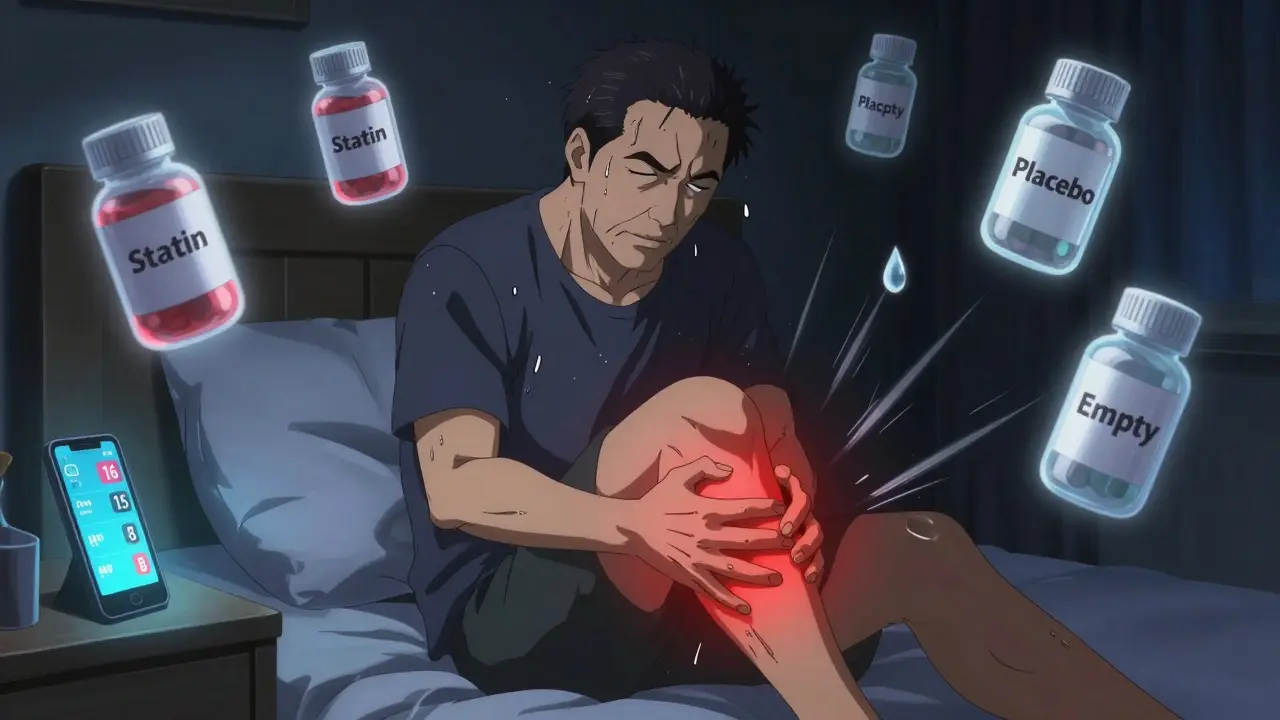
When you take a statin and start feeling muscle aches, fatigue, or weakness, it’s easy to blame the drug. After all, the package insert says these side effects are possible. But what if the real culprit isn’t the medication at all - but your expectation of it?
What the Nocebo Effect Really Means
The nocebo effect is the dark twin of the placebo effect. Placebo is when you feel better because you believe a treatment will help. Nocebo is when you feel worse because you believe it will hurt you. In statin therapy, this means that many people report side effects not because the drug is damaging their muscles, but because they’ve heard stories, read warnings, or watched videos about statin side effects - and their body reacts accordingly.This isn’t just theory. In 2021, a landmark study called SAMSON - short for Self-Assessment Method for Statin Side-effects Or Nocebo - gave us hard data. Researchers in the UK enrolled 60 people who had quit statins because of side effects. These weren’t people with mild discomfort. They’d stopped because they felt bad enough to walk away from a life-saving medication.
Here’s how the trial worked: each person got 12 bottles over 12 months. Four had atorvastatin (a real statin). Four had sugar pills (placebo). Four were empty (no pill at all). They tracked their symptoms daily using a smartphone app, rating pain on a scale from 0 to 100. No doctor visits. No blood tests. Just honest, real-time feedback.
The Shocking Results
The findings were startling. People reported nearly identical levels of muscle pain during statin months and placebo months. The average symptom score during statin use? 16.3. During placebo? 15.4. The difference? Statistically meaningless. But during the no-pill months? Symptoms dropped to just 8.0.That means 90% of the side effects people blamed on statins were also happening when they took nothing at all. The drug itself wasn’t causing most of the pain - their minds were.
And here’s the kicker: the timing matched too. Symptoms started within days of starting any pill - statin or placebo. They faded just as fast when they stopped. That’s not how real drug reactions work. Real side effects usually build up over time, or linger after stopping. These symptoms came and went like a switch.
Why Statins Are Unique
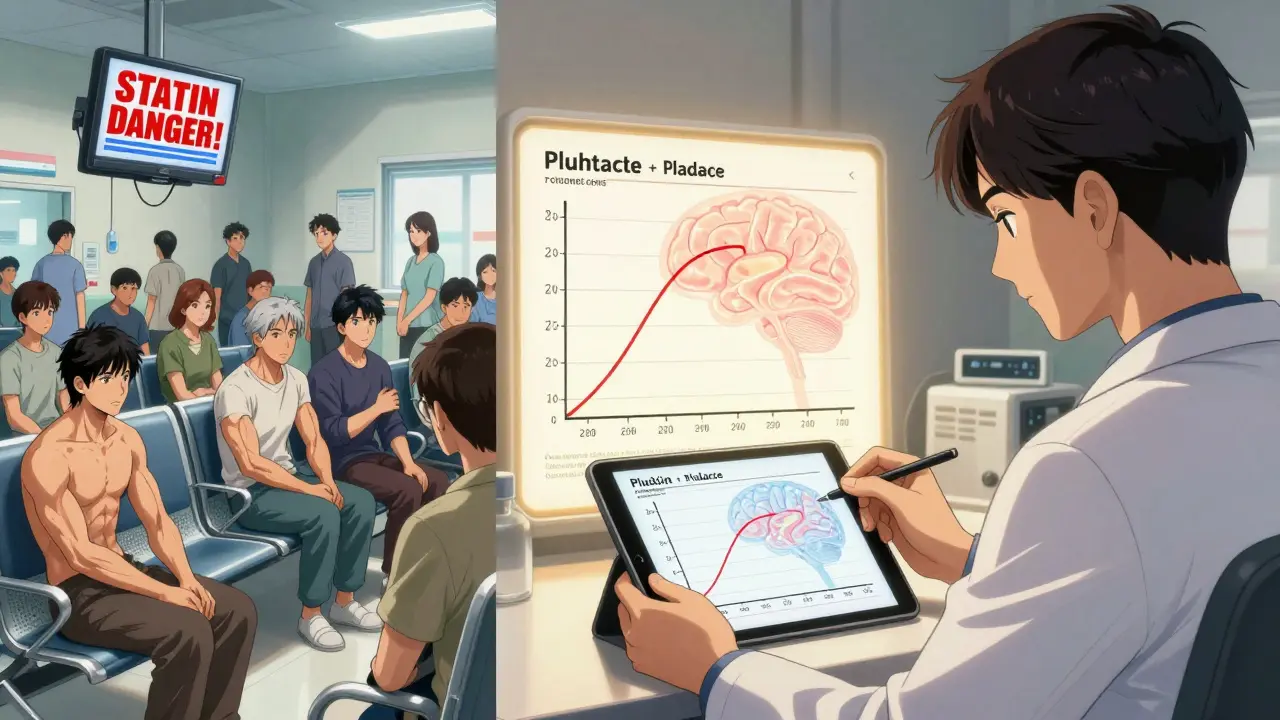
Statin side effects are unusually common in real-world practice - up to 20% of people report muscle pain. But in blinded clinical trials - where patients don’t know if they’re taking the drug or a placebo - the difference vanishes. A 2021 analysis of over 18,000 people showed no increase in muscle symptoms between statin and placebo groups. The same pattern shows up in other drugs: antidepressants, blood pressure pills, even antibiotics. But statins stand out because of how loudly they’re talked about.Why? Because statins are taken by millions. Because muscle pain is vague and common. Because headlines scream about statin dangers. And because many people have heard stories from friends or family who "couldn’t tolerate" statins. That creates a feedback loop: the more you hear about side effects, the more likely you are to notice normal aches and blame them on the pill.
Real Risks vs. Perceived Risks
Let’s be clear: statins can cause real problems. True statin-induced myopathy - confirmed by blood tests showing muscle damage - is extremely rare. About 5 in 10,000 people. Rhabdomyolysis, the most severe form, happens in fewer than 1 in a million. That’s less likely than being struck by lightning.But the nocebo effect? It’s everywhere. The SAMSON trial showed that for most people, the risk of muscle pain from statins is about 5% - the same as the risk from a sugar pill. That’s why the Mayo Clinic says: "The strongest predictor of whether you’ll get muscle aches on statins is whether you read about the potential side effects."
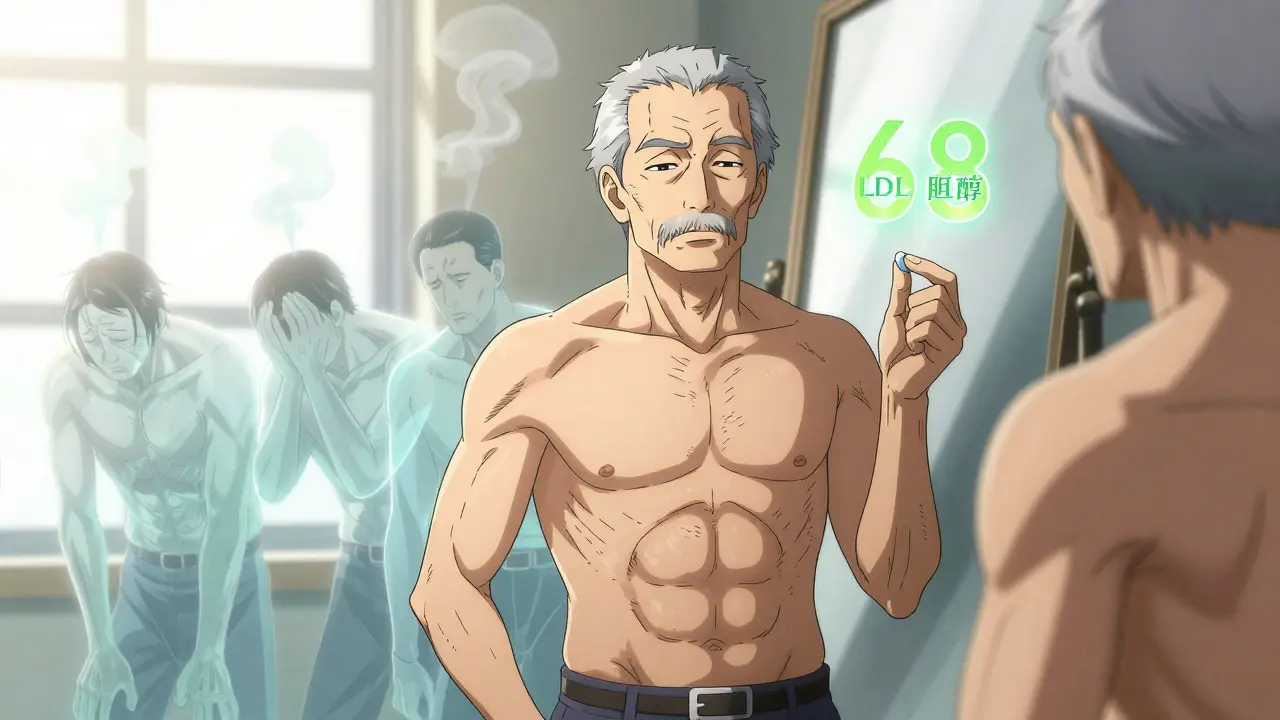
When patients in the study saw their own symptom data - how their pain was just as bad on placebo - half of them restarted statins. One 72-year-old man, who had quit three different statins over five years, went from an LDL of 142 to 68 after restarting rosuvastatin. His doctor didn’t change the dose. He just showed him the numbers.
How Clinicians Are Changing
Doctors are starting to catch on. The American College of Cardiology now recommends a simple protocol for patients who say they can’t tolerate statins: do an n-of-1 trial. That’s what SAMSON did - let the patient test themselves. One visit. A few bottles. A smartphone app. No bloodwork needed.Cardiologists who use this approach see statin restart rates jump from 22% to nearly 50%. That’s not magic. It’s education. When patients understand that their symptoms are likely tied to expectation, not chemistry, they feel empowered. Not dismissed. Not crazy. Just human.
Some pharmaceutical companies have already adapted. Pfizer added nocebo education to their statin support programs. Amgen’s marketing for Repatha - a non-statin cholesterol drug - explicitly says: "Unlike statins, which may cause symptoms due to expectation in many patients, Repatha has a different mechanism of action."
What You Can Do
If you’ve stopped statins because of side effects:- Don’t assume the drug is to blame. Muscle pain is common - from aging, from inactivity, from stress. It happens to everyone.
- Track your symptoms daily for a few weeks. Use a simple app or even a notebook. Note when you feel bad - and when you don’t.
- Ask your doctor about a structured reintroduction. Start with a low dose. Use a placebo-controlled approach if possible.
- Stop reading horror stories online. The more you focus on side effects, the more you’ll notice them.
If you’re still on statins and feeling fine? Keep going. The benefits - preventing heart attacks, strokes, and death - are massive. For every 1,000 people who take statins for five years, 15-20 major cardiovascular events are prevented. That’s thousands of lives saved every year.
The Bigger Picture
The nocebo effect isn’t just about statins. It’s about how medicine works in the real world. We’re not just chemical machines. We’re psychological beings. Our beliefs shape our biology. And when fear is amplified by media, labels, and word-of-mouth, the body responds - even if there’s no physical trigger.Fixing this isn’t about silencing patients. It’s about giving them better information. The SAMSON trial didn’t say "your pain isn’t real." It said, "here’s what’s really happening." And that made all the difference.
Cardiovascular disease kills more people than cancer. Statins are one of the most effective tools we have. But if we keep letting fear stop people from taking them - fear that’s often created by fear itself - we’re losing more than just pills. We’re losing years of life.
Can statins really cause muscle damage?
Yes, but it’s extremely rare. True statin-induced muscle damage, confirmed by elevated CPK levels and clinical symptoms, occurs in about 5 out of 10,000 people per year. Severe rhabdomyolysis - which can lead to kidney failure - is rarer than 1 in a million. Most muscle aches reported by statin users are not caused by the drug itself but by the nocebo effect.
If I feel better off statins, doesn’t that mean they’re causing the problem?
Not necessarily. Many people feel better when they stop any pill, even a placebo. That’s called the nocebo effect in reverse. When you stop taking something you believe is harmful, your anxiety drops - and so do symptoms. The SAMSON trial showed that symptoms improved just as much during no-pill months as during statin-free periods. The real test is whether symptoms return when you restart - and whether they’re identical to when you were on the drug.
Is the nocebo effect just "in my head"?
No. The nocebo effect is biological. When you expect pain, your brain activates real pain pathways. Stress hormones rise. Muscle tension increases. Inflammation markers can spike. This isn’t imagination - it’s your nervous system responding to belief. That’s why symptom tracking over time is so powerful: it shows you the pattern isn’t random. It’s tied to taking a pill - not to the pill’s chemistry.
Should I stop taking statins if I have side effects?
Don’t stop without talking to your doctor. Many side effects are due to the nocebo effect and can be managed. Try a lower dose. Switch to a different statin. Use a structured reintroduction plan. In the SAMSON trial, half of people who had quit statins were able to restart successfully after seeing their data. Stopping statins without a plan increases your risk of heart attack or stroke - especially if you have a history of heart disease.
How can I tell if my symptoms are real or from the nocebo effect?
Track your symptoms daily for at least four weeks. Note when they occur: right after taking a pill? During stressful days? After exercise? If symptoms are consistent across placebo and statin periods - and drop during no-pill weeks - it’s likely the nocebo effect. If symptoms only appear on statins and are severe (e.g., dark urine, extreme weakness), get blood tests. True muscle damage shows up in CPK levels. Most people don’t need them - but if you’re unsure, ask your doctor.
Lillian Knezek
February 22, 2026 AT 04:44next they'll say gravity is a hoax and we're all just thinking ourselves down
pharma wants you scared of statins so they can sell you $$$ non-statin drugs
watch the video on youtube called "The Statin Lie" - it's all controlled by the shadow government 🕵️♂️
Maranda Najar
February 22, 2026 AT 16:28Imagine: the body, a temple of flesh and bone, trembling under the weight of expectation. A single thought - a whisper of dread - and muscles convulse. Not from chemical betrayal... but from psychological crucifixion.
Each pill - whether inert sugar or life-saving statin - becomes a vessel of dread. A sacrament of suffering. The mind, that cruel, brilliant, tormented architect, constructs pain where none exists. And oh, the tragedy - that we call this "nocebo" as if it were a footnote, not a cathedral of suffering.
I weep for the millions who have abandoned their statins, not because they were harmed - but because they were terrified. Terrified by headlines. Terrified by whispers. Terrified by the echo of a stranger’s pain in their own bones.
And now? Now we are told - gently, clinically - that their agony was a ghost. A phantom limb of fear. A symphony played in the dark, with no instrument but the mind.
How cruel. How beautiful. How devastatingly true.
Christopher Brown
February 24, 2026 AT 05:25People think they’re sick because they read about it online
Real men don’t need statins
Real men lift weights and eat bacon
Stop coddling weaklings with placebo trials
Just take the pill or get out of the gene pool
Sanjaykumar Rabari
February 24, 2026 AT 11:20Statins are poison
They make you weak so you need more medicine
Doctors are paid by drug companies
They dont want you healthy
They want you dependent
Why did symptoms drop when no pill? Because your body was healing
Not because of placebo
They hiding the truth
Kenzie Goode
February 25, 2026 AT 18:39Then suddenly - oh wow - my calves were *so* achy!
Turns out I’d been hiking more, sleeping less, and stressing about work.
When I stopped obsessing over "statin side effects" and started tracking my actual habits? The pain vanished.
It wasn’t the drug. It was the noise.
Jacob Carthy
February 27, 2026 AT 03:09Thats wild
Next youll tell me if i think im rich i am rich
Or if i think i can fly i can fly
Statin is still a drug
Its still in my system
Its still changing my chemistry
So yeah maybe i think i feel pain but its still there
Its still real
Bhaskar Anand
February 27, 2026 AT 15:03Too many variables
Who controls the bottles
Who logs the data
Who edits the results
Big Pharma owns this
They want you to think its all in your head
So they can sell you more drugs
And charge you more
And keep you dependent
And silence the truth
Statin damage is real
It is documented
It is ignored
Because profit > people
William James
February 27, 2026 AT 16:57One guy, 68, thought he had "statin myopathy" - until we did a 4-week self-trial. He tracked his symptoms. Turns out: pain spiked on days he skipped sleep. On days he argued with his daughter. On days he drank coffee after 3 p.m.
He restarted statins. Now his LDL is 58. His knee pain? Still there. But now he knows: it’s not the pill. It’s his life.
We don’t dismiss pain. We help people understand its source. That’s not magic. That’s medicine.
David McKie
February 28, 2026 AT 12:25"Oh, your muscle pain? Not the drug - it’s your *fear*!"
How convenient.
Let’s not forget that statins *do* deplete CoQ10. That *does* impair mitochondrial function. That *does* cause real, measurable myopathy in susceptible individuals.
But no - let’s pathologize the patient. Let’s call them hysterical. Let’s blame their anxiety.
It’s easier than admitting: we overprescribe. We ignore genetics. We ignore drug interactions. We ignore the fact that 1 in 5 people are genetically predisposed to statin intolerance.
This isn’t enlightenment. It’s corporate gaslighting dressed up as science.
Nick Hamby
February 28, 2026 AT 12:35Too often, when patients report side effects, they’re told "it’s all in your head" - with zero compassion.
But this - this is different.
You’re not saying the pain isn’t real. You’re saying: here’s what’s *actually* happening.
That’s the difference between dismissal and empowerment.
I’ve seen patients cry when they realize: "I’m not weak. I’m not crazy. I just believed a story. And now I can rewrite it."
That’s not just medicine. That’s healing.
kirti juneja
March 2, 2026 AT 06:18I stopped statins because my legs felt like lead - then I started reading all these "statin horror stories" online.
Next thing I know? EVERYTHING hurt.
My shoulders. My back. My toes.
Then I tried the "no pill" week - and guess what? I felt better.
So I did a 2-week placebo trial - same pain.
Then I restarted - still same.
Turns out I was just stressed out and dehydrated.
Now I take statins and drink more water. Life is good 💕
Haley Gumm
March 2, 2026 AT 10:17Not because it’s perfect - but because it’s honest.
It doesn’t say "you’re imagining it."
It says: "Here’s what we know. Here’s what we don’t. Let’s test it."
And when we test it - we find out the truth.
Not the story. Not the fear. The data.
Gabrielle Conroy
March 4, 2026 AT 05:03Patients come in terrified because their cousin "got ruined by statins"
Then we do the n-of-1 trial - and they’re like "Wait… I felt worse on the sugar pill?!"
It’s mind-blowing.
And yes - 50% restart. No pressure. No judgment. Just facts.
Also - please stop Googling "statin side effects" at 2am 🙏❤️
Spenser Bickett
March 5, 2026 AT 01:10Wow.
What a revelation.
Next you’ll tell me the moon landing was fake because people "believed" it was real.
Or that cancer is just a mindset.
Statin = bad. Placebo = good. No pill = better.
So… should we just stop prescribing drugs entirely?
Or maybe… just stop letting people read the internet?