
Pneumothorax: Recognizing Collapsed Lung Symptoms and Getting Emergency Care Fast
 Dec, 28 2025
What Exactly Is a Collapsed Lung?
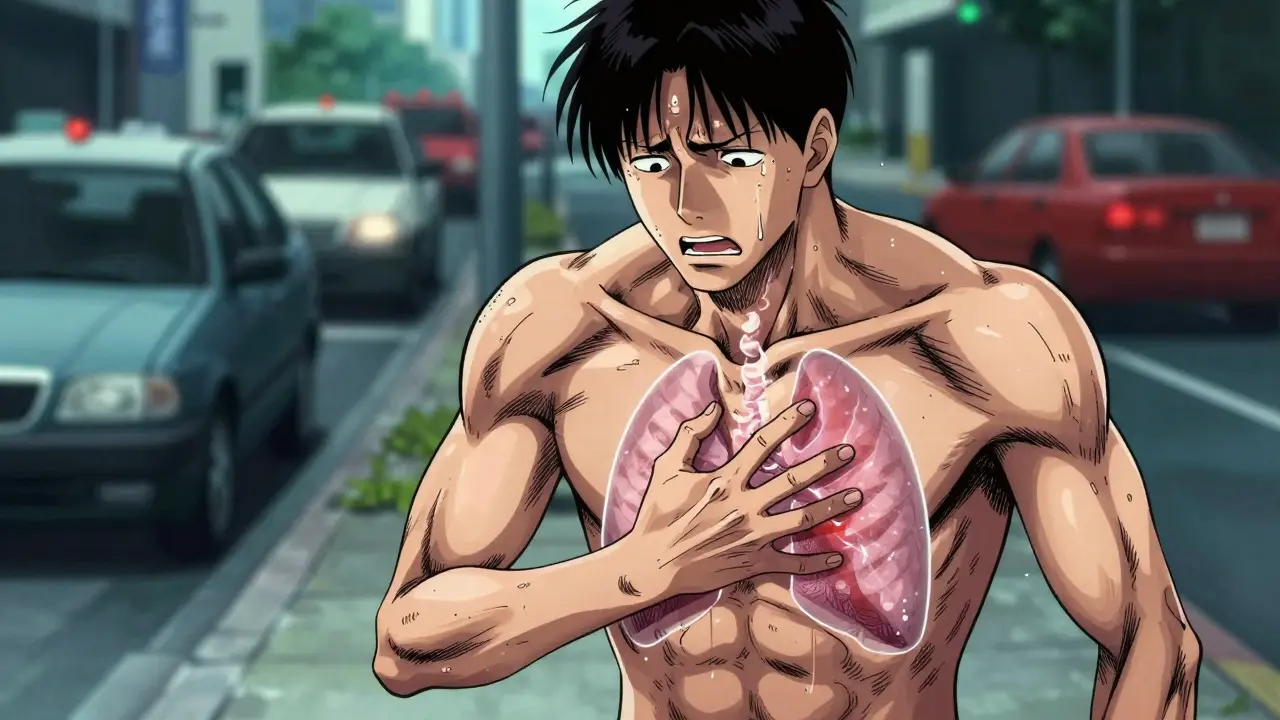
A collapsed lung, or pneumothorax, happens when air leaks out of the lung and gets trapped between the lung and the chest wall. This air builds up pressure, pushing the lung inward so it can’t expand properly when you breathe. It’s not just a minor hiccup - it’s a medical emergency that can turn deadly in minutes if ignored.
This isn’t something that only happens to older people or those with chronic illness. Healthy young adults, especially tall, slim men, can get it too. The air leak might come from a tiny tear in the lung surface, a broken rib, or even from a medical procedure like a biopsy. Sometimes, there’s no clear cause at all - that’s called primary spontaneous pneumothorax.
How Do You Know If It’s a Collapsed Lung?
The symptoms are hard to miss once you know what to look for. The most common sign is sudden, sharp chest pain on one side - often described as a stabbing sensation that gets worse when you breathe in or cough. It doesn’t feel like a muscle pull or heartburn. It’s localized, intense, and doesn’t go away with rest.
More than 85% of people with pneumothorax also feel short of breath. If the collapse is small (under 15% of the lung), you might only notice it when climbing stairs. But if it’s bigger (over 30%), you’ll likely struggle to catch your breath even while sitting still. In severe cases, people can’t speak in full sentences.
Other key signs include:
- Decreased or absent breath sounds on one side of the chest
- Skin that feels unusually cool or clammy
- A rapid heartbeat - over 130 beats per minute
- Oxygen levels dropping below 90% on a pulse oximeter
One of the most dangerous forms is tension pneumothorax. This happens when air keeps building up and pushes the heart and other organs to the other side of the chest. Signs include low blood pressure, bluish lips or fingertips, and sometimes a trachea that’s visibly shifted away from the affected side. But here’s the critical point: you don’t wait for that last sign. If someone is struggling to breathe and their oxygen is low, treat it as tension pneumothorax - now.
Why Speed Matters in Emergency Care
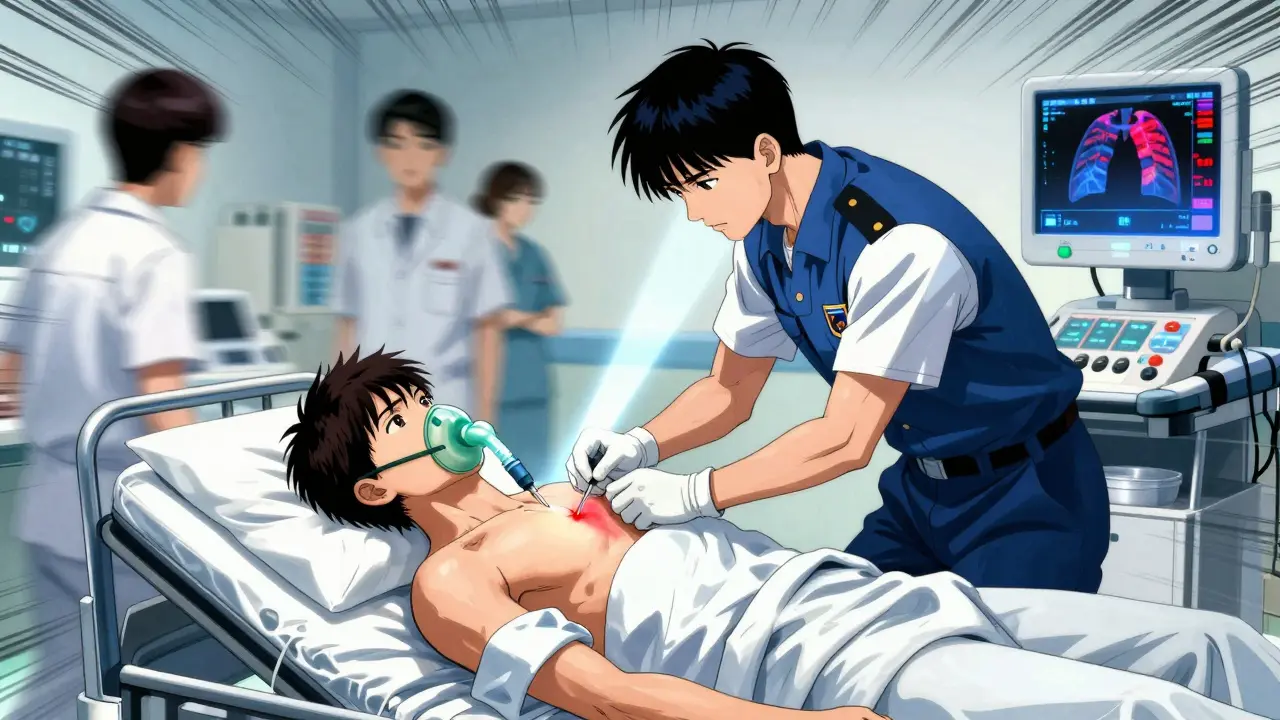
Every minute counts. In a tension pneumothorax, death can occur within 10 to 15 minutes if the pressure isn’t released. Emergency teams are trained to act before imaging confirms the diagnosis. If a patient is unstable - struggling to breathe, low oxygen, rapid heart rate - they get a needle inserted into the chest right away, even before an X-ray.
That’s because chest X-rays, while commonly used, aren’t perfect. In trauma patients lying on their backs, up to 60% of pneumothoraces are missed on X-ray. That’s why many emergency rooms now use ultrasound - called E-FAST - to check for air in the chest. Experienced providers can spot it with 94% accuracy in under a minute.
For stable patients, the goal is to get imaging done quickly and decide on treatment within 30 minutes. Hospitals that follow best practices can diagnose and treat simple pneumothorax in under 25 minutes. Delays increase the risk of complications like lung infection or fluid buildup.
How Is It Diagnosed?
Doctors use a mix of physical exam and imaging. First, they listen to your lungs with a stethoscope. If breath sounds are faint or gone on one side, that’s a red flag. Then they tap on your chest - if it sounds unusually hollow (hyperresonant), that’s another clue.
The go-to test is a chest X-ray. It catches most cases, especially if you’re sitting up. But if the X-ray is unclear or you’re in trauma, a CT scan gives the full picture. It can detect as little as 50 milliliters of air - about the size of a golf ball - and shows exactly how much of the lung is collapsed.
Ultrasound is becoming the frontline tool in emergency settings. The “lung point” sign - where the edge of the lung is just barely visible on the screen - is a near-perfect indicator. It’s fast, radiation-free, and available in ambulances and ERs across the UK and US.
Arterial blood gas tests might also be done to check oxygen and carbon dioxide levels. Low oxygen and low carbon dioxide are common in pneumothorax because the lung isn’t exchanging air properly.
What Are the Treatment Options?
Treatment depends on how big the collapse is, whether you’re stable, and if you have underlying lung disease.
Small, stable pneumothorax (under 2 cm rim): Many of these heal on their own. Oxygen therapy speeds things up - breathing 10-15 liters per minute through a mask can help the body reabsorb the air up to four times faster. About 82% of these cases resolve within two weeks without any procedure.
Larger collapse (over 2 cm) or symptoms: Doctors will remove the air. The first option is needle aspiration - a thin tube is inserted into the chest to suck out the air. It works about 65% of the time. If that fails, or if the collapse is big, a chest tube (usually 28F size) is placed. This drains the air continuously and lets the lung re-expand. Success rate is 92%, but there’s a 15-30% risk of complications like infection or fluid buildup.
Recurrent or secondary pneumothorax: If you’ve had it before, or if you have COPD, asthma, or cystic fibrosis, the risk of it happening again is high. In these cases, doctors often recommend surgery - video-assisted thoracoscopic surgery (VATS). This is a minimally invasive procedure where they remove the weak spots on the lung and sometimes glue the lung to the chest wall. It cuts recurrence risk from 40% down to 3-5%.
Tension pneumothorax: This is a true emergency. The treatment is immediate needle decompression - a large-bore needle inserted into the second rib space on the affected side. This releases the trapped air and buys time until a chest tube can be placed.
What Happens After Treatment?
Even after the air is removed and the lung re-expands, you’re not out of the woods. Follow-up is critical.
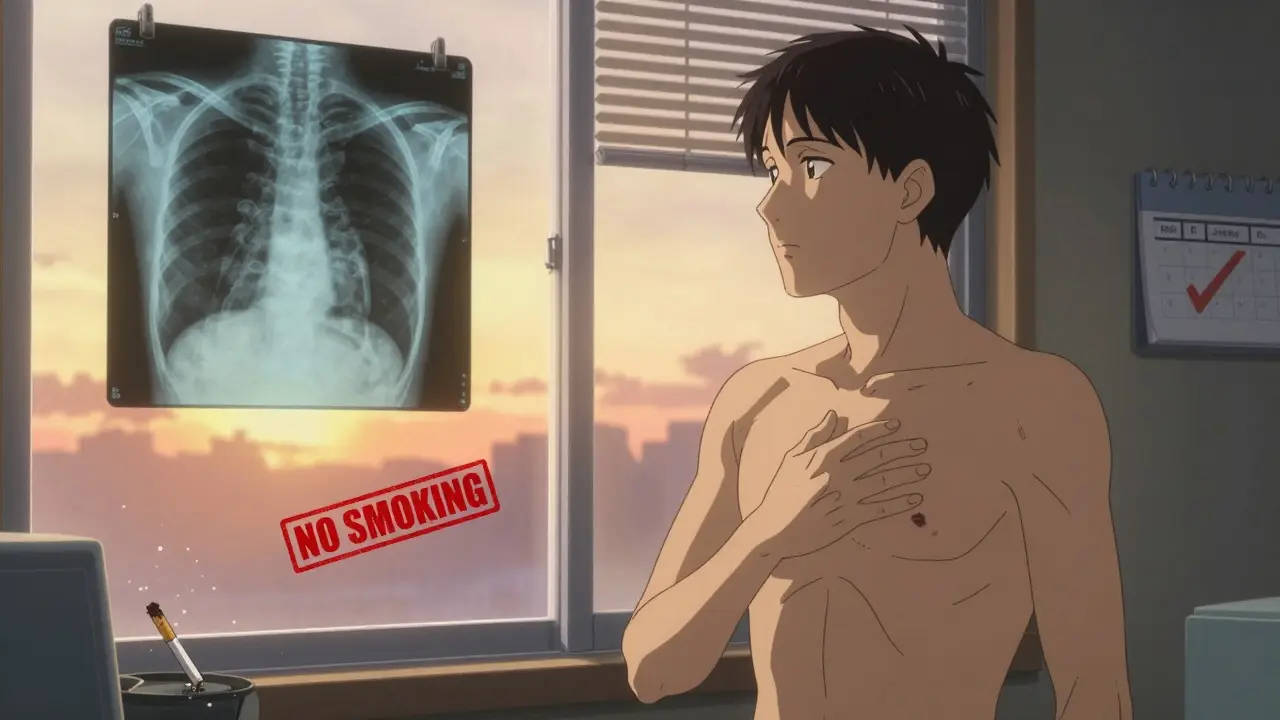
You’ll need a chest X-ray 4 to 6 weeks after discharge to make sure the lung healed fully. About 8% of people develop delayed problems - like fluid or scarring - if they skip this check.
Here’s what you absolutely must avoid:
- No flying for at least 2-3 weeks. Changes in cabin pressure can cause the air pocket to expand again.
- No scuba diving unless you’ve had surgery. The risk of recurrence underwater is over 12%.
- No smoking. If you smoke, quitting is the single most effective way to prevent another episode. Studies show quitting reduces recurrence risk by 77% in the first year.
Who’s Most at Risk?
Some people are far more likely to get a collapsed lung than others.
- Tall, thin men under 40 - especially those over 70 inches tall - have over three times the risk.
- Smokers are 22 times more likely to develop pneumothorax than non-smokers. Even light smoking increases risk.
- People with lung disease - COPD, emphysema, cystic fibrosis, tuberculosis - have a much higher chance of secondary pneumothorax. And here’s the scary part: for these patients, the one-year mortality rate is 16.2%. For healthy people, it’s 0.16%.
- Those who’ve had it before - if you’ve had one episode, you have a 15-40% chance of another within two years. After two episodes, the risk jumps to 62%.
When Should You Call 999?
You don’t need to be an expert to know when it’s time to get help. If you or someone else has:
- Sudden, sharp chest pain on one side
- Difficulty breathing that’s worse than usual
- Blue lips or fingertips
- Can’t speak in full sentences
- Heart racing without cause
Call emergency services immediately. Don’t wait to see if it gets better. Don’t drive yourself. Don’t assume it’s just a pulled muscle or anxiety. Pneumothorax doesn’t resolve on its own once it reaches a certain size - and delays cost lives.
Preventing Another Episode
If you’ve had a pneumothorax, prevention isn’t optional - it’s essential.
Quit smoking. Period. No exceptions. It’s the most powerful tool you have.
Get vaccinated. Pneumonia and flu can worsen lung damage and increase risk. Get your annual flu shot and pneumococcal vaccine if your doctor recommends it.
Consider surgery after a second episode. VATS isn’t a big operation - most people go home in 2-4 days. But it reduces your chance of another collapse from over 60% to under 5%.
Know your warning signs. If chest pain comes back, even mildly, get it checked. Recurrent pneumothorax often starts with subtle symptoms that people ignore.
Can a collapsed lung fix itself without treatment?
Yes, but only in very small cases - usually less than 2 cm of air on a chest X-ray and no symptoms like shortness of breath. Even then, oxygen therapy speeds up healing. Larger collapses won’t resolve on their own and can get worse. Never assume it’s harmless.
Is pneumothorax the same as a pulmonary embolism?
No. A pulmonary embolism is a blood clot in the lung arteries, often causing sudden shortness of breath and chest pain that feels more like pressure. Pneumothorax is air outside the lung, causing sharp, stabbing pain that worsens with breathing. Both are emergencies, but they need completely different treatments.
Can I fly after having a pneumothorax?
No - not for at least 2-3 weeks after full recovery, confirmed by a follow-up X-ray. Air trapped in the chest can expand at high altitudes and cause the lung to collapse again. The FAA and British Thoracic Society both warn against flying until cleared by a doctor.
Does vaping cause pneumothorax?
Yes. Vaping damages lung tissue just like smoking, and multiple case studies link it to spontaneous pneumothorax, especially in young, otherwise healthy people. The chemicals in vape juice can weaken the lung surface, making tears more likely.
How long does it take to recover from a chest tube?
Most people go home in 3-5 days after the tube is removed. Full healing takes 4-6 weeks. You’ll need to avoid heavy lifting and strenuous activity during that time. Follow-up X-rays are required to confirm the lung stayed expanded.
Janette Martens
December 30, 2025 AT 01:36now they can’t run up stairs without wheezing. thanks, big vape.
Marie-Pierre Gonzalez
December 31, 2025 AT 16:42Louis Paré
January 2, 2026 AT 12:14Wow. So we’re just one bad inhale away from medical intervention. Humanity’s greatest achievement: turning biology into a glitch you can fix with a syringe.
Samantha Hobbs
January 3, 2026 AT 02:42now i don’t vape. i don’t smoke. i don’t even do yoga too hard. i’m just trying to keep my lungs in one piece.
Nicole Beasley
January 4, 2026 AT 03:50Mimi Bos
January 5, 2026 AT 10:16Now he’s got surgery next week. Please, people - if your chest hurts and it doesn’t go away, just go to the ER. Don’t be cool. Don’t be tough. Just go.
Payton Daily
January 5, 2026 AT 10:33And why do we call it "spontaneous"? Like, the lung just woke up one day and said, "Nah, I’m done"?
Also - if you’re tall and skinny, are you just a walking pneumothorax waiting to happen? I’m 6’4" and I’m now scared to breathe.
Kelsey Youmans
January 5, 2026 AT 22:49Bradly Draper
January 7, 2026 AT 00:32Gran Badshah
January 7, 2026 AT 22:44finally found a doc who knew. got a chest tube. now i don’t fly. i don’t run. i just sit. and pray.
Ellen-Cathryn Nash
January 8, 2026 AT 10:13People die from this. Quietly. Alone. Because they thought it was "just a cough."
And now you’re going to tell me it’s a personal choice?
When your lungs fail, it’s not just your problem anymore.