
QT Prolongation: Medications That Raise Arrhythmia Risk
 Jan, 3 2026
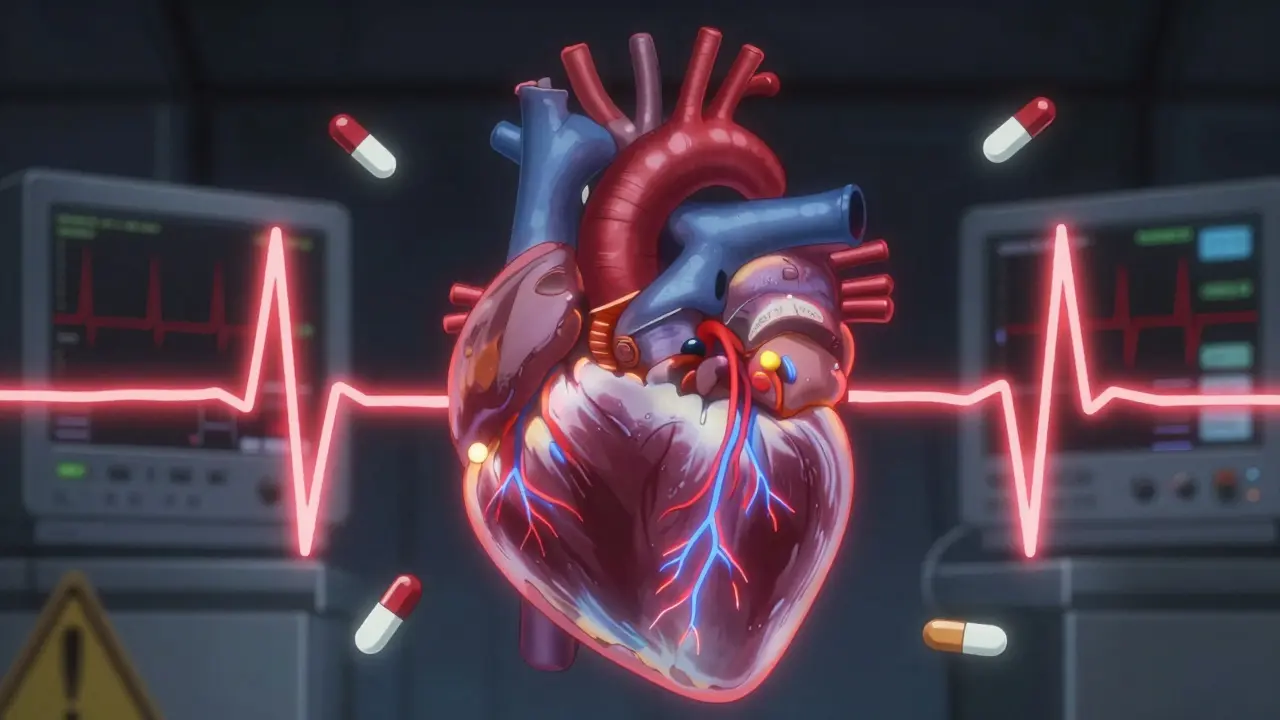
When your heart beats, it follows a precise electrical rhythm. That rhythm shows up on an ECG as a series of waves - P, Q, R, S, T - and the time between the start of the Q wave and the end of the T wave is called the QT interval. If this interval gets too long, it’s called QT prolongation. It’s not a disease on its own, but it’s a red flag. A prolonged QT interval can trigger a dangerous heart rhythm called torsades de pointes (TdP), which can lead to sudden cardiac death. And surprisingly, many common medications - not just heart drugs - can cause this.
What Actually Happens When QT Prolongs?
The QT interval measures how long it takes the heart’s lower chambers (ventricles) to recharge after each beat. This recharge is controlled by tiny electrical channels in heart cells, especially the hERG potassium channel. When this channel gets blocked - often by a drug - the heart takes longer to reset. That delay creates a window where the next electrical signal can hit at the wrong time, causing chaotic, rapid beats.
The problem isn’t just the length of the QT interval. It’s how much it changes from your normal baseline. If your QTc (corrected QT interval) jumps more than 60 milliseconds from your usual reading, your risk of TdP spikes. And if your QTc hits 500 milliseconds or higher, you’re in the danger zone. That’s not theoretical - studies show the risk of TdP triples or even quintuples at this point.
Drugs That Are Known to Cause QT Prolongation
It’s not just the obvious ones. You might be surprised what’s on this list.
- Antiarrhythmics: These are designed to fix heart rhythms but can cause them. Sotalol and dofetilide carry the highest risk - up to 5% of patients on sotalol develop TdP. Quinidine, an older drug, causes TdP in about 6% of users. Amiodarone also prolongs QT, but its risk is lower (under 1%) because it blocks multiple channels, not just one.
- Antibiotics: Erythromycin and clarithromycin (both macrolides) are common culprits. They can stretch the QT interval by 15-25 milliseconds. Even azithromycin, often thought to be safer, has been linked to cases. Fluoroquinolones like moxifloxacin add 6-10 milliseconds - small, but dangerous when combined with other drugs.
- Antipsychotics: Haloperidol, ziprasidone, and thioridazine are high-risk. Ziprasidone even carries a black box warning from the FDA. These drugs block hERG channels directly. The risk goes up with higher doses and in older adults.
- Antiemetics: Ondansetron (Zofran), used for nausea, especially after chemo or surgery, is one of the most common drugs involved in reported TdP cases. In one study, it appeared in 42% of TdP cases reported to the FDA.
- Antidepressants: Citalopram and escitalopram are dose-dependent. The FDA limited citalopram to 40 mg daily (20 mg if you’re over 60) because higher doses can push QTc past 500 ms. Even at approved doses, risk increases in people with other heart conditions.
- Methadone: Used for pain and opioid addiction, methadone can prolong QT significantly, especially above 100 mg daily. Many patients on long-term methadone maintenance have had TdP - but with careful monitoring, it’s manageable.
- Oncology drugs: Newer cancer drugs like vandetanib, nilotinib, and sunitinib carry QT warnings. About 44% of tyrosine kinase inhibitors now have this risk built into their labels.
There are over 220 drugs listed on crediblemeds.org as having some level of QT risk. The list updates every quarter. And it’s not just about one drug - it’s about combinations.
Why Some People Are at Much Higher Risk
Not everyone who takes one of these drugs will have a problem. But certain factors stack the deck.
- Gender: Women are 70% of documented TdP cases. Hormonal differences make their hearts more sensitive to hERG blockade, especially after menopause or in the postpartum period.
- Age: People over 65 are at higher risk. Their kidneys and liver clear drugs slower, leading to higher blood levels. They’re also more likely to be on multiple medications.
- Electrolyte imbalances: Low potassium (hypokalemia) or low magnesium (hypomagnesemia) make QT prolongation worse. This is common in people on diuretics, with eating disorders, or after vomiting/diarrhea.
- Heart disease: If you’ve had a heart attack, heart failure, or have a slow heart rate (bradycardia), your heart is already electrically unstable.
- Genetics: About 30% of drug-induced TdP cases involve hidden genetic variants in the hERG channel. Some people have a mild, unnoticed form of long QT syndrome that only shows up when they take a triggering drug.
- Drug interactions: Taking two QT-prolonging drugs together is the biggest red flag. For example, combining ondansetron and haloperidol - a common combo in ERs - can push QTc from 460 ms to 550 ms in hours. Even a drug that’s low-risk on its own becomes dangerous when paired.

How Doctors Screen for Risk
There’s no universal rule, but best practices are clear.
Before starting a high-risk drug, a baseline ECG is essential. This gives you a personal benchmark. If your QTc is already 450 ms, and you start a drug that adds 40 ms, you’re at 490 - close to the danger line. But if your baseline is 390, the same drug might only take you to 430 - still safe.
Guidelines from the European Society of Cardiology and the American Heart Association recommend:
- ECG before starting drugs like sotalol, dofetilide, or methadone
- Repeat ECG within 3-7 days after starting or increasing the dose
- Check electrolytes - especially potassium and magnesium - before and during treatment
- Avoid combining two or more QT-prolonging drugs unless absolutely necessary
Some hospitals now use electronic health record systems that flag risky drug combinations automatically. One study showed this cut inappropriate prescribing by 58% in 12 hospitals.
But not everyone agrees on routine screening. Some argue that for low-risk drugs like ondansetron, the chance of TdP is less than 1 in 10,000 patients per year. Screening everyone would cost too much. The key is risk stratification - who needs it, and who doesn’t.
What to Do If Your QTc Is Too Long
If your QTc is over 500 ms, or has increased by more than 60 ms from baseline:
- Stop the drug immediately - unless you’re in a life-threatening situation and there’s no alternative.
- Check potassium and magnesium levels. Give IV magnesium if levels are low - it’s the first-line treatment for TdP.
- Discontinue any other QT-prolonging drugs.
- Monitor with continuous ECG. TdP often comes in short bursts, and you need to catch it early.
- Consider temporary pacing if the heart rate is slow - a faster rate can shorten the QT interval.
Recovery is usually quick once the trigger is removed. But if TdP turns into ventricular fibrillation, it’s a cardiac arrest - and you need immediate defibrillation.

What’s Changing in Drug Safety
Drug makers used to just test if a new drug prolonged the QT interval. That’s not enough anymore.
The FDA and other global agencies launched the CiPA initiative in 2013. It’s a new testing standard that looks at how drugs affect multiple heart channels - not just hERG - and uses computer models to predict real-world risk. Since 2016, about 22 drugs have been dropped from development because of proarrhythmia risk identified by CiPA.
That’s expensive - each failed drug costs $2.6 billion on average. But it’s saving lives. The next wave of drugs will be safer.
Meanwhile, AI is stepping in. A 2024 study showed an algorithm could predict TdP risk with 89% accuracy by analyzing tiny ECG waveform patterns that humans miss. This could one day replace manual QT measurement.
Real Stories Behind the Numbers
A 65-year-old woman in Bristol was admitted with nausea and vomiting. She was given ondansetron and azithromycin - both common, both low-risk alone. Her QTc jumped from 440 ms to 530 ms in 24 hours. She went into torsades de pointes. She survived, but spent 10 days in the ICU.
Another case: a man on methadone for 10 years, with a QTc of 480 ms. He was on no other QT-prolonging drugs, had normal electrolytes, and was monitored quarterly. No event. Safe. The difference? Careful management.
It’s not about avoiding these drugs. It’s about knowing who’s at risk - and how to protect them.
Bottom Line
QT prolongation is silent until it’s not. Many of the drugs that cause it are prescribed every day - for infections, nausea, depression, pain, cancer. But the risk isn’t random. It’s predictable. And it’s preventable.
If you’re on any of these medications - especially if you’re a woman, over 65, or taking more than one - ask your doctor: "Has my QT interval been checked?" If you’ve had an ECG recently, ask: "What was the QTc?" And if you’re starting a new drug, ask: "Is this on the list of drugs that can affect heart rhythm?"
Knowledge isn’t just power here. It’s protection.
veronica guillen giles
January 4, 2026 AT 13:49Ian Detrick
January 6, 2026 AT 13:11Brittany Wallace
January 8, 2026 AT 03:00Palesa Makuru
January 9, 2026 AT 12:56Lori Jackson
January 9, 2026 AT 13:02Wren Hamley
January 10, 2026 AT 18:24Sarah Little
January 11, 2026 AT 08:17innocent massawe
January 11, 2026 AT 10:12Ian Ring
January 11, 2026 AT 22:43Tru Vista
January 12, 2026 AT 15:10JUNE OHM
January 13, 2026 AT 05:25Philip Leth
January 13, 2026 AT 11:31Shanahan Crowell
January 14, 2026 AT 16:25