
Renal Dosing of Antibiotics: How to Avoid Toxicity in Kidney Disease
 Nov, 19 2025
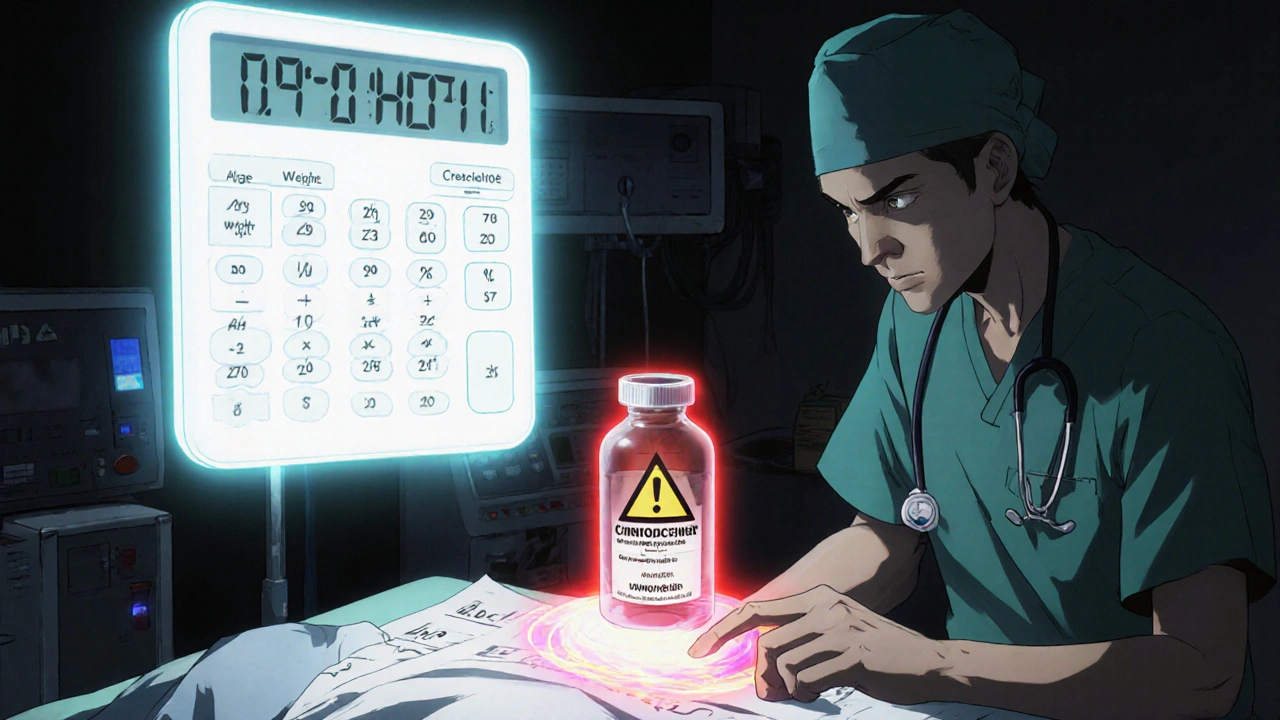
Renal Dosing Calculator
Calculate Creatinine Clearance
Use the Cockcroft-Gault equation to determine renal function for appropriate antibiotic dosing in kidney disease.
When someone has kidney disease, giving them the same antibiotic dose as a healthy person isn’t just risky-it can be deadly. Antibiotics like ampicillin, vancomycin, and cefazolin are cleared by the kidneys. If those kidneys aren’t working well, the drugs build up. Too much? Toxicity. Too little? Treatment fails. This isn’t theoretical. In hospitals across the U.S., renal dosing of antibiotics is one of the most common causes of preventable harm in patients with chronic kidney disease (CKD).
Why Renal Dosing Matters More Than You Think
About 37 million Americans have CKD. Globally, that number hits 850 million. One in five of these patients will need an antibiotic during their hospital stay. And here’s the problem: nearly half of them get the wrong dose. Not because doctors are careless. But because the rules are confusing, inconsistent, and often outdated. A 2019 review in Clinical Infectious Diseases found that incorrect antibiotic dosing in CKD patients raised death rates by up to 27% in pneumonia cases. That’s not a small risk. It’s a systemic failure. And it’s happening every day in ICUs, ERs, and outpatient clinics. The goal is simple: get enough drug into the bloodstream to kill the infection, but not so much that it poisons the body. That balance depends almost entirely on one number: creatinine clearance (CrCl).How Creatinine Clearance Guides Dosing
CrCl measures how well your kidneys filter waste. It’s not the same as your serum creatinine level. That’s just a blood test. CrCl is a calculation based on age, weight, sex, and serum creatinine. The formula most doctors still use? The Cockcroft-Gault equation:CrCl = [(140 − age) × weight (kg)] / [72 × serum creatinine (mg/dL)] × 0.85 (if female)
It’s old. It’s imperfect. But it’s still the gold standard. Why? Because eGFR-another common estimate-was designed for tracking kidney disease progression, not for dosing drugs. When you’re trying to decide whether to give 1 gram or 3 grams of an antibiotic, you need precision. And Cockcroft-Gault gives it.
Here’s how CrCl levels translate into dosing categories:
- Normal: CrCl >50 mL/min
- Mild impairment: CrCl 31-50 mL/min
- Moderate impairment: CrCl 10-30 mL/min
- Severe impairment or dialysis: CrCl <10 mL/min
These aren’t arbitrary. They’re based on decades of clinical data showing how drugs accumulate at each level. For example, ampicillin/sulbactam at normal CrCl? 2 grams every 6 hours. At CrCl <15 mL/min? Cut it to 2 grams every 24 hours. Miss that change, and you’re asking for seizures, confusion, or even coma.
Which Antibiotics Need Adjustment? (And Which Don’t)
Not all antibiotics are created equal. About 60% require dose changes in kidney disease. But only 25% have a narrow therapeutic window-meaning the difference between effective and toxic is razor-thin.High-risk antibiotics (narrow window):
- Vancomycin
- Aminoglycosides (gentamicin, tobramycin)
- Fluoroquinolones (ciprofloxacin, levofloxacin)
- Trimethoprim-sulfamethoxazole
For these, even small dosing errors can lead to kidney damage, nerve toxicity, or antibiotic-resistant infections. Vancomycin, for example, can cause irreversible hearing loss if levels get too high. That’s why therapeutic drug monitoring (TDM) is critical for these drugs-especially in patients on dialysis.
Lower-risk antibiotics (wide window):
- Cefazolin
- Ceftriaxone
- Amoxicillin
- Clindamycin
These are more forgiving. But don’t assume that means you can ignore kidney function. A 2022 study showed that underdosing cefazolin in acute kidney injury (AKI) increased treatment failure by 34%. Overdosing it in someone whose kidneys are recovering? Risk of toxicity jumps 28%. So even "safe" drugs need attention.

The Big Gap: Acute vs. Chronic Kidney Disease
This is where most guidelines fail. Almost all dosing recommendations are written for patients with stable, long-term CKD. But what about someone who just had sepsis and now has acute kidney injury (AKI)?Here’s the reality: 57% of AKI cases resolve within 48 hours. Yet, many hospitals automatically reduce antibiotic doses as soon as creatinine rises-even if the patient is improving. That’s dangerous. In sepsis, you need high drug levels fast. Holding back antibiotics because creatinine went up? You’re trading one risk for another: treatment failure.
Dr. Jason Roberts, lead author of the 2019 review, puts it bluntly: "We’re overcorrecting. For drugs with wide therapeutic indices, we should delay dose reduction until we’re sure the kidney injury is persistent."
That’s why some hospitals now use dynamic dosing: check CrCl every 24-48 hours in AKI patients, and adjust antibiotics accordingly. No automatic reductions. No one-size-fits-all rules.
Conflicting Guidelines? You’re Not Alone
You’ll find different dosing recommendations from UNMC, Northwestern Medicine, KDIGO, and your hospital’s own formulary. And they often disagree.Take ceftriaxone:
- UNMC: No adjustment needed at any CrCl level
- Northwestern Medicine: Same-no adjustment needed
- Some older institutional guidelines: Reduce dose if CrCl <30 mL/min
For clarithromycin:
- UNMC: Reduce to 500 mg every 24 hours if CrCl <30 mL/min
- Northwestern Medicine: Reduce only if CrCl <50 mL/min
Why the difference? Some guidelines prioritize safety. Others prioritize efficacy. Neither is wrong-but it creates chaos. A 2023 survey found that 63% of physicians couldn’t correctly calculate CrCl using Cockcroft-Gault. And 29% didn’t adjust for ideal body weight in obese patients. That’s not ignorance. That’s a system broken by too many conflicting rules.
Solution? Pick one guideline and stick with it. Most academic hospitals now use KDIGO as their standard. It’s the most comprehensive, updated, and evidence-based. If your hospital doesn’t have a protocol, push for one.
What About Dialysis Patients?
Patients on hemodialysis (HD) or continuous renal replacement therapy (CRRT) need special attention. Antibiotics are removed during dialysis-but not all at the same rate.For example:
- Vancomycin: Needs a loading dose, then 10-15 mg/kg after each HD session
- Cefazolin: Give 1-2 g after each HD session
- Meropenem: Give 500 mg every 8-12 hours, even on dialysis days
Northwestern Medicine’s 2025 guidelines are the only major source that includes detailed CRRT dosing for newer antibiotics like ceftazidime-avibactam. If you’re treating someone on CRRT, don’t guess. Use those guidelines.

What’s Changing in 2025?
The field is finally catching up. The KDIGO 2023 update-expected in 2025-will finally separate recommendations for AKI and CKD. That’s huge. It means dosing won’t be based on outdated assumptions anymore.Also, the FDA now requires renal dosing studies for every new antibiotic approved since 2018. The European Medicines Agency has done the same since 2020. Why? Because clinical trials kept failing. Patients with kidney disease were getting the wrong dose-and the drugs looked ineffective. It wasn’t the drug. It was the dosing.
Next up? AI-assisted dosing tools. Pilot programs at 17 U.S. teaching hospitals are already using algorithms that pull lab data, weight, age, and dialysis status to recommend doses in real time. By 2027, over 65% of academic centers plan to use therapeutic drug monitoring more routinely.
How to Get It Right Every Time
Here’s what works in real-world practice:- Always calculate CrCl using Cockcroft-Gault. Don’t rely on eGFR or automated EHR estimates.
- Check if the drug is renally cleared. Use KDIGO’s 60% rule as a starting point.
- For narrow-window drugs, use therapeutic drug monitoring. Vancomycin, aminoglycosides-don’t wing it.
- Don’t reduce doses automatically in AKI. Wait 48 hours. Reassess. If kidneys are recovering, you might not need to change anything.
- Use institutional protocols. If your hospital uses KDIGO, stick with it. No mixing sources.
- Ask the pharmacist. Pharmacist-led dosing services cut antibiotic errors by 37%.
- Never skip a loading dose. For drugs like vancomycin or linezolid, the first dose is critical-even in kidney disease.
One more thing: oral antibiotics get overlooked. Ciprofloxacin is commonly prescribed for UTIs. Standard dose: 500 mg every 12 hours. For CrCl 10-30 mL/min? Cut it to 250 mg every 12 hours. Miss that? You’re underdosing. And underdosing breeds resistance.
Final Thought: It’s Not About Complexity. It’s About Consistency.
Renal dosing isn’t rocket science. But it’s easy to mess up when you’re tired, rushed, or confused by conflicting rules. The solution isn’t more guidelines. It’s better systems: standardized protocols, EHR alerts, pharmacist support, and regular training.Every time you calculate CrCl correctly. Every time you adjust a dose. Every time you double-check with a pharmacist. You’re not just preventing toxicity. You’re saving lives.
How do I calculate creatinine clearance for antibiotic dosing?
Use the Cockcroft-Gault equation: CrCl = [(140 − age) × weight (kg)] / [72 × serum creatinine (mg/dL)] × 0.85 (if female). Always use actual body weight unless the patient is obese-then use ideal body weight. Don’t rely on eGFR or automated EHR values for dosing decisions.
Do all antibiotics need dose adjustment in kidney disease?
No. About 60% of commonly used antibiotics require adjustment. Drugs like ceftriaxone, amoxicillin, and clindamycin have wide therapeutic windows and often don’t need changes. But always check a reliable source-don’t assume.
What’s the difference between AKI and CKD in antibiotic dosing?
For chronic kidney disease (CKD), use stable CrCl values to set long-term doses. For acute kidney injury (AKI), don’t reduce doses immediately. Wait 48 hours. If kidney function improves, the original dose may still be safe. Many guidelines still treat AKI like CKD, leading to unnecessary underdosing and treatment failure.
Should I reduce the dose for patients on dialysis?
Yes-but timing matters. Most antibiotics are removed during dialysis, so you’ll need to give a dose after each session. The amount and timing vary by drug. Vancomycin needs a loading dose and then 10-15 mg/kg post-HD. Cefazolin: 1-2 g after dialysis. Always use a guideline that includes dialysis dosing, like Northwestern Medicine’s 2025 protocol.
Can I use eGFR instead of CrCl for antibiotic dosing?
No. eGFR was designed to track kidney disease progression, not to guide drug dosing. Studies show it underestimates clearance in younger patients and overestimates it in older adults. Cockcroft-Gault remains the standard for dosing because it accounts for weight and sex, which directly affect drug distribution.
What’s the biggest mistake doctors make with renal dosing?
The biggest mistake is assuming that if a patient has kidney disease, you must reduce every antibiotic dose. Many drugs are safe at standard doses. The real danger is underdosing in acute kidney injury or skipping loading doses. Always check the specific drug’s profile-don’t apply a blanket rule.
swatantra kumar
November 20, 2025 AT 01:25Finally someone talks about this like it matters. I work in a rural clinic in India and we see this all the time - doctors just guess the dose because the charts are outdated or in English and no one bothers to calculate CrCl. We lose people over this. Not because they’re sick. Because we’re lazy.
Nick Naylor
November 21, 2025 AT 16:32Let’s be clear: the Cockcroft-Gault equation is not ‘imperfect’-it’s the only clinically validated tool that accounts for weight, age, and sex in real-time dosing scenarios. eGFR was designed for epidemiology, not pharmacokinetics. Anyone who suggests otherwise is either a theoretician with no ICU experience or an AI that’s never seen a creatinine level spike after vancomycin.
Brianna Groleau
November 22, 2025 AT 08:25I had my dad in the hospital last year with CKD and pneumonia. They gave him the full dose of cefazolin like he was 25. He spent three days in delirium, shaking, hallucinating. We didn’t know what was happening until the pharmacist pulled me aside and said, ‘His kidneys are barely working.’ I cried in the hallway. This isn’t just medical jargon-it’s someone’s father, mother, sibling. We need better systems. Not just better math.
Sarah Swiatek
November 23, 2025 AT 10:44Oh wow. So the entire U.S. healthcare system is just winging it with antibiotics because someone didn’t update the reference tables in 1987? And we wonder why people don’t trust doctors? I mean, I get it-CrCl is a pain to calculate. But if you’re prescribing nephrotoxic drugs and you’re not running the numbers, you’re not a doctor. You’re a roulette wheel with a stethoscope.
Dave Wooldridge
November 23, 2025 AT 16:03They don’t want you to know this-but the pharmaceutical companies lobby to keep the old dosing charts. Why? Because if you dose properly, you use less drug. Less drug = less profit. That’s why they push eGFR. It’s a scam. They want you to overdose so you need more meds. Watch the documentary ‘Pill Pushers’-it’s all there.
Rebecca Cosenza
November 25, 2025 AT 05:49Stop killing people.
Pawan Jamwal
November 26, 2025 AT 00:26India has the same problem. But here, we don’t even have access to serum creatinine kits in 60% of rural centers. We use weight-based guesses. Sometimes it works. Sometimes it doesn’t. We need mobile apps with built-in Cockcroft-Gault calculators. And they need to be free. Not some $200 hospital software.
serge jane
November 27, 2025 AT 10:53It’s funny how we treat kidney function like a switch-on or off-but it’s not. It’s a gradient. A slow fade. And we treat patients like they’re either perfectly healthy or on dialysis. But what about the 40 mL/min guy? The one who’s not sick enough for a transplant but too sick for standard dosing? No one talks about that middle ground. We just label them ‘moderate impairment’ and hope for the best. That’s not medicine. That’s math with a blindfold on.
robert cardy solano
November 28, 2025 AT 09:04My brother’s a nephrologist. He says the real issue isn’t the formula-it’s the time. No one has 10 minutes to calculate CrCl during a code blue. We need automated EHR alerts. If the creatinine is >2.0 and the antibiotic is vancomycin, auto-suggest a reduced dose. Simple. Done. No one has to think. Just let the computer scream at the prescriber.
Lemmy Coco
November 30, 2025 AT 05:42i read this and thought ‘this is why i hate being a nurse’… we catch so many of these errors but no one listens. i had to email a doctor 3 times about a 3g dose of ampicillin for someone with crcl of 18. he finally changed it after the patient started having seizures. i’m not even mad anymore. just tired.
Cinkoon Marketing
December 1, 2025 AT 22:10Okay but have you considered that maybe we’re overprescribing antibiotics in general? Like… maybe we shouldn’t be giving them to 1 in 5 CKD patients at all? Maybe we need better diagnostics before we start throwing nephrotoxins at people? Just a thought.
robert cardy solano
December 2, 2025 AT 13:01That’s actually the real problem. Antibiotics are prescribed like vitamins. UTI? Vancomycin. Fever? Cefazolin. No culture. No suspicion. Just ‘cover it.’ We’re not just overdosing-we’re overusing. And then we wonder why resistance is rising and patients are dying from toxicity. It’s a cascade.
rob lafata
December 3, 2025 AT 16:45You people are naive. This isn’t about dosing. It’s about control. The AMA, the FDA, the pharma lobby-they all want you dependent on their systems. They don’t want you learning CrCl. They don’t want you questioning. They want you clicking ‘approve’ on a pre-filled order set. And if you’re smart enough to calculate it yourself? They’ll call you ‘difficult.’ That’s why this keeps happening. It’s not incompetence. It’s intentional.
Bill Camp
December 4, 2025 AT 16:52My uncle died in the ICU from vancomycin toxicity. They didn’t adjust for his CrCl. They said ‘he’s old, he’s sick, he’ll be fine.’ He was 67. Not 92. He was still walking his dog every morning. They gave him 1.5g every 8 hours. He coded three days later. No one apologized. No one got in trouble. Just another statistic. And now I can’t look at a hospital without feeling sick.