
State Laws on Generic Drug Substitution: What Pharmacists and Patients Need to Know
 Dec, 4 2025
Every year, Americans fill over 6 billion prescriptions. More than 9 out of 10 of those are for generic drugs. But here’s the thing: generic substitution isn’t automatic. It doesn’t happen the same way in New York as it does in Hawaii. Each state has its own rules - and if you’re a patient, a pharmacist, or even just someone trying to save money on meds, you need to know how they work.
Why Do State Laws Even Exist?
The federal government lets the FDA approve generic drugs as safe and effective replacements for brand-name pills. But when it comes to actually swapping one for the other at the pharmacy counter? That’s up to each state. Why? Because lawmakers wanted to balance two things: saving money and keeping people safe. Generic drugs save the U.S. healthcare system over $1.7 trillion in a decade. That’s huge. But some drugs - like warfarin, levothyroxine, and certain epilepsy meds - have a narrow therapeutic index. That means even tiny differences in how they’re made can cause big problems. One study found patients in Minnesota had adverse reactions after switching from one brand of warfarin to a generic, even though both were FDA-approved. So states stepped in to add extra layers of control.Four Key Ways State Laws Differ
Not all state laws are created equal. They vary in four main ways:- Do pharmacists have to substitute? In 22 states, pharmacists must switch to the generic unless the doctor or patient says no. That’s called mandatory substitution. In the other 28 states plus D.C., they can choose to substitute - but they don’t have to. This is permissive substitution.
- Do patients have to say yes? In 32 states, substitution happens automatically unless the patient says, “No, I want the brand.” That’s presumed consent. In 18 states, the pharmacist has to ask, “Do you want the generic?” and wait for a clear yes. That’s explicit consent.
- Do patients get notified? Forty-one states require pharmacists to tell patients after they’ve been switched. That might be a printed note, a verbal explanation, or a message on the label. The goal? Transparency. The problem? Many patients never read it.
- Are pharmacists protected if something goes wrong? Thirty-seven states give pharmacists legal immunity as long as they follow the rules. If a patient has a bad reaction after a proper substitution, the pharmacist can’t be sued - as long as they did everything right. But in states without that protection, pharmacists face real legal risk.
What About Biosimilars? It’s Even Messier
Biosimilars are the generic version of complex biologic drugs - things like insulin, rheumatoid arthritis meds, and cancer treatments. They’re harder to copy than a simple pill, so the rules are stricter. As of 2023, 49 states and D.C. have laws for biosimilar substitution. But Hawaii? It’s the outlier. For epilepsy drugs, Hawaii requires both the doctor and the patient to give written consent before switching. Florida requires each pharmacy to build its own formulary - a list of biosimilars they’re comfortable substituting. Iowa tells pharmacists to stick to the FDA’s Orange Book. No extra lists. Just the federal standard. The FDA now has a special “interchangeable” designation for biosimilars that can be swapped without a doctor’s approval - just like generics. But only 12 states have updated their laws to reflect that as of mid-2023. That means a pharmacist in Ohio might be allowed to swap an interchangeable biosimilar automatically, while one in Texas might need a doctor’s note. Confusing? Absolutely.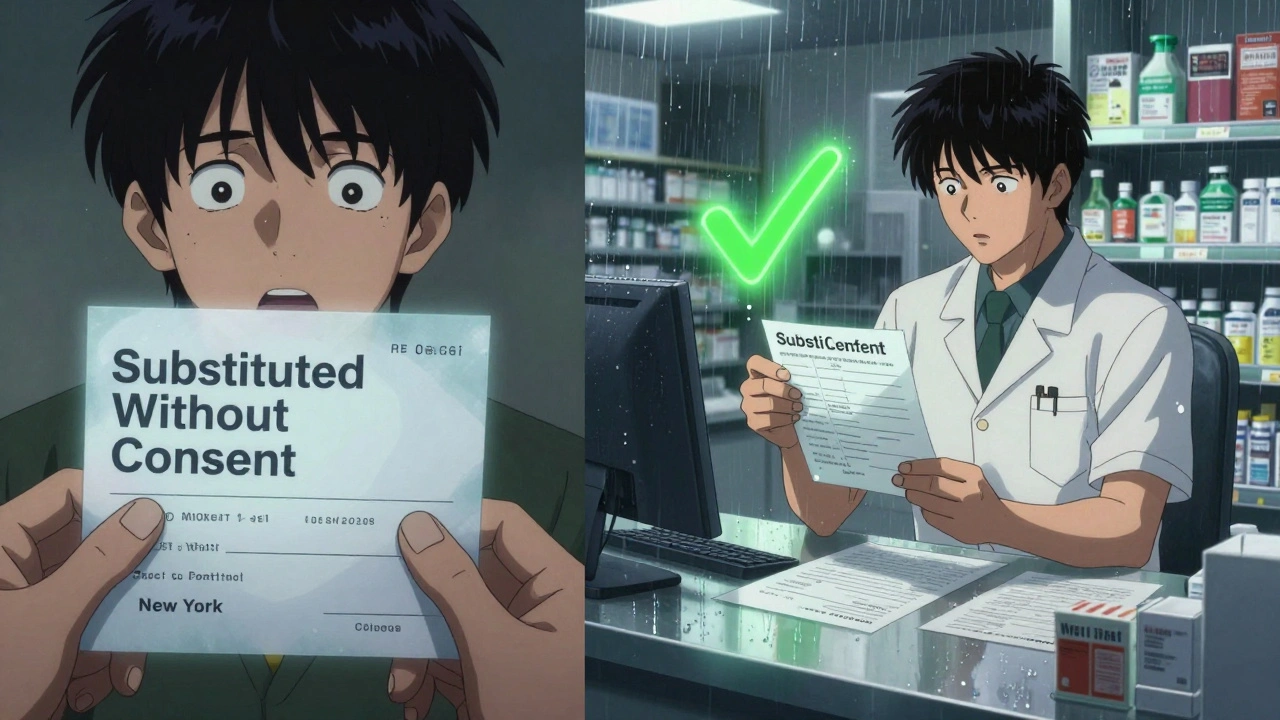
Real Impact: Numbers Don’t Lie
The differences in state laws directly affect how often generics are used. - States with mandatory substitution saw 12.3% higher generic use for statins than permissive states. - States with presumed consent had 8.7% more substitutions across nine common drug classes. Louisiana scores a 0 on the National Conference of State Legislatures’ substitution favorability scale - meaning it’s the most friendly to generics. Hawaii scores a 4 - the strictest. Oklahoma won’t allow substitution unless the prescriber or the patient specifically authorizes it. That’s rare. The result? In mandatory substitution states, 94.1% of prescriptions are filled with generics. In permissive states? Only 88.3%. That’s a 5.8% gap - and millions of dollars in savings lost.What Patients Experience
Patients aren’t always aware they’ve been switched. Some don’t care. Others notice. The FDA’s MedWatch system recorded 217 complaints between 2020 and 2022 from people who felt their meds stopped working after a switch. Most involved levothyroxine (89 cases) or warfarin (53). One Reddit user from New York said: “I live right near the New Jersey border. I fill my prescription in Jersey - automatic substitution. Then I go to my New York doctor, and they say, ‘Why did you switch?’ I didn’t even know I had.” Cancer patients are especially wary. A 2023 survey by the Life Raft Group found that 41% of them worried about substitution for NTI drugs. Nearly a third had doctors who wrote “dispense as written” on the prescription to block any substitution.What Pharmacists Deal With
Pharmacists are on the front lines. They’re expected to know the rules in 50 different states - and sometimes dozens of local regulations. A 2022 study found pharmacists spend an average of 12.7 minutes per prescription checking substitution rules. That’s time they could spend counseling patients. And it’s not just about knowing the law - it’s about knowing which state’s law applies. If a patient lives in Pennsylvania but gets a prescription from a doctor in Maryland, which rules apply? The prescribing state? The filling state? The patient’s home state? There’s no clear answer. Chain pharmacies handle 18.3% of prescriptions that cross state lines. That’s a lot of confusion. And 78% of pharmacists surveyed by the American Pharmacists Association said they’re confused when filling out-of-state prescriptions. The good news? 83% of pharmacy software now automatically checks state laws and flags potential issues. That’s cut substitution errors by 64%. But it’s still not perfect. And not every small pharmacy can afford that tech.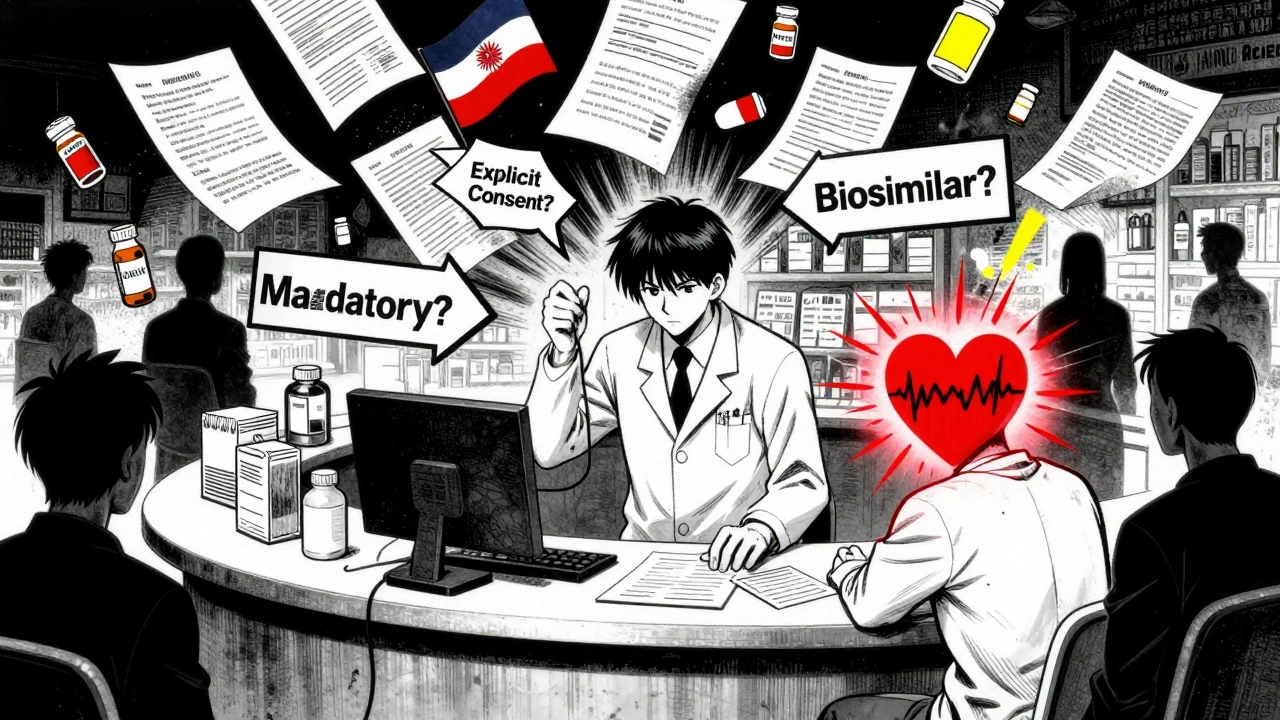
Who Benefits? Who Loses?
The biggest winners are state Medicaid programs. One analysis found mandatory substitution laws save Medicaid about $1.2 billion a year. Insurance companies and PBMs (pharmacy benefit managers) benefit too. Generic drugs now make up 92.5% of all prescriptions filled - and save $313 billion annually. But the cost isn’t just financial. There’s a risk to patient safety. For people on antiepileptic drugs, thyroid meds, or blood thinners, even a small change in absorption can lead to seizures, strokes, or clots. And when patients don’t understand why they were switched - or worse, when they’re switched without knowing - trust in the system erodes. Some states have responded by creating their own lists of drugs that can’t be substituted - even if the FDA says they’re equivalent. Kentucky, for example, bans substitution for digitalis glycosides and certain epilepsy drugs. California has its own NTI list. The FDA says all Orange Book-listed generics are therapeutically equivalent. But doctors and patients don’t always believe that.What’s Next?
The system is broken - not because it doesn’t work, but because it’s too messy. The Uniform Law Commission drafted a model bill in 2023 to standardize biosimilar substitution rules across states. It’s a step toward clarity. But change is slow. Some states want more control. Others want less. Patient advocacy groups are pushing for stricter rules for NTI drugs. Pharmacists want one set of rules they can learn once. And the federal government? It’s watching, but not stepping in. The bottom line: generic substitution is saving billions - but it’s also creating a patchwork of rules that confuse patients, burden pharmacists, and put some people at risk. Until there’s a national standard - or at least better communication - this system will keep working, but never quite smoothly.What You Should Do
- If you’re a patient: Ask your pharmacist if your prescription was switched. If you’ve had side effects after a switch, tell your doctor. Write “dispense as written” on your prescription if you want to avoid substitution.
- If you’re a pharmacist: Use your software’s state-check tool. Document every refusal. Know your state’s NTI list. And don’t assume a patient knows what’s happening.
- If you’re a provider: Be specific. Don’t just write “generic OK.” Write “dispense as written” if you’re concerned. Or write “substitution allowed” if you’re not. Clarity saves time - and lives.
Generic drugs are a win for the system. But the rules around them? They’re still stuck in 1984. It’s time to update them - for everyone’s sake.
Stephanie Bodde
December 5, 2025 AT 07:02Just had my levothyroxine switched last week and I swear I felt like a zombie for 3 days 😩 My doctor didn’t even know it happened until I told them. Why do they do this without asking??
Jimmy Jude
December 6, 2025 AT 21:48Oh wow, so now we’re trusting pharmacists to play God with our life-saving meds? 🤡 Next they’ll be deciding if we need coffee or not. This isn’t healthcare-it’s a lottery where the house always wins. And don’t even get me started on how the FDA just shrugs and says ‘they’re equivalent.’ Equivalent? My grandma’s cat has more consistency than these generics.
Mark Ziegenbein
December 7, 2025 AT 14:58The entire regulatory architecture surrounding generic substitution is a grotesque parody of federalism in action. Each state acting as its own micronation with arbitrary pharmacological sovereignty creates not efficiency but chaos. The FDA’s Orange Book is a scientifically rigorous document, yet 13 states refuse to recognize it as binding. This isn’t patient protection-it’s bureaucratic narcissism masquerading as caution. The real tragedy is that the cost of this fragmentation isn’t borne by legislators but by the elderly, the chronically ill, and the underinsured who are left navigating a labyrinth of state-specific consent forms, label ambiguities, and pharmacist ignorance. We’ve turned healthcare into a geography quiz.
Juliet Morgan
December 8, 2025 AT 01:51Ugh I feel you Stephanie 😔 I had the same thing with warfarin. My pharmacist didn’t even tell me they switched it until I asked. I’m so glad I started writing ‘dispense as written’ on every script. It’s saved me so much stress. If you’re feeling off after a switch, don’t ignore it. Your body knows.
Norene Fulwiler
December 8, 2025 AT 11:52As someone who grew up in Hawaii, I can tell you-our rules aren’t just strict, they’re personal. My aunt with epilepsy had to sign a notarized form just to switch her meds. It’s annoying, yeah, but after seeing someone have a seizure because of a ‘safe’ switch, I get it. Sometimes slow is safer. And yeah, the paperwork sucks-but it’s not red tape, it’s a lifeline.
William Chin
December 8, 2025 AT 17:21It is imperative that the American public be made aware that the current state-by-state regulatory framework for generic drug substitution constitutes a fundamental failure of intergovernmental coordination. The absence of a unified national standard is not merely inconvenient-it is a public health liability of alarming proportions. I urge all stakeholders to petition Congress for immediate federal preemption under the Commerce Clause.
Ada Maklagina
December 9, 2025 AT 07:20My pharmacy just auto-switches everything. I never read the slip. I just take the pill. If it works, it works. If it doesn’t, I go back. Simple.
Harry Nguyen
December 10, 2025 AT 21:55Of course the left-wing bureaucrats in New York want mandatory substitution. More pills for less money. Classic socialist healthcare. Meanwhile, real Americans who actually pay for their meds are getting screwed by cheap knockoffs made in China. FDA says it’s fine? Yeah, and the FDA also said vaping was safe in 2015. Wake up.
Deborah Jacobs
December 12, 2025 AT 12:50Let me tell you about my cousin who takes phenytoin-he’s been on the same brand for 15 years. One month, the pharmacy switched it without telling him. He had a seizure in the middle of a grocery store. They rushed him to the ER. Turns out, the generic had a different filler that changed how his body absorbed it. He’s fine now, but his trust in the system? Gone. This isn’t about saving a buck-it’s about not killing people with paperwork.
Michael Dioso
December 14, 2025 AT 12:42You guys are overthinking this. The FDA approves these generics. End of story. If your body can’t handle a pill that’s chemically identical, maybe your body’s the problem. Stop being a hypochondriac. Also, if you don’t want generics, pay for the brand name. No one’s holding a gun to your head. And for the love of god, stop writing ‘dispense as written’ like it’s a magic spell. It’s not a movie.