
Strep Throat: How to Diagnose, Treat with Antibiotics, and Know When You're Recovering
 Dec, 9 2025
When your throat suddenly feels like sandpaper and your fever spikes without warning, it’s easy to assume it’s just a cold. But if you’ve got a sore throat with no cough, swollen tonsils with white patches, and a fever over 100.4°F, you might be dealing with strep throat-a bacterial infection caused by Streptococcus pyogenes, also known as Group A Streptococcus. Unlike viral sore throats, strep doesn’t go away on its own. Left untreated, it can lead to serious complications like rheumatic fever, which damages heart valves and affects over 300,000 children globally each year.
How Doctors Tell Strep Throat from a Cold
| Sign or Symptom | Strep Throat | Viral Sore Throat |
|---|---|---|
| Onset | Sudden, often overnight | Gradual, over a few days |
| Cough | Absent (90% specificity) | Common |
| Fever | Usually above 100.4°F (38°C) | Mild or absent |
| Tonsil Exudate | White patches or pus common | Rare |
| Cough or Runny Nose | Not present | Very common |
| Swollen Lymph Nodes | Tender, noticeable in neck | Mild or absent |
| Conjunctivitis | Not associated | Possible |
Doctors use a tool called the Centor criteria to quickly estimate your chances of having strep. You get one point each for: no cough, fever over 100.4°F, swollen lymph nodes in the neck, and white patches on your tonsils. If you score 3 or higher, testing is recommended. The absence of a cough is one of the strongest clues-when you have a cough, it’s almost never strep.
Children aged 3 to 9 are most at risk, making up 15-30% of all sore throat cases in this group. Adults get it too, but only 5-15% of adult sore throats are bacterial. Kids under 3 almost never get strep-your toddler’s sore throat is almost certainly viral.
Testing: Rapid Test, Culture, or PCR?
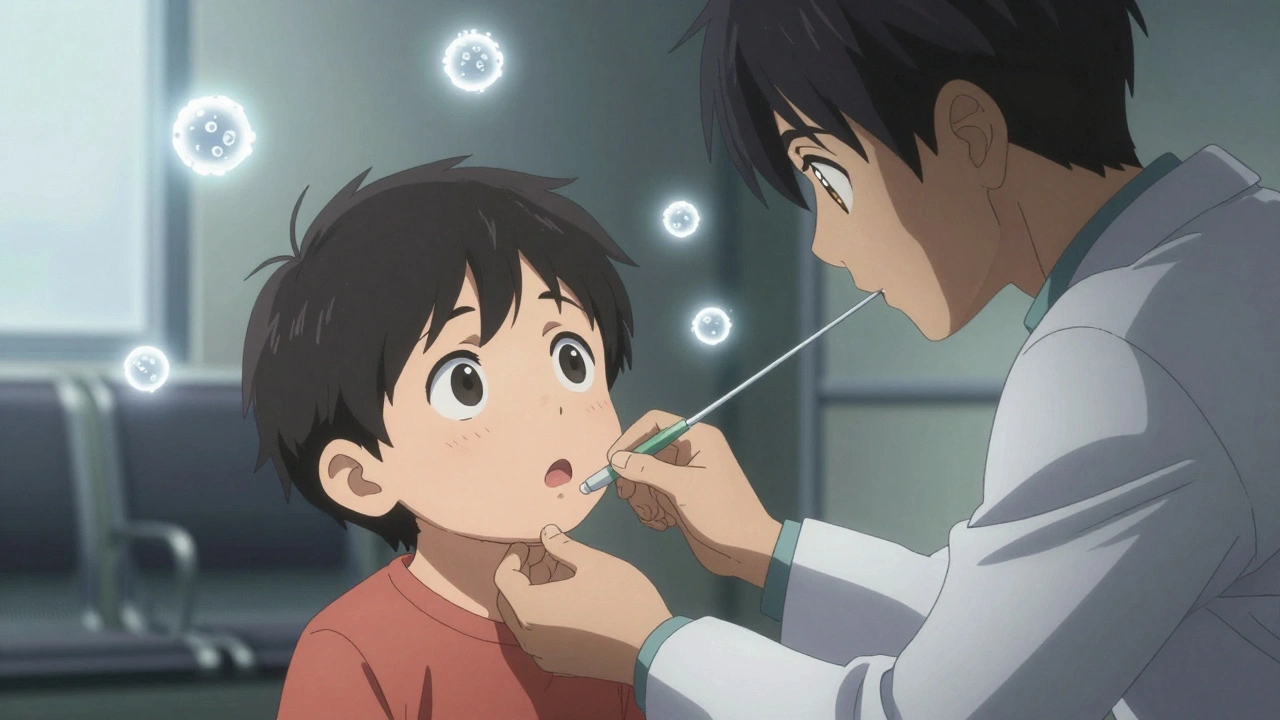
There’s no way to tell for sure just by looking. You need a test. The most common is the rapid antigen detection test (RADT). A swab from your throat is checked for strep bacteria, and you get results in 10 to 30 minutes. It’s fast, but not perfect. It catches 85-95% of cases, meaning about 1 in 10 tests can be false negatives.
That’s why, especially in children and teens, a negative rapid test is followed by a throat culture. The culture takes longer-18 to 48 hours-but it’s the gold standard, catching 90-95% of infections. If your child has strep symptoms and the rapid test is negative, the culture will confirm or rule it out.
More clinics are now using PCR tests, which are even more accurate (95-98% sensitivity). They’re faster than cultures but slower than rapid tests, usually taking 24 to 48 hours. In 2024, the FDA approved a new rapid molecular test called Strep Ultra, with 98% sensitivity and results in 15 minutes. It’s starting to replace older rapid tests in urgent care centers and hospitals.
Adults with low Centor scores (0-2) and no risk factors may not need testing at all. The European Society of Clinical Microbiology says clinical judgment is enough for low-risk adults. But in the U.S., the CDC recommends testing everyone with symptoms to prevent complications.
Antibiotics: What Works, What Doesn’t
Strep throat is treated with antibiotics. Not to make you feel better faster (though they help)-but to stop the spread, prevent serious complications, and reduce the chance of relapse.
The first-line treatment? Penicillin V or amoxicillin. Both are cheap, effective, and have been used for over 70 years. For adults, it’s 500 mg twice a day for 10 days. For kids, it’s 250 mg twice a day. Amoxicillin is often preferred for children because it tastes better and can be given once a day.
If you’re allergic to penicillin, options include cephalexin, clindamycin, or azithromycin. But here’s the catch: azithromycin is only 85-90% effective. Resistance to macrolides like azithromycin is rising-up to 15% in some areas. Clindamycin resistance is also creeping up, especially in communities with high antibiotic use.
Antibiotics cut your contagiousness by 80% within 24 hours. That’s why you can go back to school or work after one full day on antibiotics-as long as your fever is gone. Without antibiotics, you stay contagious for up to two weeks.
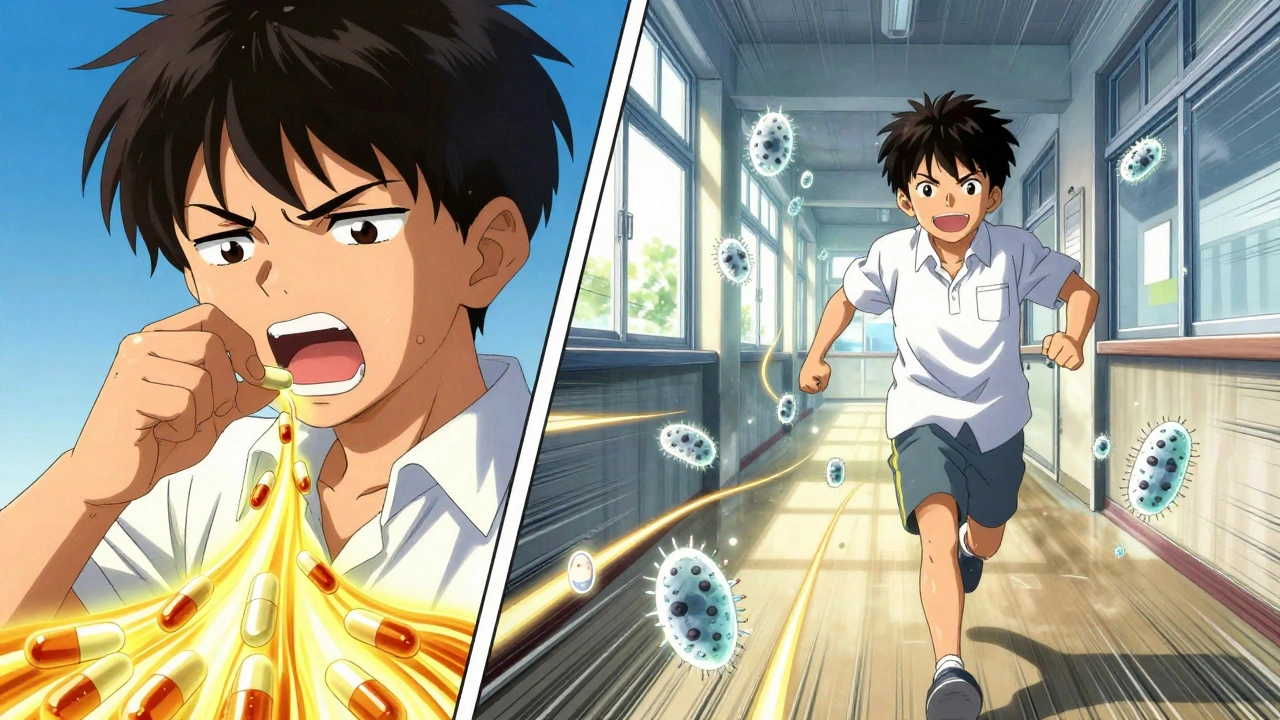
But here’s the biggest mistake people make: stopping antibiotics early. About 40% of parents stop giving them once the child feels better. That’s dangerous. Incomplete treatment leads to relapse in 5-15% of cases. It also increases the risk of rheumatic fever and helps bacteria become resistant. Studies show 95% compliance = 99% eradication. Partial compliance? Only 85% success.
Recovery Timeline: What to Expect
With antibiotics, most people start feeling better within 24 to 48 hours. The throat pain eases, the fever drops, and swallowing gets easier. But don’t confuse feeling better with being cured.
- Day 1-2: Fever and pain begin to improve. You’re no longer contagious after 24 hours of antibiotics.
- Day 3-5: Most symptoms are gone. Tonsils may still look red or swollen, but that’s normal.
- Day 6-10: Full recovery. You should finish your entire antibiotic course-even if you feel 100%.
Without treatment, symptoms last 7 to 10 days. You’re contagious the whole time. And while you might recover on your own, you’re risking complications like peritonsillar abscess (a pus-filled pocket near the tonsil), which happens in 1-2% of untreated cases.
If your symptoms don’t improve after 48 hours on antibiotics, or if they get worse-new fever, difficulty swallowing, swelling in the neck-you need to be rechecked. That could mean a complication, or maybe it wasn’t strep at all.
Common Mistakes and Hidden Risks
Many people think: "I had strep last year, I know what it is." But strep doesn’t give you immunity. You can get it again. And you can’t treat it with leftover antibiotics from a previous illness. That’s a major contributor to resistance.
One in 12 adults admits to using leftover antibiotics for a new sore throat, according to the CDC. And 8% of adults on Reddit’s health forums admitted to sharing antibiotics with family members. That’s not just unsafe-it’s illegal in many places.
Some cases are sneaky. Kids might complain of stomach pain or headaches instead of a sore throat. Adults might feel fatigued or have a rash. These atypical symptoms delay diagnosis by days.
And then there’s the cost. A penicillin prescription can cost as little as $4. Azithromycin? Up to $250. But the real cost is in complications. Rheumatic fever treatment can run into tens of thousands of dollars. Preventing it with a $4 antibiotic is the smartest health decision you’ll make this year.
What’s Changing in 2025?
Doctors are now testing whether a 5-day antibiotic course works as well as the standard 10-day one. Early results from a major U.S. trial (NCT05678901) suggest it might, especially for adults. If confirmed, guidelines will change.
Point-of-care PCR testing is becoming more common in urgent care centers. By 2026, nearly half of these clinics may use it. That means faster, more accurate results without the wait.
But there’s no vaccine yet. Scientists have been trying for decades. The problem? There are over 200 different strains of Group A Streptococcus. The M-protein vaccine in Phase II trials struggles to cover them all.
For now, the best defense is accurate diagnosis and full antibiotic treatment. Don’t skip the test. Don’t stop the pills. And don’t guess.
When to Call the Doctor
- Fever lasts more than 48 hours after starting antibiotics
- Difficulty swallowing or breathing
- Swelling in the neck or jaw
- Red rash that feels like sandpaper (could be scarlet fever)
- Symptoms return after you finish antibiotics
If you’re unsure, get it checked. Strep throat is simple to treat-if you catch it early. But it’s dangerous if ignored.
Can you get strep throat without a fever?
Yes, but it’s rare. Fever is present in about 85% of confirmed cases. If you have a sore throat with no fever, it’s more likely viral. However, some adults-especially older or immunocompromised people-may not develop a high fever even with strep. Always get tested if you have other key signs like white patches on tonsils or swollen lymph nodes.
Is strep throat contagious after 24 hours of antibiotics?
No. Once you’ve taken antibiotics for a full 24 hours and your fever is gone, you’re no longer contagious. That’s why kids can return to school after one day on medication. But don’t stop the pills early-just because you’re not contagious doesn’t mean the infection is gone.
Can you have strep throat and a cough?
Almost never. A cough is a sign of a viral infection like a cold or flu. If you have a sore throat and a cough, it’s unlikely to be strep. The absence of cough is one of the most reliable indicators-90% specific for bacterial strep throat. If you have both, test for viruses instead.
Why do I still feel tired after finishing antibiotics?
It’s normal. Your body spent energy fighting infection, and recovery takes time. Fatigue can linger for a few days after the sore throat is gone. But if you’re still feverish, have swollen glands, or feel worse after finishing the course, you may have a secondary infection or incomplete treatment. See your doctor.
Can strep throat come back after treatment?
Yes, if you didn’t finish your antibiotics. Relapse happens in 5-15% of cases when treatment is stopped early. It can also happen if you’re re-exposed to someone still contagious. Strep doesn’t give lifelong immunity, so you can get it again-even after successful treatment. Always complete the full course to prevent this.
Are there natural remedies that cure strep throat?
No. Honey, salt water gargles, and herbal teas can soothe symptoms, but they don’t kill the bacteria. Only antibiotics can prevent complications like rheumatic fever. Relying on natural remedies alone is risky. If you suspect strep, get tested and treated properly.
How do I know if I need a throat culture after a negative rapid test?
Children and teens with symptoms and a negative rapid test should always get a culture. Adults with low risk (low Centor score, no fever, no swollen nodes) usually don’t need one. But if you’re a parent, teacher, or healthcare worker, or if symptoms persist, ask your doctor. False negatives are more common in younger kids because they carry fewer bacteria.
George Taylor
December 10, 2025 AT 09:53ian septian
December 12, 2025 AT 01:40Chris Marel
December 12, 2025 AT 14:32Evelyn Pastrana
December 14, 2025 AT 06:48Carina M
December 15, 2025 AT 17:10William Umstattd
December 16, 2025 AT 04:52Elliot Barrett
December 17, 2025 AT 18:04Angela R. Cartes
December 18, 2025 AT 03:04