
Tendinopathy Treatment: Eccentric Training vs. Injections Guide
 Jun, 13 2026
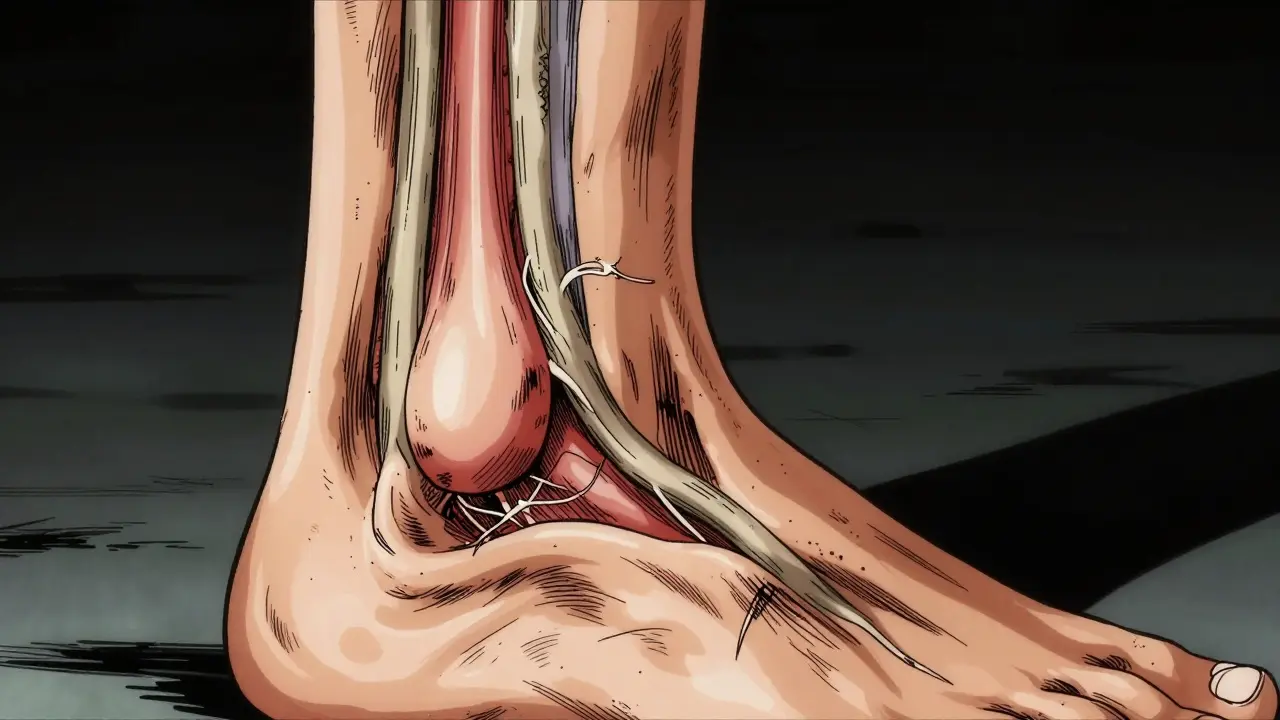
That sharp pain at the back of your heel or just below your kneecap isn't just 'getting older.' It is tendinopathy, a degenerative condition where your tendons lose their structural integrity, causing swelling and impaired performance. For decades, doctors treated this with rest and ice, but that approach often fails because it doesn't address the root cause: the tendon's inability to handle load. Today, the conversation has shifted dramatically toward active rehabilitation. You are likely standing at a crossroads between two popular paths: eccentric training, a specific type of exercise protocol, or injection therapies like corticosteroids and platelet-rich plasma (PRP). This guide breaks down exactly how these treatments work, what the latest research says about their effectiveness, and which option might actually get you back to running, jumping, or living pain-free.
Understanding the Tendon Continuum
Before choosing a treatment, you need to understand what is happening inside your tendon. Tendinopathy is not simply inflammation; it is a failure of the tendon to adapt to the loads placed upon it. Think of your tendon as a rope. Over time, due to repetitive stress or sudden increases in activity, the fibers within that rope begin to fray and disorganize. This process was first systematically described in medical literature in the late 20th century, evolving from the term "tendinitis" (which implies inflammation) to "tendinopathy" (which implies structural change).
The most common sites for this issue are the Achilles tendon and the patellar tendon. According to the American College of Sports Medicine, approximately 30% of all sports medicine consultations involve some form of tendinopathy. The key insight here is that pain does not always equal damage. Dr. Jill Cook, a leading professor at Monash University, developed the "tendon continuum model," which suggests that patients exist on a spectrum from reactive tendinopathy (acute irritation) to degenerative tendinopathy (structural changes). Your treatment choice depends heavily on where you fall on this continuum. If you are in the early stages, load management is key. If you have chronic structural changes, you need mechanical stimulus to remodel the tissue.
Eccentric Training: The Gold Standard for Remodeling
Eccentric training involves lengthening the muscle under tension. Unlike concentric exercises (where you lift a weight up), eccentric exercises focus on the lowering phase. This creates high levels of mechanical tension within the tendon, which stimulates tenocytes-the cells responsible for producing collagen-to realign and strengthen the tissue. This method became famous after Alfredson et al. published their seminal protocol for Achilles tendinopathy in 1998, showing significant improvements where other treatments had failed.
Here is how the protocols typically break down by tendon site:
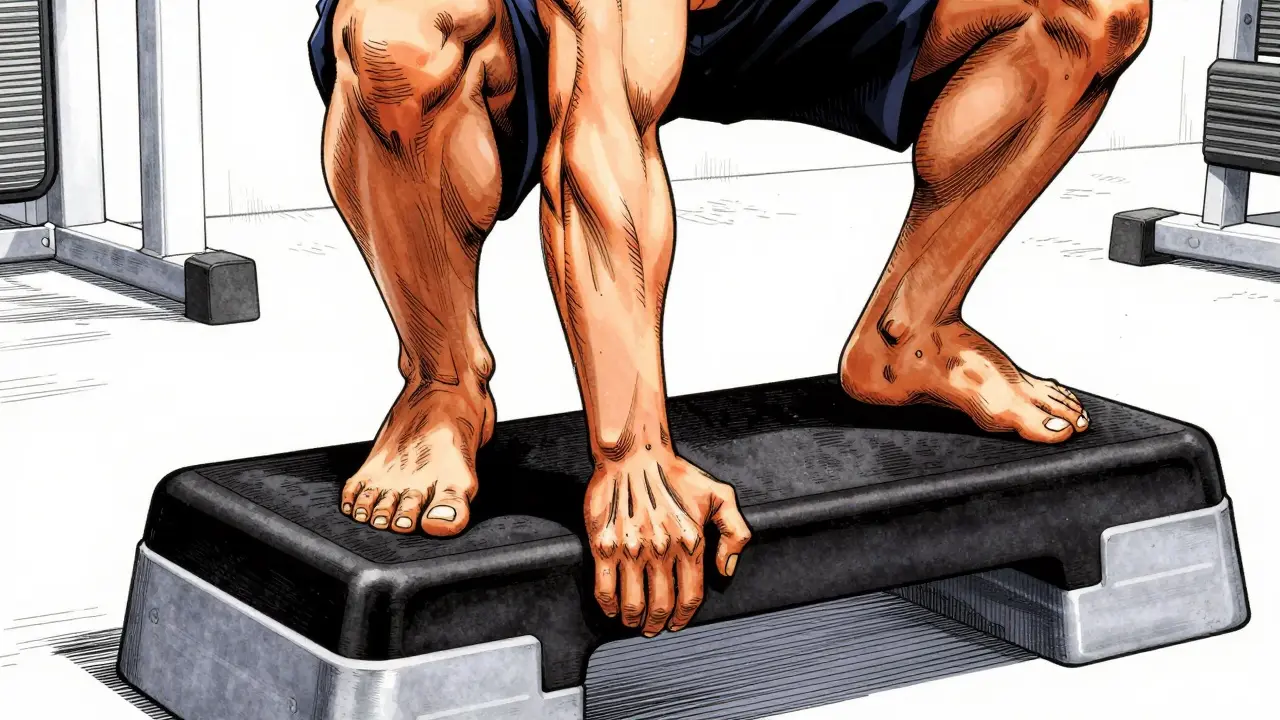
- Achilles Tendinopathy: The classic Alfredson heel-drop method involves 3 sets of 15 repetitions twice daily. You perform these on a step, lowering your heel slowly over 3-5 seconds. To target the gastrocnemius (upper calf), keep your knee straight. To target the soleus (lower calf), bend your knee slightly. Rest for 60-90 seconds between sets.
- Patellar Tendinopathy: Single-leg decline squats are the standard. Using a board set at a 25-degree decline, you lower yourself slowly for 3-5 seconds. Perform 3 sets of 15 repetitions daily.
Biomechanical studies using ultrasound tissue characterization show that effective eccentric training increases tendon stiffness by 15-20% and improves collagen alignment. However, there is a catch: it hurts initially. About 68% of patients report high pain levels during the first two weeks. This is known as "acceptable pain" if it stays between 2-5 out of 10 on a visual analog scale (VAS) and settles down within 24 hours. If pain exceeds 7/10 or lasts longer than a day, you are pushing too hard.
Heavy Slow Resistance (HSR): A Viable Alternative
If the idea of doing hundreds of slow reps sounds tedious, you might consider Heavy Slow Resistance (HSR) training. A pivotal 2015 study by Beyer et al., published in the *Journal of Orthopaedic & Sports Physical Therapy*, compared HSR directly against eccentric training for Achilles tendinopathy. The results were striking: both groups showed equivalent outcomes, with 60-65% improvement in Victorian Institute of Sports Assessment (VISA-A) scores after 12 weeks.
HSR involves lifting heavier weights (around 70% of your one-repetition maximum) but moving very slowly-3 seconds up, 3 seconds down. You perform 3 sets of 15 repetitions three times a week, rather than twice daily. Why do many patients prefer HSR? Adherence. The same study found that 87% of people stuck with HSR, compared to only 72% who completed the eccentric protocol. The reason is simple: HSR causes less initial pain. If you struggle with consistency, HSR might be the better path to long-term recovery.
| Feature | Eccentric Training | Heavy Slow Resistance (HSR) |
|---|---|---|
| Frequency | Twice daily | Three times weekly |
| Intensity | Bodyweight/Light Load | Heavy Load (~70% 1RM) |
| Initial Pain | High (reported by 68%) | Moderate to Low |
| Adherence Rate | 72% | 87% |
| Best For | Patient compliance with frequent low-load work | Gym-goers preferring heavy lifting |
Injection Options: Quick Relief vs. Long-Term Risk
When pain prevents you from exercising, injections become tempting. They offer a quick fix, but the science warns against relying on them as a primary solution. There are two main types: Corticosteroid injections and Platelet-Rich Plasma (PRP).
Corticosteroids provide powerful anti-inflammatory effects. They can reduce pain by 30-50% within four weeks. However, this relief is often short-lived. A landmark 2013 study in the *BMJ* by Coombes et al. found that while steroid injection patients felt better initially, 65% required additional intervention at six months. In contrast, only 35% of those who did eccentric training needed further help. Worse, steroids can weaken tendon structure, increasing the risk of rupture if you return to sport too quickly.
PRP injections involve drawing your own blood, spinning it to concentrate platelets, and injecting those growth factors into the tendon. The theory is appealing: use your body’s natural healing agents to repair damage. Yet, a 2020 systematic review in the *American Journal of Sports Medicine* found that PRP offered only a 15-20% greater improvement over placebo at six months. Most experts agree this margin is too small to justify the cost and discomfort of routine clinical use, especially when exercise-based treatments show superior long-term results.
The Role of Isometrics for Immediate Pain Relief
You cannot build strength if you are in too much pain to move. This is where Isometric exercises come in. Unlike eccentrics, which involve movement, isometrics hold a static position. Rio et al.’s 2015 crossover study demonstrated that isometric holds provide superior immediate pain relief, reducing pain by 50% within 45 minutes. Eccentric exercises, by comparison, only reduced pain by 20% in the short term.
Use isometrics as a pre-hab strategy. Before you start your eccentric or HSR session, perform 5 sets of 45-second isometric holds. For the Achilles, this might mean standing on a step and holding your heels off the ground. For the patella, try a wall sit. This "analgesic effect" allows you to tolerate the loading exercises that actually rebuild the tendon. It bridges the gap between pain and progress.
Implementation Strategy: How to Succeed
Knowing the protocol is one thing; sticking to it is another. Here is a practical roadmap to ensure you get results without setting yourself back.
- Get a Professional Assessment: Self-managed patients have a 40% higher error rate in technique, according to a 2021 BMC Sports Science study. Work with a physical therapist for the first 1-2 sessions to master form. Proper alignment ensures the load goes into the tendon, not the joint.
- Monitor Pain Carefully: Use the VAS scale. Pain during exercise should be no more than 5/10. If your morning pain is worse than yesterday, you overloaded the tendon. Reduce volume or intensity by 10-20%.
- Be Patient: Structural changes take time. Ultrasound scans show measurable improvements in collagen alignment only after 8-12 weeks of consistent training. Do not quit after two weeks because it still hurts.
- Use Technology: Apps like Tendon Rehab (version 3.2) have shown an 85% adherence rate over 12 weeks, compared to 65% with paper logs. Real-time feedback helps maintain consistency.
- Address Load Management: Dr. Neal Barton warns that focusing solely on eccentric loading can overshadow overall load management. Ensure your daily activities, work posture, and other sports are not constantly irritating the tendon.
Future Directions: Precision Rehabilitation
The field of tendinopathy management is evolving. The future lies in "precision rehabilitation," where biomarkers and individualized dosing replace one-size-fits-all protocols. Current trials, such as NCT05969652, are comparing HSR versus eccentric training for rotator cuff tendinopathy, expanding our knowledge beyond the lower limb. Researchers are also exploring molecular approaches, including tenocyte-activating peptides, though these are still in early phases.
For now, the consensus remains clear: mechanical loading through eccentric or heavy slow resistance training is the cornerstone of treatment. Injections may have a role in managing acute flare-ups to allow exercise to begin, but they are not a cure. By understanding the biology of your tendon and committing to a structured, patient-driven program, you can restore function and return to the activities you love.
How long does it take for eccentric training to work for Achilles tendinopathy?
Significant structural changes and symptom relief typically require a minimum of 12 weeks of consistent training. While some pain reduction may occur earlier, ultrasound studies show that collagen realignment and increased tendon stiffness become measurable after 8-12 weeks. Patients should expect initial pain exacerbation in the first 2-3 weeks before seeing sustained improvement.
Are corticosteroid injections safe for tendinopathy?
Corticosteroid injections provide short-term pain relief (30-50% reduction at 4 weeks) but carry risks. Research indicates they can weaken tendon structure and increase rupture risk if loaded too soon. Furthermore, long-term outcomes are inferior to exercise therapy, with 65% of injection patients requiring additional intervention at 6 months compared to 35% in exercise groups. They are generally not recommended as a first-line treatment.
What is the difference between eccentric training and Heavy Slow Resistance (HSR)?
Eccentric training focuses on the lowering phase of movement, usually performed with bodyweight or light loads twice daily. HSR uses heavier weights (approx. 70% of 1-repetition max) with slow concentric and eccentric phases, performed three times weekly. Studies show both produce similar clinical outcomes, but HSR often has better patient adherence due to lower initial pain and less frequent sessions.
Can I do eccentric exercises if I am in severe pain?
If pain is severe (>7/10), direct loading may aggravate the condition. Start with isometric exercises, which provide immediate pain relief (up to 50% reduction within 45 minutes). Once pain is manageable, introduce eccentric or HSR exercises gradually, keeping exercise-related pain below 5/10 on the VAS scale. Consult a physical therapist to tailor the progression to your pain tolerance.
Is Platelet-Rich Plasma (PRP) effective for tendon repair?
Current evidence suggests PRP offers only marginal benefits over placebo. A 2020 systematic review found only 15-20% greater improvement at 6 months compared to saline injections. Given the cost and invasive nature of PRP, most guidelines recommend prioritizing evidence-based exercise protocols like eccentric training or HSR, which show superior long-term functional outcomes.