
The Purple Book: Understanding Biosimilars and Interchangeability from the FDA
 Dec, 24 2025
The Purple Book isn’t a novel you read for fun-it’s the FDA’s official, searchable database that tells you exactly which biological drugs are approved, which ones are biosimilars, and which ones can be swapped out like generics. If you’re a pharmacist, a doctor, or even a patient trying to understand why your insulin prescription changed, this is the document that holds the answers.
What Exactly Is the Purple Book?
The Purple Book is the U.S. Food and Drug Administration’s living database of all licensed biological products. It includes reference biologics-the original, brand-name drugs-and their biosimilar and interchangeable copies. Before 2020, this information was split across two separate lists, making it confusing to navigate. Now, it’s one clean, searchable tool updated in real time.
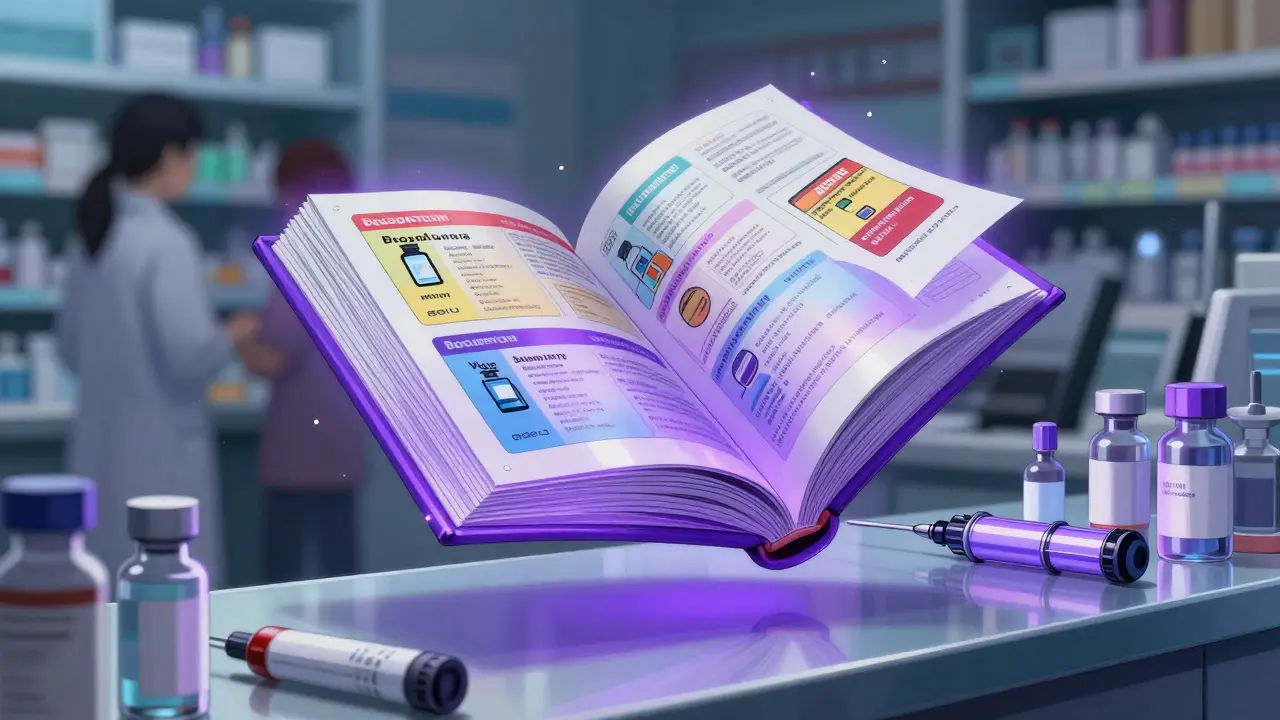
Think of it like a phone book for biologics. Instead of listing names and numbers, it lists drug names, approval dates, whether a product is biosimilar or interchangeable, and what it’s approved to replace. It doesn’t just list products-it shows relationships. If you search for Humira, you’ll see every biosimilar that’s been approved to copy it, grouped right under its name. The color-coded product cards make it easy: matching colors mean they’re linked to the same reference product.
Biosimilars vs. Interchangeable Biosimilars: The Key Difference
All interchangeable products are biosimilars. But not all biosimilars are interchangeable. That’s the single most important thing to understand.
A biosimilar is a biological product that’s highly similar to an already-approved reference drug. The FDA requires proof that there are no clinically meaningful differences in safety, purity, or potency. That means it works the same way, with the same side effects, and produces the same results. But here’s the catch: a biosimilar doesn’t automatically get the green light for substitution at the pharmacy counter.
An interchangeable biosimilar goes further. To earn that label, the manufacturer must prove that switching back and forth between the biosimilar and the original drug doesn’t increase risk or reduce effectiveness. That means if a patient takes the reference drug for six months, then switches to the biosimilar for six months, then switches back-their health outcomes stay the same. These are called switching studies, and they’re more complex than the standard biosimilar trials.
The FDA is clear: interchangeability doesn’t mean the drug is better. It just means you can swap it without a doctor’s permission-assuming your state allows it.
How the FDA Determines Interchangeability
Getting an interchangeable designation isn’t just about showing similarity. It’s about proving predictability.
For a biosimilar to be labeled interchangeable, the company must submit data from clinical studies that show:
- Switching between the reference product and the biosimilar doesn’t lead to increased safety risks.
- There’s no drop in effectiveness when patients alternate between the two.
- The immune response remains stable across multiple switches.
This isn’t theoretical. For example, the first two interchangeable insulin products-Basaglar and Semglee-were approved after studies showed patients could switch between them and Lantus without changes in blood sugar control or adverse events. The same standard applies to drugs for rheumatoid arthritis, Crohn’s disease, and eye conditions.
As of late 2023, only seven biosimilars had earned the interchangeable label. That’s out of over 30 approved biosimilars. The bar is high because the FDA wants to be certain that pharmacists can substitute these drugs without compromising care.
State Laws Control What Happens at the Pharmacy
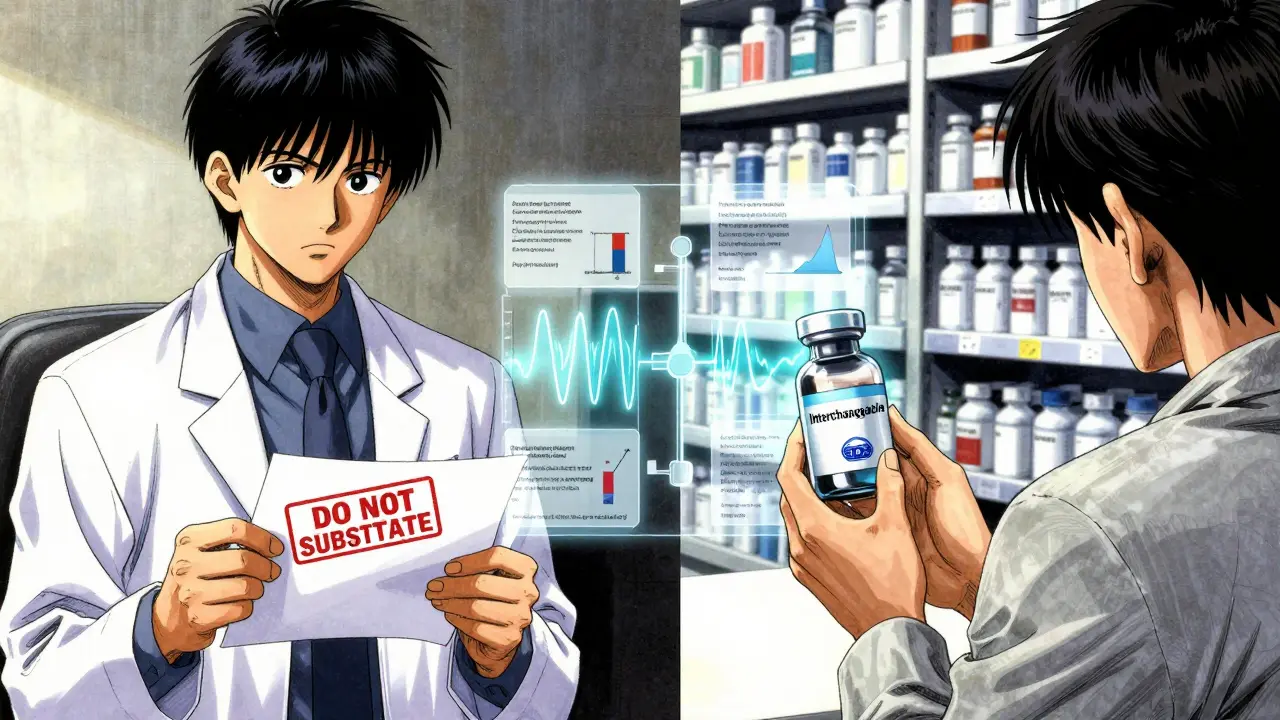
Just because the FDA says a drug is interchangeable doesn’t mean a pharmacist can automatically swap it.
Each state sets its own rules. As of 2023, 47 states and Puerto Rico allow pharmacists to substitute an interchangeable biosimilar for the prescribed reference product without contacting the doctor. But that doesn’t mean they always do.
In some states, pharmacists must:
- Notify the prescribing doctor when a substitution is made.
- Document the change in the patient’s record.
- Inform the patient that a substitution occurred.
Other states require the prescriber to specifically write “dispense as written” or “no substitution” on the prescription. And a few states still don’t allow substitution at all.
This patchwork of laws creates real-world confusion. A patient in New York might get their interchangeable biosimilar without a hitch. The same patient in California might need a new prescription just to get the same drug. The Purple Book tells you what’s federally approved-but it doesn’t tell you what your local pharmacy can do.
What the Purple Book Doesn’t Tell You
The Purple Book is precise, but it’s not complete. It doesn’t include pricing. It doesn’t tell you which biosimilars are covered by your insurance. And it doesn’t explain how to navigate the confusing labels on the packaging.
Also, don’t confuse “interchangeable” with “unbranded.” An unbranded biologic is a version of a reference product without a brand name, but it’s not necessarily a biosimilar. The FDA treats unbranded biologics as equivalent, but they don’t go through the 351(k) approval pathway. That means they’re not covered by the same interchangeability rules.
And while the Purple Book shows which products are approved, it doesn’t track how often they’re actually used. Many doctors still prescribe the original brand, even when a cheaper, interchangeable option is available-partly because of habit, partly because of misinformation.
Why the Purple Book Matters
Biologics are some of the most expensive drugs on the market. Humira, for example, cost patients and insurers over $20 billion a year before biosimilars arrived. The Purple Book is the tool that makes savings possible.
For pharmacists, it’s a quick reference to know which drugs they can swap without breaking the law. For doctors, it helps them understand what alternatives are available. For patients, it’s proof that cheaper options are safe and regulated.
It’s also a signal to manufacturers: if you want your drug to be used widely, get that interchangeable designation. The market is shifting. Companies like Pfizer, Amgen, and Sandoz are pouring resources into switching studies because they know the real win isn’t just getting approved-it’s being able to replace the brand-name drug at the pharmacy counter.

How to Use the Purple Book
Go to the FDA’s website and search for “Purple Book.” You’ll land on the searchable database. Here’s how to use it:
- Type in the brand name of a biologic-like Enbrel or Remicade.
- Look for the product card with the same color as the reference product. Those are the biosimilars.
- Check the designation: 351(a) = reference product, 351(k) Biosimilar, 351(k) Interchangeable.
- Click on the product card to see details: manufacturer, approval date, product form (autoinjector, vial, etc.), and whether it’s interchangeable.
- Use the filters to narrow results by therapeutic area or approval year.
The database is updated weekly. If a new interchangeable biosimilar gets approved, it shows up within days. That’s faster than most drug guides.
What’s Next for Biosimilars?
The number of interchangeable biosimilars is growing. More are in the pipeline-especially for diabetes, autoimmune diseases, and cancer treatments. The FDA has signaled it will continue to refine its guidance, particularly around labeling, to make sure patients and providers aren’t misled.
But progress depends on more than science. It depends on education. Many clinicians still think biosimilars are “second-rate.” The Purple Book helps correct that by showing exactly what data the FDA used to approve them.
As more biosimilars get interchangeable status, and as more states update their laws to allow substitution, we’ll see real cost savings. The goal isn’t just to lower prices-it’s to make sure patients get the right treatment, without barriers.
Is the Purple Book the same as the Orange Book?
No. The Orange Book lists approved generic drugs for small-molecule medications like aspirin or metformin. The Purple Book does the same thing-but for complex biological drugs like insulin, antibodies, and vaccines. They’re two different systems for two different kinds of medicines.
Can a pharmacist substitute a biosimilar without my permission?
Only if it’s labeled as interchangeable AND your state allows substitution. If it’s just a biosimilar (not interchangeable), the pharmacist must get your doctor’s okay. Always check your prescription label and ask your pharmacist what you’re getting.
Are interchangeable biosimilars safer than regular biosimilars?
No. Both are equally safe and effective. The interchangeable label just means the FDA has extra proof that switching between the brand and the copy won’t cause problems. It’s about predictability, not superiority.
Why aren’t more biosimilars interchangeable?
Because the clinical studies needed to prove interchangeability are expensive and time-consuming. Companies have to run multiple switching trials, which can cost tens of millions of dollars. Many manufacturers choose to get biosimilar approval first and wait to see if the market demands interchangeability.
Does the Purple Book include pricing information?
No. The Purple Book only shows regulatory status-approval date, manufacturer, and interchangeability designation. You’ll need to check with your pharmacy, insurer, or drug pricing tools like GoodRx to find out how much a drug costs.
How often is the Purple Book updated?
The FDA updates the Purple Book weekly. New approvals, label changes, and withdrawn products are added within days of the FDA’s decision. It’s the most current source for biosimilar status in the U.S.
What to Do Next
If you’re a patient: Ask your pharmacist if your biologic has an interchangeable biosimilar option. Check the Purple Book yourself to confirm the status.
If you’re a provider: Use the Purple Book to stay current on available alternatives. Don’t assume your patient’s drug hasn’t changed-new biosimilars arrive every few months.
If you’re a pharmacist: Bookmark the Purple Book. Keep a printed cheat sheet of your state’s substitution laws. And always document substitutions clearly.
The Purple Book isn’t just a government document. It’s the key to making complex, expensive drugs more accessible. The science is solid. The approvals are real. Now, it’s up to the system to catch up.
Michael Dillon
December 26, 2025 AT 01:08The Purple Book is the only reason I haven’t quit my job as a pharmacy tech. Before this, I was guessing which biosimilars were swappable and getting yelled at by patients who thought I was trying to scam them. Now I just pull up the site, show them the color-coded cards, and they calm right down. It’s not glamorous, but it’s the closest thing we’ve got to a pharmacy bible.
Winni Victor
December 27, 2025 AT 08:54Let me guess - the FDA just made this so they can pretend they’re doing something about drug prices. Meanwhile, the same companies that made Humira for $70k a year are now selling the biosimilar for $68k and calling it a win. This isn’t transparency - it’s theater with footnotes.
Gary Hartung
December 29, 2025 AT 08:34Oh, please. You call this a 'phone book'? That’s like calling the Library of Congress a 'sticky note collection.' The Purple Book is a meticulously curated, federally mandated, real-time regulatory ledger - with color-coding, no less - that represents the pinnacle of post-2010 biologics governance. It’s not just data. It’s architecture. And you? You’re just staring at the blueprint while the engineers build the future.
Justin James
December 30, 2025 AT 06:35Did you know the Purple Book was originally meant to be a secret? They only made it public after whistleblowers leaked that the FDA was letting companies skip switching studies by bribing reviewers with free golf trips to Scottsdale. The color-coding? That’s not for clarity - it’s to hide which products are actually the same chemical soup under different brand names. They want you to think it’s transparent. It’s not. It’s a smokescreen with a website.
Jason Jasper
December 31, 2025 AT 05:18I’ve used the Purple Book for three years now - mostly to explain to my elderly patients why their insulin isn’t the same box anymore. Most of them don’t care what it’s called as long as it works and costs less. The real win isn’t the database - it’s that people are finally getting cheaper meds without losing safety. Sometimes the quietest tools make the biggest difference.
Carlos Narvaez
December 31, 2025 AT 06:34Interchangeable ≠ better. Biosimilar ≠ inferior. These are facts. If you’re still prescribing Humira because you're 'used to it,' you're not being careful - you're being lazy. The data is there. Use it.
Harbans Singh
January 2, 2026 AT 02:25Coming from India, where biosimilars are the norm and not a luxury, this feels like a slow-motion revolution. Back home, we’ve had biosimilar insulin for over a decade - cheap, safe, and everywhere. The Purple Book is just the U.S. finally catching up to what the rest of the world already knew: biology doesn’t care about brand names. Only outcomes.
Terry Free
January 3, 2026 AT 10:23Wow. So the FDA spent millions to create a database so pharmacists can swap drugs without a doctor’s signature. Meanwhile, the same system lets Big Pharma charge $100k for a cancer drug that’s been around since 2003. This isn’t progress. It’s a tax on hope.
Lindsay Hensel
January 4, 2026 AT 11:39As a nurse practitioner, I’ve watched patients cry because they couldn’t afford their biologic. The Purple Book doesn’t fix that - but it gives us a tool to fight for them. When I show a patient the interchangeable designation, their shoulders drop. They finally feel seen. That’s not just data. That’s dignity.
Zabihullah Saleh
January 6, 2026 AT 07:46There’s something poetic about a purple book being the key to unlocking access to life-saving medicine. Purple has always been the color of royalty - and now, for the first time, the power to choose your treatment isn’t reserved for the wealthy. It’s in the hands of the pharmacist, the patient, the system. Maybe the FDA got one thing right.
Ben Harris
January 6, 2026 AT 17:02Wait so if my doctor writes 'dispense as written' and I live in Texas I can still get the biosimilar because the FDA says so but the state says no so the pharmacist just shrugs and gives me the expensive one anyway and then I have to go back to the doctor who doesn't care because they're already paid and now I'm out of pocket and the whole thing is just a giant bureaucratic loop designed to make everyone feel powerless
Rick Kimberly
January 6, 2026 AT 22:18Thank you for this comprehensive overview. The distinction between biosimilar and interchangeable is critical, and the regulatory nuance surrounding state-level substitution laws is often overlooked. I would recommend the FDA consider publishing a companion guide for clinicians that maps state laws by jurisdiction, as this information remains fragmented and inaccessible to many providers. This is an important step forward, but not yet sufficient.