
Urate Targets in Gout: Allopurinol and Febuxostat Strategies
 Jul, 14 2026
Imagine your joints are slowly filling with microscopic shards of glass. That is essentially what happens in gout. It is not just a sudden attack of pain; it is a chronic condition driven by high levels of uric acid in your blood. For decades, doctors treated gout like a fire alarm-silencing the noise (pain) without fixing the smoke (the underlying cause). Today, that approach has changed completely. The new standard is "treat-to-target" therapy, which focuses on lowering your serum urate levels to specific numbers to dissolve existing crystals and prevent future damage.
If you have been prescribed allopurinol or febuxostat, you might be confused about why your doctor keeps adjusting your dose or asking for frequent blood tests. You are not alone. Many patients stop taking these medications because they feel better after the first flare subsides, only to see the pain return worse than before. Understanding the exact urate targets and how these two main drugs work can change your experience from one of constant anxiety to long-term relief.
The Magic Number: Why Serum Urate Matters
To understand gout treatment, you need to understand saturation. Think of uric acid in your blood like sugar in tea. If you add too much sugar, it stops dissolving and settles at the bottom as gritty crystals. In your body, this saturation point is approximately 6.8 mg/dL (or 0.40 mmol/L). Above this level, monosodium urate crystals form in your joints, tendons, and even kidneys. Below this level, those crystals begin to dissolve.
This is why simply reducing pain is not enough. To truly cure the underlying issue, you must keep your serum urate below the saturation point. Major guidelines, including the American College of Rheumatology (ACR) 2020 guidelines and the UK's NICE Guideline NG219, agree on a universal target:
- Standard Target: Less than 6 mg/dL (360 micromol/L or 0.36 mmol/L).
- Severe Gout Target: Less than 5 mg/dL (300 micromol/L or 0.30 mmol/L) for patients with tophi (lumps under the skin), chronic joint damage, or frequent flares despite being on medication.
Why so low? Because maintaining levels below 6 mg/dL ensures that no new crystals can form. If you have visible tophi or significant joint erosion, dropping below 5 mg/dL accelerates the dissolution process. Research published in the Annals of the Rheumatic Diseases shows that keeping levels below 0.30 mmol/L reduces tophus burden by 89%, compared to 72% at the standard target. However, there is a floor. Experts warn against dropping serum urate below 3 mg/dL (180 micromol/L) because the benefits are unclear and potential risks may exist.
Allopurinol: The First-Line Standard
Allopurinol remains the most widely used drug for gout worldwide. It works by inhibiting xanthine oxidase, an enzyme that produces uric acid. It is effective, safe for most people, and incredibly cheap-often costing less than $12 per month in generic form. Despite its effectiveness, many patients fail to benefit from it because they take it incorrectly.
The biggest mistake? Starting with a high dose. Old-school prescribing often started patients at 300 mg/day. This is dangerous and ineffective for modern "treat-to-target" strategies. High initial doses can trigger severe flares and increase the risk of hypersensitivity reactions. Current guidelines recommend starting low and going slow:
- Start Low: Begin with 50-100 mg per day. If you have moderate to severe chronic kidney disease (CKD stage 3 or higher), start with 50 mg or less.
- Titrate Up: Increase the dose by 50-100 mg every 2-5 weeks based on your serum urate levels.
- Monitor Monthly: Get your blood tested monthly during titration. Studies show that monthly monitoring increases target achievement by 31% compared to quarterly checks.
- Go High if Needed: Do not stop at 300 mg. Real-world data from New Zealand shows that 30-50% of patients need doses exceeding 300 mg to reach their target. Doses up to 600-800 mg/day are safe and effective for patients with normal kidney function.
It is crucial to continue taking anti-inflammatory prophylaxis (like colchicine or NSAIDs) during this titration phase. As you lower your urate levels, existing crystals may shift, triggering flares. This is known as the "flare paradox." It does not mean the drug is failing; it means it is working. About 78% of patients report needing more than six months to reach their target levels, and nearly half require doses over 400 mg/day.
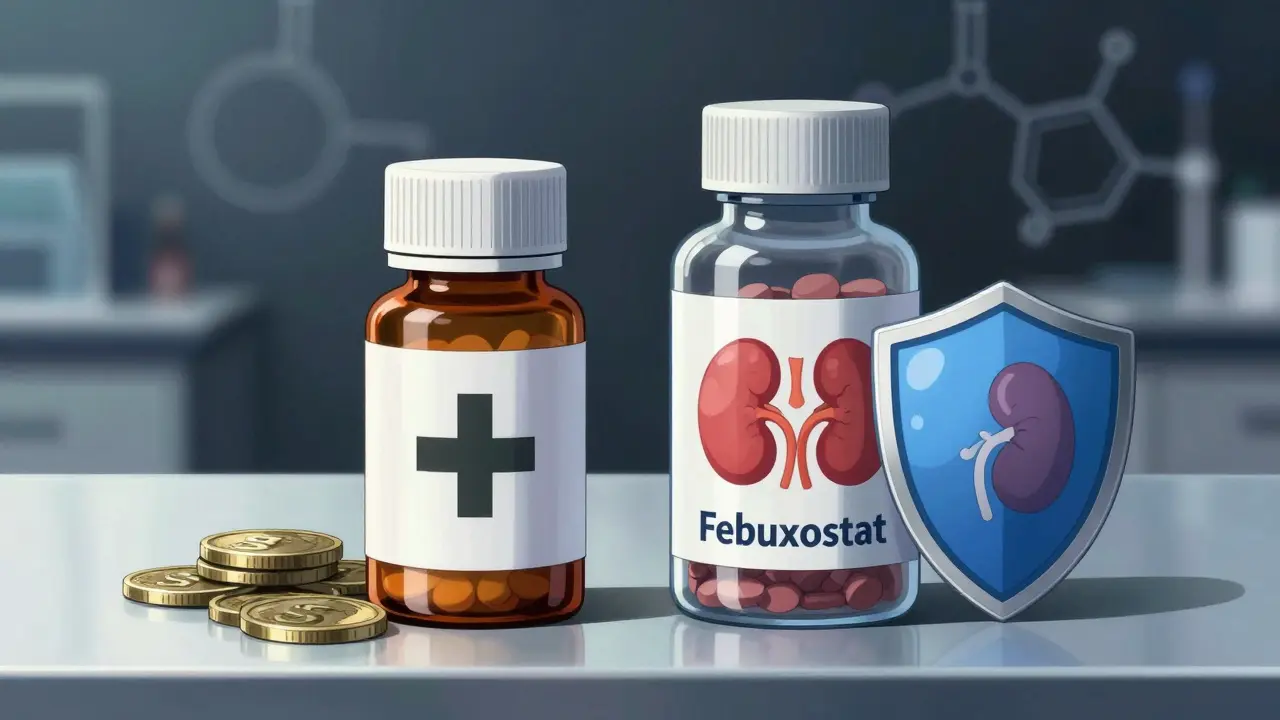
Febuxostat: The Alternative Option
When allopurinol fails or causes side effects, febuxostat steps in. Like allopurinol, it inhibits xanthine oxidase, but it is a non-purine selective inhibitor. This chemical difference matters for two groups of patients: those with kidney issues and those who had allergic reactions to allopurinol.
Febuxostat is metabolized by the liver rather than excreted by the kidneys, making it a strong option for patients with chronic kidney disease (CKD). A 2023 meta-analysis in Rheumatology found that febuxostat achieved target urate levels 15% more often than allopurinol in patients with severe CKD. Additionally, it does not share the same genetic hypersensitivity risks as allopurinol, specifically regarding the HLA-B*5801 allele, which significantly increases the risk of severe skin reactions in certain populations.
However, febuxostat comes with caveats. It is significantly more expensive-often $30-$50 per month-and carries a black box warning in some regions regarding cardiovascular risks, although recent large-scale trials have nuanced this concern. Guidelines suggest starting febuxostat at 40 mg/day and titrating to 80 mg if needed. While NICE guidelines allow it as a first-line alternative based on patient preference, the ACR strongly recommends trying allopurinol first unless contraindicated.
| Feature | Allopurinol | Febuxostat |
|---|---|---|
| Cost (US Generic) | $4-$12/month | $30-$50/month |
| Kidney Excretion | Yes (adjust dose in CKD) | No (safer in severe CKD) |
| Hypersensitivity Risk | Higher (check HLA-B*5801) | Lower |
| Target Achievement Rate | High (with proper titration) | Higher in CKD patients |
| Guideline Preference | First-line (ACR/EULAR) | Second-line or Alternative (NICE) |
Implementing Treat-to-Target Therapy
Knowing the target is only half the battle. Achieving it requires a structured partnership between you and your healthcare provider. The concept of "treat-to-dissolve," introduced in the 2023 EULAR recommendations, emphasizes that you should not relax your efforts until objective evidence shows crystal dissolution. For severe cases, this might even involve dual-energy CT scans to confirm that tophi are shrinking.
One of the biggest barriers to success is inadequate education. Many primary care providers still prescribe static doses rather than dynamic titration. If your doctor prescribes 100 mg of allopurinol and says "take this daily," ask them: "What is our target serum urate level, and when will we re-test to adjust the dose?" Without a plan to escalate the dose, you will likely remain above the 6 mg/dL threshold.
Another critical factor is adherence. Gout is a lifelong metabolic condition. Stopping medication when pain disappears allows uric acid levels to creep back up, leading to recurrent flares and permanent joint damage. Consistency is key. Take your medication at the same time every day, regardless of whether you are having a flare or feeling fine.

Common Pitfalls and How to Avoid Them
Even with the best intentions, patients stumble. Here are the most common mistakes and how to sidestep them:
- Stopping During Flares: Never stop your urate-lowering therapy (ULT) when a flare starts. Stopping causes rapid fluctuations in urate levels, which prolongs the flare. Continue your ULT and treat the inflammation separately with colchicine or steroids.
- Ignoring Kidney Function: Your kidney health dictates your dosing strategy. Regularly monitor your eGFR (estimated glomerular filtration rate). If your kidney function declines, your allopurinol dose may need adjustment to avoid toxicity, though recent guidelines suggest maintaining efficacy is priority.
- Dietary Myths: Diet plays a role, but it is minor. Even the strictest diet typically lowers serum urate by only 1-2 mg/dL. Medication is necessary to reach the <6 mg/dL target. Do not rely solely on avoiding red meat or alcohol.
- Lack of Monitoring: If you are not getting blood tests every 2-5 weeks during titration, you are guessing. Blindly increasing doses without checking levels is unsafe and inefficient.
Future Directions in Gout Care
The landscape of gout treatment is evolving. Researchers are moving toward precision medicine. The 2024 GOUT-PRO study demonstrated that genotype-guided dosing, considering polymorphisms in genes like ABCG2 and SLC22A12, increased target achievement rates from 61% to 83%. This means that in the near future, a simple genetic test could tell your doctor exactly which dose of allopurinol will work for you, eliminating the trial-and-error phase.
Newer drugs like verinurad, a uricosuric agent that helps kidneys excrete uric acid, are also in development. These may offer alternatives for patients who cannot tolerate xanthine oxidase inhibitors. Meanwhile, value-based care models, such as those implemented by Kaiser Permanente, are showing that protocol-driven management can boost target achievement rates to 67%, far surpassing the national average of 28%.
Gout is no longer a sentence of periodic agony. With clear targets, appropriate medication choices, and consistent monitoring, you can dissolve the crystals and live pain-free. The science is solid; the challenge is now in the implementation. Work closely with your rheumatologist or GP, demand regular blood tests, and remember: the number on the lab report is the true measure of your progress, not just the absence of pain.
What is the ideal serum urate level for gout?
For most patients, the target is less than 6 mg/dL (360 micromol/L). For those with severe gout, including tophi or joint damage, the target is stricter: less than 5 mg/dL (300 micromol/L). Levels should generally not fall below 3 mg/dL.
Can I switch from Allopurinol to Febuxostat?
Yes, especially if you have chronic kidney disease or experienced an allergic reaction to allopurinol. Febuxostat is often more effective in patients with reduced kidney function. However, it is more expensive and should be discussed with your doctor due to potential cardiovascular considerations.
Why do I get more flares when I start medication?
This is called the "flare paradox." As your urate levels drop rapidly, existing crystals in your joints destabilize and shed, triggering inflammation. This is a sign the medication is working. Doctors usually prescribe preventive anti-inflammatories like colchicine for the first 3-6 months to manage this.
How long does it take to dissolve gout crystals?
It varies by individual and severity. On average, it takes 6-12 months of maintaining serum urate below 6 mg/dL to see significant reduction in flares. Dissolving large tophi can take several years of sustained low urate levels.
Is diet enough to control gout?
No. Dietary changes can lower serum urate by only 1-2 mg/dL, which is rarely enough to reach the therapeutic target of <6 mg/dL. Medication is essential for long-term management and crystal dissolution.