
Where to Find Free or Low-Cost Medications at Community Clinics: A Complete Guide
 May, 18 2026
Medication costs can crush your budget before you even think about rent or groceries. If you are uninsured, underinsured, or simply earning too much for government aid but not enough to afford brand-name drugs, the standard pharmacy counter is often a dead end. You might feel stuck between skipping doses or paying out of pocket. But there is a safety net that many people miss. Community clinics are local healthcare providers that offer medical services and medications on a sliding fee scale or for free to low-income and uninsured patients. These facilities are not just places for quick check-ups; they are critical hubs for accessing essential pharmaceuticals without the sticker shock.
The reality is stark: over 30 million Americans remain uninsured, and millions more have coverage with deductibles so high they might as well be uninsured. For these individuals, chronic conditions like diabetes, hypertension, and mental health disorders require consistent medication access. Without it, small issues become emergencies. This guide breaks down exactly where to look, how to qualify, and what documents you need to secure free or low-cost medications through community health resources.
Understanding Your Options: Free Clinics vs. Federally Qualified Health Centers
Not all low-cost clinics operate the same way. Knowing the difference between a traditional free clinic and a Federally Qualified Health Center (FQHC) will save you time and help you set realistic expectations. Both serve vulnerable populations, but their funding models and eligibility rules differ significantly.
Federally Qualified Health Centers (FQHCs) are primary care providers located in underserved areas that receive funds from the Health Resources and Services Administration (HRSA) to provide care on a sliding fee scale based on income. If you walk into an FQHC, you will likely pay something, but it will be adjusted to your ability to pay. According to Healthcare.gov, patients might pay between $20 and $50 per visit depending on their income level. The key advantage here is consistency. FQHCs usually have regular hours, broader service availability, and established partnerships with local pharmacies. They are accessible through the HRSA’s Find a Health Center tool, which lists centers across every state.
On the other hand, Free and Charitable Clinics are volunteer-driven organizations that provide completely free medical care and medications to uninsured patients who earn less than 200% of the federal poverty level. These clinics often rely on donations and volunteer staff rather than federal grants. Organizations like the National Association of Free & Charitable Clinics (NAFC) represent this network. While the cost is zero, the trade-off is often limited hours-some clinics only open two evenings a week-and longer wait times for appointments, which can average four to six weeks. However, if you meet the strict income criteria, these clinics can eliminate medication costs entirely.
| Feature | Free & Charitable Clinics | Federally Qualified Health Centers (FQHCs) |
|---|---|---|
| Cost | Free (for eligible patients) | Sliding Scale ($20-$50 typical) |
| Eligibility | Uninsured, <200% Federal Poverty Level | Open to all, priority for uninsured/low-income |
| Hours | Limited (often evenings/weekends) | Regular business hours |
| Medication Source | Donations, in-house pharmacy, assistance programs | Contracted pharmacies, patient assistance programs |
| Wait Times | Longer (4-6 weeks common) | Shorter, more predictable |
How Clinics Source Free Medications
You might wonder how a clinic gives away medicine for free. The answer lies in a complex web of donations, partnerships, and assistance programs. Understanding this supply chain helps you know what to ask for when you apply.
Many free clinics do not have a full-service pharmacy on-site. Instead, they act as intermediaries. They verify your eligibility and then connect you with pharmaceutical company assistance programs. As noted in the AMA Foundation’s Free Medical Clinic Handbook, 68% of surveyed free clinics provide prescription assistance programs. These programs allow patients to receive medications directly from drug manufacturers at no cost. For example, Americares U.S. Program partners with safety-net clinics to distribute donated medicines for chronic conditions. In 2023 alone, they distributed $190 million in health programs and supplies to nearly 1,000 clinics.
Some clinics, like the Free Clinic of Powhatan in Virginia, operate an in-house pharmacy. This means they stock specific medications for common conditions like hypertension, diabetes, and asthma. If you need one of these staples, you might get them right after your appointment. For specialty drugs or newer medications, clinics often rely on targeted grants. The Community Routes program, a partnership between Direct Relief, NAFC, and Teva Pharmaceuticals, specifically funds mental health medications. This initiative provides grants to clinics in states like California, Florida, and New Jersey to ensure patients can access anxiety and depression treatments.
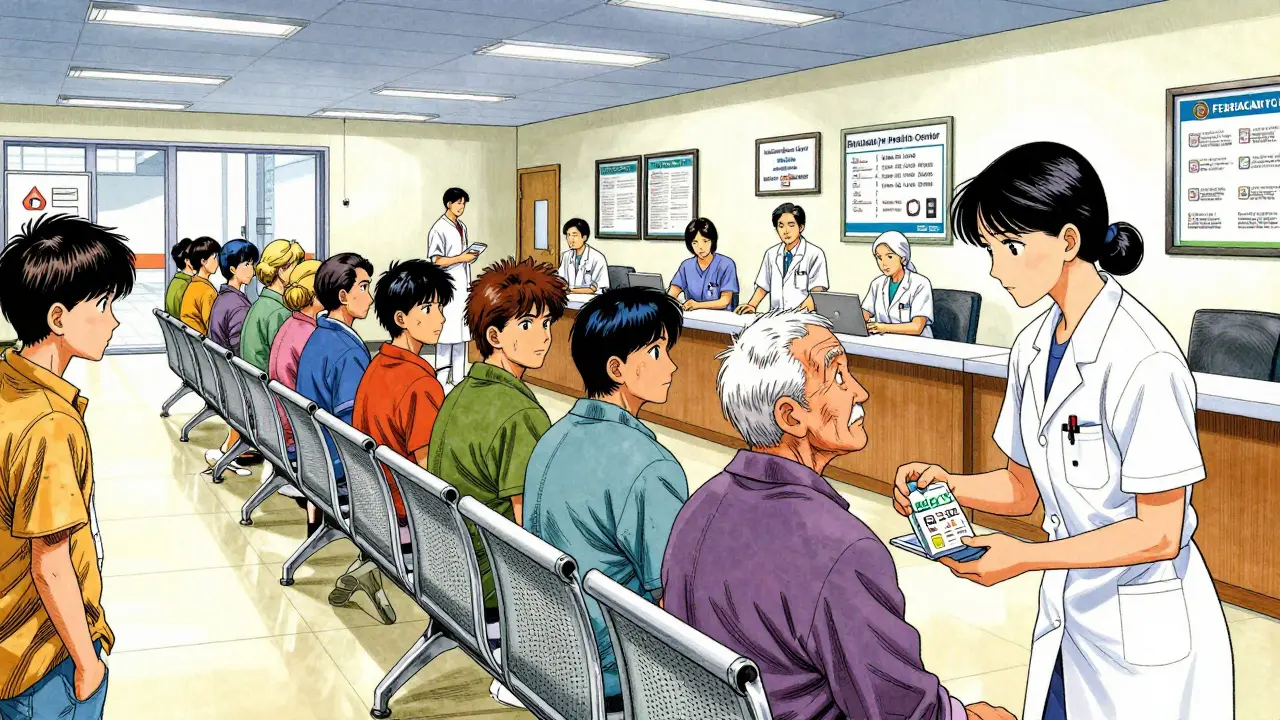
Step-by-Step Guide to Finding and Applying
Finding a clinic is easier than you might think, but applying requires preparation. Follow these steps to maximize your chances of getting approved quickly.
- Locate a Clinic Near You: Start by visiting the National Association of Free & Charitable Clinics website (nafcclinics.org). They maintain a directory of member clinics. Alternatively, use the HRSA’s Find a Health Center tool (findahealthcenter.hrsa.gov) to locate FQHCs. If you live in a state with its own association, such as the Virginia Association of Free & Charitable Clinics, check their local directory for smaller, independent options.
- Check Eligibility Criteria: Most free clinics require you to earn less than 200% of the federal poverty level. For an individual in 2023, this was approximately $29,160 annually. You must also be uninsured or have inadequate coverage. Some clinics define "underinsured" as having high deductibles or copays that prevent you from affording care. Call ahead to confirm their specific thresholds.
- Gather Documentation: Do not show up empty-handed. Clinics need proof of income and residency. Typical documents include:
- Recent pay stubs or tax returns (to prove income)
- A utility bill or lease agreement (to prove residency in the service area)
- Proof of insurance status (or lack thereof)
- A list of current medications and dosages
- Schedule an Intake Appointment: Be prepared for wait times. Many clinics are overwhelmed with demand. When you call, explain your situation clearly. Mention if you have a chronic condition that requires immediate medication management. Some clinics prioritize patients with acute needs.
- Discuss Your Medical History: During your visit, be honest about your health history. Clinics need this information to determine if you qualify for specific pharmaceutical assistance programs. Americares, for instance, focuses on long-term conditions like diabetes, heart disease, and cancer. If your condition fits their criteria, they may be able to fast-track your medication access.
Specialized Programs for Mental Health and Chronic Conditions
Mental health medications have historically been harder to find in free clinics due to higher costs and fewer donation streams. However, this is changing. The expansion of programs like Community Routes has brought anxiety and depression medications into seven new states. If you struggle with mental health issues, explicitly ask your clinic provider about these specialized grants.
For chronic physical conditions, the landscape is more established. Diabetes and hypertension medications are among the most commonly donated drugs. Pharmaceutical companies often donate near-expiry lots or excess inventory to safety-net clinics. If you manage a chronic condition, ensure your clinic knows your specific diagnosis. This allows them to target their requests to donors who specialize in those therapeutic areas.
Navigating Limitations and Setting Expectations
It is important to be realistic about what community clinics can offer. They are a lifeline, not a replacement for comprehensive insurance. One major limitation is medication availability. Because clinics rely on donations, they may not have the exact brand or formulation you prefer. You might be switched to a generic alternative. While generics are equally effective, the change can sometimes cause adjustment periods. Communicate openly with your provider about any side effects.
Another challenge is sustainability. Volunteer staffing and fluctuating donations mean that services can change overnight. A clinic that served you last month might pause operations if they lose a key donor or volunteer. To mitigate this, build relationships with multiple providers if possible. Also, keep your documentation updated. If your income changes, notify the clinic immediately, as this could affect your eligibility for future visits.
Finally, consider the geographic disparity. Rural areas often have fewer free clinics than urban centers. If you live in a rural location, you might need to travel further for care. In these cases, FQHCs might be a more reliable option due to their federal funding stability, even if they charge a small sliding-scale fee.
Do I need insurance to get free medications at a community clinic?
No, most free and charitable clinics specifically serve uninsured patients. However, some Federally Qualified Health Centers (FQHCs) accept patients with insurance but offer sliding-scale fees for those who cannot afford their copays. Always check the specific eligibility requirements of the clinic you choose.
What is the income limit for free clinic eligibility?
Most free clinics require patients to earn less than 200% of the federal poverty level. For an individual, this was approximately $29,160 in 2023. This threshold can vary slightly by clinic and state, so it is best to confirm with the specific facility.
Can I get mental health medications for free?
Yes, though access varies. Programs like Community Routes specifically fund mental health medications for anxiety and depression. Additionally, many pharmaceutical companies donate psychotropic medications to safety-net clinics. Ask your provider about available assistance programs for your specific medication.
How long does it take to get an appointment at a free clinic?
Wait times can range from a few days to several weeks. On average, NAFC reports wait times of 4-6 weeks for new patients. If you have an urgent need for medication, explain this during your intake call, as some clinics prioritize acute cases.
What documents do I need to bring to my first visit?
You typically need proof of income (pay stubs or tax returns), proof of residency (utility bill or lease), and a list of your current medications. Having these documents ready speeds up the application process and increases your chances of approval.
Are free clinics available in all states?
Yes, networks like Americares and the National Association of Free & Charitable Clinics operate in all 50 states and Puerto Rico. However, the density of clinics varies, with rural areas often having fewer options than urban centers.
What if my income is above the free clinic limit?
If you earn above the free clinic threshold, consider a Federally Qualified Health Center (FQHC). They offer sliding-scale fees based on income, meaning you pay a reduced rate that fits your budget. You can find these centers using the HRSA locator tool.
victoria catharinaa
May 20, 2026 AT 01:37THIS IS EXACTLY WHAT PEOPLE NEED TO KNOW. I am so sick of seeing people suffer because they are too proud to ask for help or just dont know where to look. The system is broken and we need to fix it NOW. Thank you for putting this out there.
Yuvraj Singh
May 20, 2026 AT 07:22This is a very comprehensive guide, thank you for sharing. In my experience working with healthcare NGOs in India, the distinction between FQHCs and free clinics is often blurred for patients who are not familiar with the US healthcare infrastructure.
The sliding fee scale model used by FQHCs is actually quite similar to some of the subsidized health schemes we see here, though the funding mechanisms differ significantly. It is interesting to note that 68% of free clinics provide prescription assistance programs directly. This statistic highlights the critical role these intermediaries play in bridging the gap between pharmaceutical manufacturers and underserved populations.
One thing I would add for international readers or those moving to the US is that documentation requirements can be quite strict. Having your tax returns and proof of residency ready before even calling can save you weeks of back-and-forth. Also, do not underestimate the power of asking specifically about mental health grants like Community Routes, as many providers might not proactively mention them unless prompted.
Dana Ellington
May 20, 2026 AT 13:01OMG thank you so much for this!! I have been stressing out about my meds for months and i thought i had no options. My heart was racing reading this but now i feel like there is actual hope. I am gonna call the local FQHC tomorrow morning. fingers crossed they can help me with my anxiety meds too. You are literally saving lives with this post! ❤️
Justina Ingram
May 21, 2026 AT 15:49lol nice try bot. nobody reads walls of text like this. just go to the ER if u r dying. otherwise tough luck. :P
Emma Olliff
May 23, 2026 AT 09:09It is frankly insulting that we must rely on charity and volunteer-driven organizations for basic human necessities like medication. The fact that 30 million Americans are uninsured is a moral failing of the highest order. These clinics are not a solution; they are a band-aid on a gaping wound caused by systemic neglect. While I appreciate the information provided, one should not mistake temporary relief for structural justice. We need universal coverage, not a patchwork of donations and sliding scales that leave the most vulnerable at the mercy of fluctuating grant cycles and volunteer availability. The reliance on near-expiry lots and excess inventory is particularly egregious when one considers the life-saving potential of consistent, high-quality pharmaceutical access.
Glen Speck
May 24, 2026 AT 02:41the philosophical implication here is profound. we treat health as a commodity rather than a right. the distinction between free clinics and fqhcs shows how fragmented our approach to care has become. it is a reflection of a society that values efficiency over equity. the wait times alone speak volumes about the demand versus supply dynamic. we are essentially rationing care through inconvenience. perhaps we should look at how other nations handle this without such bureaucratic hurdles. the human cost is immeasurable.
amit kumar
May 25, 2026 AT 22:59Great info! 👍 In India, we have government hospitals that provide free medicines, but the quality and availability can vary. It's good to see structured systems like FQHCs in the US. The part about gathering documentation is crucial. Many people forget to bring proof of income and get turned away. Always keep digital copies handy 📱. Thanks for sharing this helpful guide! 🙏
Diana Wiechecka
May 27, 2026 AT 03:31I found the section on mental health medications really interesting. 😊 It’s great that programs like Community Routes are expanding. I’ve heard from friends that getting anxiety meds through traditional channels can be incredibly expensive. This gives me hope. 💊✨
Sam Mackellar
May 27, 2026 AT 06:24One must consider the logistical challenges inherent in these models. The reliance on donations introduces an element of unpredictability that is unacceptable for chronic condition management. If a clinic loses a key donor, patients may find themselves abruptly cut off from essential treatments. Furthermore, the geographic disparity mentioned in the article underscores a significant inequity. Rural residents are disproportionately affected by the lack of facilities. It is imperative that policymakers address these structural deficiencies rather than relying solely on charitable interventions. The sliding scale fees at FQHCs, while better than nothing, still impose a financial burden on those already struggling.
Lori Wildrick
May 28, 2026 AT 10:06I quietly appreciate this resource. It is easy to feel overwhelmed by the healthcare system, but breaking it down into steps makes it manageable. I will share this with a neighbor who has been struggling to afford her diabetes medication. Small acts of kindness can make a big difference. Thank you for compiling this information so clearly.